Healing Spring

It seems at this time of year I go from zero to 100 in the space of a few days. While I usually have several designs to work on over the winter, the pace is very relaxed – no pressure, just creative calm. Except I don’t pace myself – I languish throughout the early winter months, then as spring approaches I must hustle to complete my winter projects. Still, spring comes in fits and starts, so even then there’s a little breathing space… until now. Warmer weather is finally here, and while my fellow gardeners are out playing in the dirt, I am playing catch-up so my clients can have their designs, and my landscape contractors can start getting to work – like tomorrow. Zero to 100.

When I first became a designer, I naively thought it would be a rewarding way to make some extra money to spend on my own garden. Don’t get me wrong, I love what I do – it is very rewarding, and while I do indeed have extra money to spend on my own garden, I now have very little time.

So today I work in my garden – cleaning up the refuse that remains after last year’s early snowfall, and breathing in the burgeoning spring, late as it is. It was a difficult winter for me – not just because it was unusually long, but because life brought some unwelcome challenges. I’ll spare you the details (despite the very public nature of blogging, I am a very private person) and say only that nursing someone dear to me through a broken heart has been a very painful experience. Sobering it is too, accepting that words – no matter how wise or comforting – cannot heal. Only the passage of time can do this.

Time. Is she enemy or is she friend? She oft dawdles behind us… then gets way ahead, sometimes giving too much of herself and more frequently, not enough.

C.S. Lewis, the great Christian apologist, believed that humans are discomfited by the concept of time because we are actually timeless beings imprisoned in a time-stamped existence, and only in the “great beyond” is there timeless joy. Of course the subject of this blog isn’t theology or philosophy, but I often find that when working in the garden, tending the ground, my thoughts ironically turn to the cosmos, the ethereal.

As gardeners, we tend to think of time as the enemy, or at the very least, a big ol’ thorn in our side – I mean we’re always waiting for something, right? But as I rake the blanket of leaves off awakening perennials, watching the ladybugs scurry off, it occurs to me that it is time that has brought me here, to this simple healing moment.

A Red Admiral butterfly flutters past. A pair of nesting crows coo at each other in a nearby tree. Finch-song and robin-twitter float on the breeze. Overhead a Prairie Merlin squeals, as if sounding the all-clear to trees and shrubs that it’s safe to leaf out. All around life erupts in the symphony that is spring. Yes we must make peace with time, knowing she is both harsh mistress and nurturing healer – the passing of the seasons bears witness to this.

A week or so ago my sister Pat and I took a drive out of the city. Turning a corner onto a gravel road I noticed a flurry of avian activity – as we drew closer, a smallish very bright blue bird alit on a fence post. “Bluebirds,” Pat exclaimed. I caught my breath and whispered “I’ve never seen a bluebird before.” Growing up on an acreage in Southern Ontario, one would think this bird would have been a common sight, but for reasons I can’t remember, the native Eastern bluebird had become quite rare in the area. My mother spoke of them with great reverence, and catching sight of one would be an unlikely, though extraordinary occurrence. And I’m not much of a hiker, so since moving to Alberta more than 3 decades ago, I’ve never seen a Mountain bluebird either. But here they were, a whole bunch of them, apparently arguing over who got to nest in the birdhouse affixed to the fence post.

We drive on, eventually reaching a dead-end where we turn around – we find another fence-box housing a mated pair of bluebirds. The intensely hued male perches on guard a few metres away, not knowing he’s being a most co-operative photo subject. I snap a few shots. Pat snaps many more.  “The Bluebird of Happiness,” she says softly, referencing a phrase oft used in songs and literature to lift spirits and welcome a new day.

Yesterday she sent me one of her bluebird photos in an email with the message “May the bluebird of happiness take your pain away – & all that schlock”

Bluebird

Photo: Pat Gaviller

Time it seems has transformed my “winter of discontent”, at long last, into Healing Spring.

So to my fellow gardeners patiently waiting for prized perennials to rise from the ashes of winter, to all who are sick or in pain patiently waiting for time to heal you, and to my wounded loved one – may the warmth of spring wash over you, bringing new life.

…. and all that schlock.

Yours,
Sue
© Sue Gaviller and Not Another Gardening Blog 2012.Unauthorized use and/or duplication of this material without express and written permission from this blog’s author and/or owner is strictly prohibited. Excerpts and links may be used, provided that full and clear credit is given to Sue Gaviller and Not Another Gardening Blog with appropriate and specific direction to the original content.

Harbingers of Hope

A small clump of daffodils is nestled in the corner beside my front steps. I planted the bulbs there soon after we moved into the house – that is to say, at least 20 years ago. They’ve never amounted to much, unfortunately residing in an area of the garden that’s in constant flux. Despite their roots being dug into and disturbed year after year, spring snow storms knocking them down in the height of bloom every year, and foliage cut down prematurely every year, they always come back – in fact the clump gets a wee bit bigger each year.

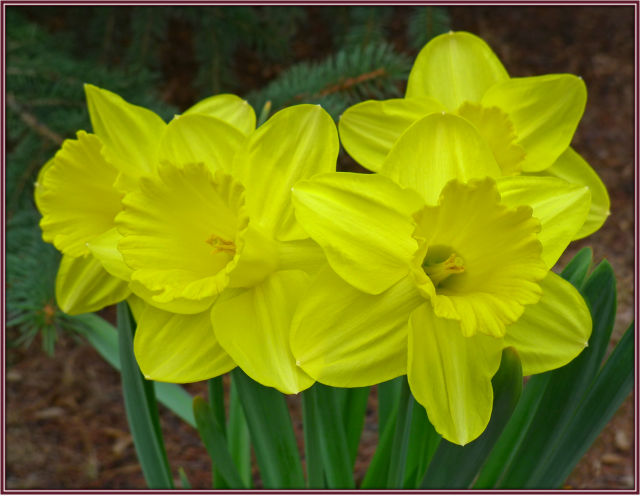
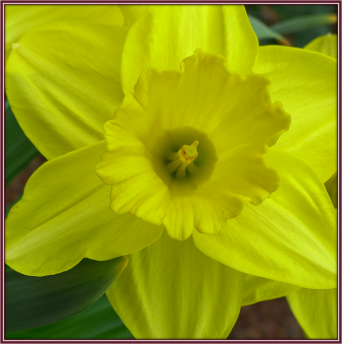
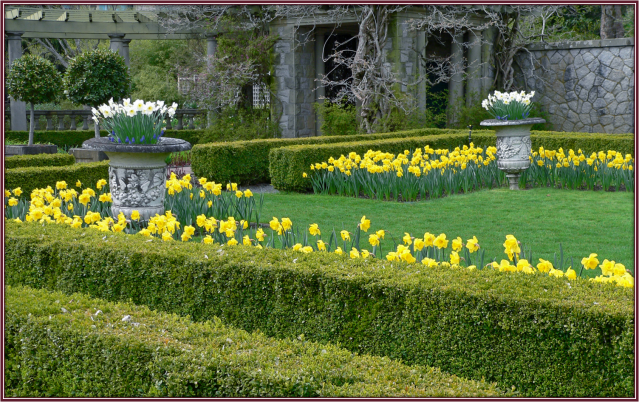
In this warm sheltered corner, the daffodils emerge from the ground in early February; a heartening assurance that winter won’t last forever. They seem to remain in stasis then, until late March when the warming sun persuades the cheery blooms to open.  While nature provides many subtle indications that spring is approaching, the lemon-hued daffodil announces spring with a flamboyant burst of colour. Indeed daffodils are the inaugural appearance of colour in my garden each spring – a true herald of winter’s end and the coming growing season.

Hope embodied.

Today they’ve begun to bloom – though a tad shorter than usual (likely due to yet another blast of snow and cold), still they speak of hope. Hello spring.

Photo: Pat Gaviller

Photo: Pat Gaviller

Much lore surrounds the daffodil: the origin of its name, its once-believed medicinal properties and even its cultural symbolism – it has been said to represent vanity, misfortune, and death. Conversely, it is also considered a symbol of rebirth, hope, joy and love. I prefer the latter.

Photo: Pat Gaviller

In the year 2000, the Canadian Cancer Society adopted the daffodil as its official emblem – the quintessential sign of hope.

Few among us can say we haven’t been touched in some way by the ‘C’ word – it has taken from us our dearest family members, our best friends and our beloved pets. For those who’ve survived its ravages, it has scarred or disfigured, taken our dignity, our youthful energy and our trust in life. But it can never take away hope – hope for a cure, hope for another day. As long as there is hope there can be joy – this is what the daffodil represents for many.

Shortly before the birth of my first child, my sister Pat was diagnosed with Stage 4 Hodgkin’s Lymphoma – a grave diagnosis requiring many months of chemo. During her intermittent hospital stays, there was always a vase of daffodils by her bedside. One such night, lying there anxious and alone, a vase of yet-to-open daffies on her nightstand, she asked God for strength, for healing, or merely for acceptance of whatever He willed. Shortly thereafter, she heard a barely audible ‘pop’………then a puff of sweet fragrance. Turning to the daffodils she saw that the first of the bunch had just opened. Then pop, pop, pop – several more opened right before her eyes, each one accompanied by the same sweet scent. I believe, as does she, that this was a moment with the Divine, an otherworldly gift – a sign of hope. My sister knew then, that regardless of the outcome, everything was going to be okay.

The month of April is Daffodil month in Canada, the Cancer Society’s spring fundraising campaign of door-to-door daffodil sales. Daffodils can also be purchased at numerous venues around your city, as well as online.

April at Hatley Park, Victoria, B.C. Photo: Jane Reksten

April at Hatley Park, Victoria, B.C. Photo: Jane Reksten

Let’s all set a vase of these bright beacons of hope, the lovely Narcissus, on our tables – it will brighten our days, and give hope to others.

“Learn from yesterday, live for today, hope for tomorrow”  ~  Albert Einstein  ~

Yours in good health
Sue
 

© Sue Gaviller and Not Another Gardening Blog 2012.

Unauthorized use and/or duplication of this material without express and written permission from this blog’s author and/or owner is strictly prohibited. Excerpts and links may be used, provided that full and clear credit is given to Sue Gaviller and Not Another Gardening Blog with appropriate and specific direction to the original content.

Gardening is a Sport Right?

To all you Hockey Fans out there – Happy Hockey Season!

No this post isn’t about the NHL and NHLPA deal that was reached earlier today, but it is about sports…….sort of.

Over the years my boys and I have had numerous animated discussions regarding what does, and does not, constitute a sport. Both my sons speak from a position of expertise on this, since one is a sports broadcaster and the other played every possible team sport in junior high and high school.

The repartee might go something like this:

Round One

Me: “Boxing shouldn’t be a legal sport.”

Them: “What? Muhammad Ali was one of the greatest athletes ever! And pugilism is the oldest sport in the world.”

Me: “Yeah I know, but there’s something wrong with a sport that requires contenders to knock their opponent out. Doesn’t that mean render him unconscious?”

Youngest Son: “Mom remember my best friend used to be an amateur boxer – he won most of his matches y’know. He wants me to start boxing too and I’m considering it. It’s an awesome fitness regime.” (Okay he probably didn’t use words like ‘fitness regime’)

Me: “Yes I know your friend was a fine young boxer, but please don’t you start boxing – you’ve already had one too many concussions.”

Oldest Son: “Mom’s right about that Bro.”

My youngest son’s friend no longer boxes because he doesn’t want to take any more blows to the head. My son quit playing football and rugby because he didn’t want to sustain any more head injuries. Thank you Lord.

Round Two

Them: “Horse racing and show jumping aren’t real sports.”

Me: “Say what? They most certainly are. Ever watched the Kentucky Derby or Grand Prix show jumping?”

Them: “Yeah but Mom the horse does all the work and the rider just sits there.”

Me: “As one who did plenty of show jumping when I was younger, I can assure you the rider is half the talent on the horse/rider team. I’ll admit the horse is the superior athlete of the two, but riders are still athletes. Riding takes real core strength. Riders have – and there’s no delicate way to put this – really tight toned buttocks, as well as strong quads and inner thighs, firm calves, strong abs………”

Them (grimacing): “Okay enough – don’t need to hear my Mom talk about buttocks.”

I suspect since seeing the movie ‘Secretariat’, they might admit that riding is indeed a sport.

Round Three

This one just the other day with my husband:

Me: “Do you think I could sell the idea of a Gardening Talk Show to our local Sports Radio station. I could call it Not Another Gardening Show”

Him: “No I don’t think so.”

Me: “Why not? If they have poker tournaments on Sports TV, why not a gardening show on Sports Radio.”

Him: “Poker is a sport.”

Me: “No it’s not. And if it is, then gardening should be considered a sport too – it requires way more physical exertion.” (We can both attest to this – so can our backs, knees, hands and wrists. And I bet if you talked to an ER doctor they’d tell you they’ve seen some nasty gardening wounds.)

Him: “I know but it’s still not a sport.”

Me: “Why not?”

Him: “Because it’s not competitive.”

Me: “Oh but it is – there are major gardening competitions all over the world.”

The conversation ends here – he’s still not buying it.

My husband isn’t particularly competitive, at least not when it comes to gardening. He’s in charge of the vegetable garden and the lawn, but he’s not one of those ‘Lawn Ranger’ guys riding around on his John Deere mower (though I bet he would if he had one). And while he grows a mean tomato, he isn’t into growing ridiculously large squash or pumpkin, just so he can say ‘mine’s bigger’. I guess it’s understandable then, that he doesn’t think of gardening as a sport.

According to Wikipedia: ‘Sport is all forms of competitive physical activity which,[1] through casual or organized participation, aim to use, maintain or improve physical ability and provide entertainment to participants.’

Sounds like gardening to me.

The SportAccord, International Sports Federations Council recognizes 5 categories of sport

  • Primarily physical – football, hockey, lacrosse, bodybuilding, etc.
  • Primarily mind – chess, bridge
  • Primarily motorised – motorcycling, powerboating
  • Primarily coordination – archery, billiards, darts
  • Primarily animal-supported – equestrian sports, sled-dog sports

I like to divide the sport of Gardening into 5 categories too:

  • Primarily physical – digging, raking, pruning, planting
  • Primarily mind – remembering botanical names and where you planted those bulbs last fall
  • Primarily motorised – riding mowers, electric hedge trimmers
  • Primarily coordination – gardening and chewing gum simultaneously
  • Primarily animal-supported – birdwatching, chasing Mr. Rabbit (if you have a dog he might do this for you), running from wasps (this can look like a weird spastic dance), swatting mosquitoes

So folks if gardening isn’t a sport I don’t know what is.

Play safe,
Sue
 
© Sue Gaviller and Not Another Gardening Blog 2012. Unauthorized use and/or duplication of this material without express and written permission from this blog’s author and/or owner is strictly prohibited. Excerpts and links may be used, provided that full and clear credit is given to Sue Gaviller and Not Another Gardening Blog with appropriate and specific direction to the original content.
 

Georgia’s World

“When you take a flower in your hand and really look at it, it’s your world for the moment. I want to give that world to someone else.” ~ Georgia O’Keeffe ~

When Georgia O’Keeffe painted the stunning floral portraits for which she was famous, she did so with the intent of expressing what she felt when looking at a flower, portraying it as she experienced it – layered, luxuriant, larger-than-life. She assigned as much significance to the details as to the whole, often painting less than the whole flower and using the outer edges merely to frame its inner beauty.

I’m a huge fan of Georgia O’Keeffe’s work – for so many reasons. The designer in me is completely enamoured by her attention to detail, creating texture so rich one can almost feel it. The gardener in me………well what gardener doesn’t love to look at big beautiful flower pictures?  And as a horticulturist, I find her sensuous presentation of every ruffle and ridge, petal, sepal and stamen, to be a breathtaking study in flower anatomy. If one looks at these paintings from this botanical vantage point, a whole new appreciation of both painter and subject ensues.

The Birds and the Bees

I think to truly appreciate a flower one must first understand its role. A flower exists, not for the purpose of our enjoyment (much as we gardeners would like to think), but rather for the purpose of reproduction. Their brightly coloured parts aren’t intended to garner the oohs and aahs of our neighbours and friends, but to attract pollinators, like birds, bees and butterflies.

“Let me tell you ‘bout the birds and the bees
  and the flowers and the trees
  and the moon up above
  and the thing called love”.

We all know those infamous Herb Newman lyrics, and what often follows is………the Talk. You know the talk of which I speak – the one your parents or grandparents, or teachers, had with you just as you were approaching puberty. Well here it is again – sort of.

Prepare yourself – I have graphic images.

Cross section of a ‘perfect’ flower, meaning it has both stamens (male) and carpels (female). Not all flowers are perfect – some plants have separate male and female flowers. In some cases, the entire plant is either male or female – these plants are referred to as dioecious.

So it goes something like this: A bee or other pollinator enters the interior of a flower in search of nectar and pollen. In the process of collecting pollen it inadvertently brushes against the stigma, thereby depositing the pollen which contains the sperm. A pollen tube then forms, growing down the style and transporting the sperm to the ovary where the ovules reside. The male sperm joins with the female ovule and voila, fertilization! Fruit and/or seeds then develop from the fertilized egg and these are dispersed by wind, rain, birds, etc., eventually settling into the soil where the seeds germinate. Plant grows, plant produces flowers, bees pollinate………..yadda yadda yadda. Did ya get all that?

Pretty in Pink – this pink hollyhock presents her best ‘come hither’ look, hoping to entice pollinators. The brighter pink veins add to her allure and serve to guide visitors in. Work it girl! Photo: Cathy Gaviller

Of course the bees have no idea that they’re participating in the plant’s sex life – they’re just there for the pollen. But they are vital to this courtship dance. In fact flowers get all dressed up in their most colourful outfits and put on their finest perfume to impress these pollinators – or any pollinator for that matter. Oh those fickle flowers.

Ah yes – success. Now that is one amorous bee! Photo: Cathy Gaviller

Come A Little Bit Closer Now

If we zoom in a little closer to have a really good look at the inner workings of these remarkable reproductive machines, you’ll see that the very heart of a flower is indeed a thing of beauty and something to be celebrated – sketched, painted or photographed. This was Georgia’s gift to the world – she made us really look at a flower.

A close-up of Hemerocallis ‘Strutter’s Ball’ reveals velvety ridges, sumptuous ruffles, delicate veins and arching stamens – worthy of Georgia’s paintbrush don’t you think? Photo: Sue Gaviller

Plants like the above-pictured daylily have large showy flowers which easily attract pollinators. Other plants, lilacs for example, have many tiny florets each with reproductive capacity. These florets are clustered together to form a large inflorescence which not only increases the chances of being noticed by passing pollinators, but vastly increases the opportunities for pollination. Most of us never really notice these tiny floral entities that make up the larger racemes, umbels and panicles, but they are miniature marvels that merit a closer look.

Syringa vulgaris ‘Katherine Havemeyer’ – each tiny floret is picture-perfect in itself. Photo: Sue Gaviller

Inner Space

Zooming in even more we can get a detailed view of the various reproductive parts of a flower. The male parts are the anthers and filaments, collectively called the stamen. Anthers are the pollen producing organs and are often quite pronounced, hence they are usually quite recognizable.

The female parts – stigma, style and ovary, together make up the carpel. Often there are multiple carpels, which are jointly referred to as the pistil. If there is only one carpel, then the terms carpel and pistil can be applied interchangeably. Carpels come in all shapes and sizes. Some have a long tube-shaped style and a bulbous stigma. Others have a bulb-shaped style and fleshy stigma. Sometimes the style appears almost non-existent and the stigma is all that’s visible. While the shape is widely variable, the carpel can usually be recognized by the surface texture of the stigma, which will appear sticky, oily or waxy – this ensures adherence of pollen grains.

Hemerocallis ‘Little Grapette’ – note the pollen-laden anthers, long tubular style and the tiny stigma. Photo: Sue Gaviller
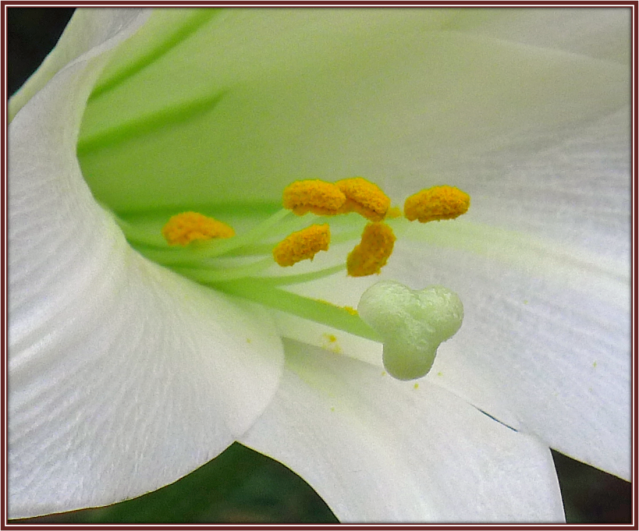
The bulbous stigma of Lilium longiflorum is quite large compared to that of the Hemerocallis in the previous image, but both stigma have the characteristic spongy, waxy surface for trapping pollen. Photo: Pat Gaviller
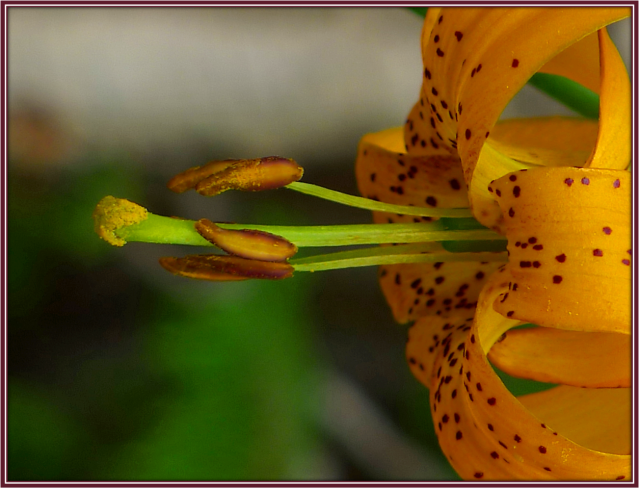
Lilium columbianum has very pronounced carpel and stamens. Here the pollen on the anthers has all but disappeared but grains of it heavily coat the sticky stigma surface. Photo: Pat Gaviller

Paoenia ‘Morning Lilac’ – a ring of bright yellow anthers atop pink filaments surrounds a group of carpels with pale greenish styles. The furled flaps of paler pink fleshy tissue are the stigma. Photo: Pat Gaviller
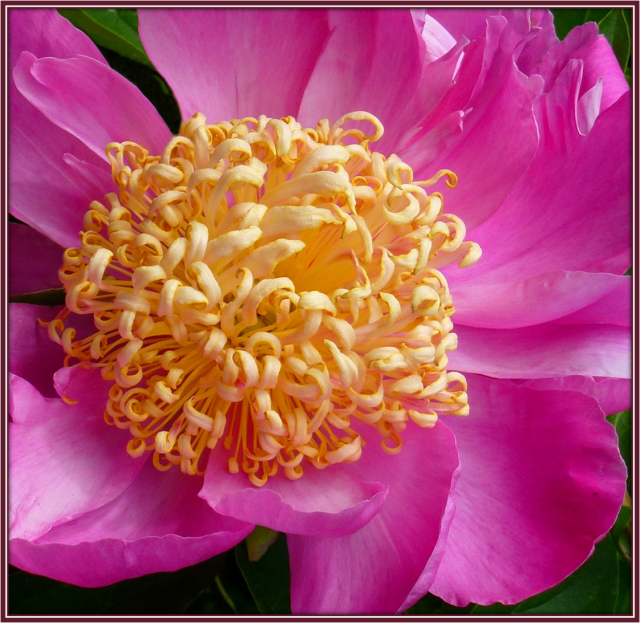
Paeonia ‘Tom Eckhart’ has a centre full of butter yellow staminodes – flattened sterile stamens that are the result of extensive hybridization Photo: Sue Gaviller
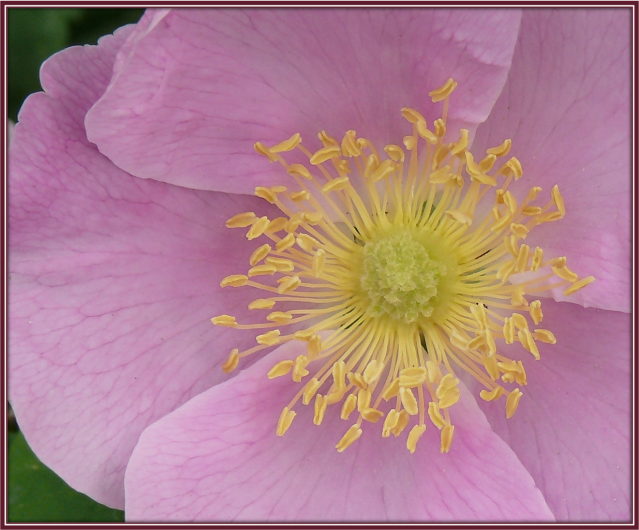
Rosa nutkana – pale yellow stamens surround a group of pale greenish carpels, of which only the stigma is visible. Photo: Pat Gaviller
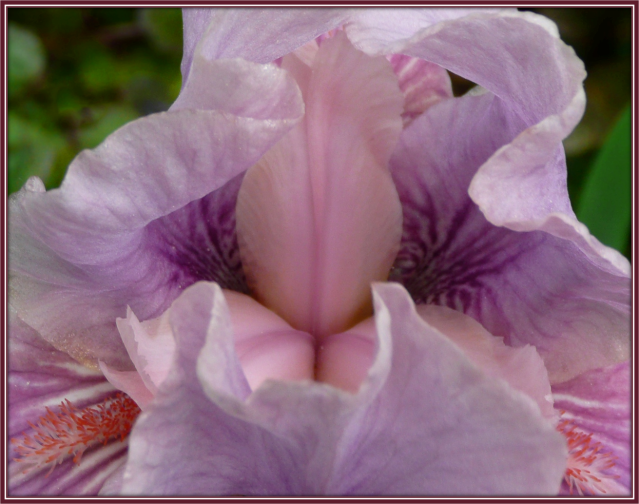
Iris ‘Raspberry Blush’ – note the voluptuous centre pieces, called style arms, each of which arches over a male stamen. Photo: Sue Gaviller

Outer Space

The outermost layer of a flower is the calyx, which is made up of all the sepals. Just inside the calyx  is the corolla which consists of all the petals.  Ah yes, the petals – this is why we grow plants that flower right? Generally speaking the petals are the largest, showiest part of the flower (there are exceptions though). Biologically speaking they serve the purpose of surrounding and protecting the flower’s reproductive parts, as well as attracting pollinators with their colourful presentation.

The sepals on the other hand, are usually nondescript, green leaf-like units that surround and enclose the flower in the bud stage, as well as support the petals once they emerge. However, there are a number of plants that have very showy sepals, almost as showy as the petals – Lilium, Hemerocallis, Iris and Narcissus to name a few.
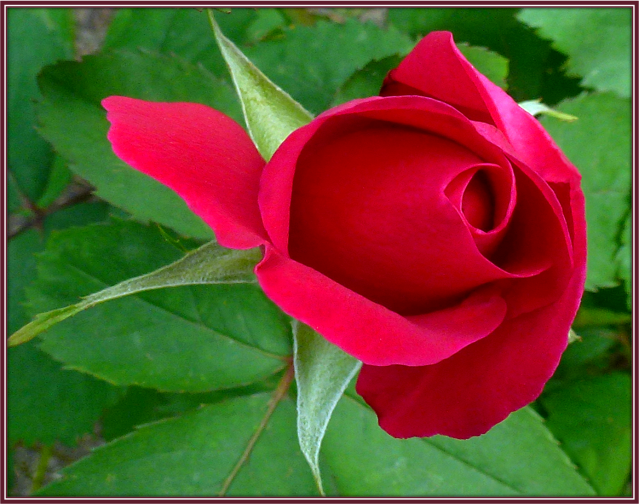
The petals of Rosa ‘Winnipeg Parks’ are bright and very flashy, whereas the pale gray-green sepals have very little ornamental value. Photo: Sue Gaviller

Daylily sepals, like this Hemerocallis ‘Chicago Antique Tapestry’, are the same colour and texture as the petals, albeit a little smaller. Photo: Sue Gaviller

The sepals of plants in the Iris genus are the downward-curving parts, called ‘falls’, and are every bit as beautiful as the upright petals or ‘standards’. Photo: Sue Gaviller

Some Irises have fuzzy caterpillar-like tufts along the midline of the sepals – these are known as ‘beards’. The Iris beard may serve to collect and protect pollen (note its proximity to the stigmatic lip directly above the beard) or it may simply provide a place for pollinators to alight and grasp onto. Photo: Pat Gaviller

Narcissus sp. has 3 petals, 3 almost identical sepals and an additional trumpet-shaped structure known as the corona. Photo: Pat Gaviller

This Bud’s for You

A flower begins as a bud – an unremarkable green protuberance that bears no resemblance to the flower it will eventually become.

Like all of the intersectional hybrids, Paeonia ‘Morning Lilac’ has unique pointy buds. Photo: Sue Gaviller

I find flower buds to be as rewarding as the blooms, more so maybe. A bud is the promise of a flower and we experience it with all the anticipation of a bride-to-be. I doubt if I’m the only gardener who has spent countless hours peering into the depth of daylily foliage, gently separating the grassy blades looking for emerging bloomscapes. Or palpating Iris fans, feeling for the swellings of blooms-to-be. Or closely examining lilac buds to determine which will be leaves and which will be gorgeous fragrant blossoms.

I count the buds to see how many blooms I’ll be blessed with this year. I observe them daily, gauging their progress, watching them swell and elongate, slowly taking on a hint of colour. I daresay by the time my flowering plants actually bloom, I’ve spent so much time anticipating it that the experience is almost anticlimactic. Almost.
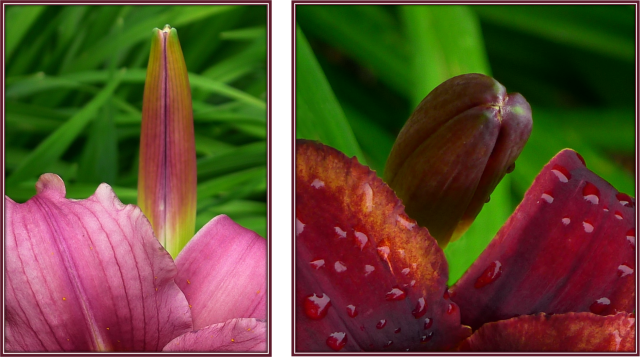
Left: Hemerocallis ‘Mary Reed’ – flower bud almost ready to open.
Right – Hemerocallis ‘Starling’ has luscious plump flower buds, as do most tetraploid daylilies.
Photos: Sue Gaviller

Today is Georgia O’Keeffe’s 125th birthday and it is in her honour I write this post.

I invite you to see every flower through new eyes and with deeper appreciation. Take a step into Georgia’s world.

Yours,
Sue
 
© Sue Gaviller and Not Another Gardening Blog 2012. Unauthorized use and/or duplication of this material without express and written permission from this blog’s author and/or owner is strictly prohibited. Excerpts and links may be used, provided that full and clear credit is given to Sue Gaviller and Not Another Gardening Blog with appropriate and specific direction to the original content.

Has It Been Six Months Already?

Six months ago today I launched this blog – I didn’t mean to. I’d been preparing my first post – writing, inserting photos etc. I hadn’t even finished it, and I certainly hadn’t edited it for spelling or grammar, when I accidentally hit the Publish button. Oops! Lucky I hadn’t told anybody about the blog yet or that could have been really embarrassing. A month or so later I did the same thing – by that time though, I actually had some followers who get notification by email the moment I press Publish, and in some cases the email contains the actual post. Yikes, that is embarrassing! Anyways, in both cases I trashed the posts immediately, then finished them, edited and reposted. I also managed to trash some things I hadn’t intended to – good thing most of these were retrievable from the trash folder.

After a number of these little mishaps I thought to myself, ‘Maybe blogging is not for me’. My husband suggested I persevere and re-evaluate in 6 months – so here we are 6 months later and I’m doing just that. So what have I gained? Well for one, a hard-drive that’s almost full with the photos I’ve taken for this blog, not to mention the photos my sister has taken for me. And when I ask Pat to take a photo of a particular garden or vignette, she does so with zeal – from every conceivable vantage point, and at least 20, maybe 50 of each.  I have learned to do this as well – the more pictures I take of one thing, the better chance there is that I’ll get at least one that works……or not. So I go and take some more. One thing’s for sure – I’m becoming a better photographer. My eyes still glaze over when my sister talks about f-stops and apertures, shutter speeds and iso settings, but I know that I must learn about these if I want to continue to improve.

So what else have I gained? Of course some faithful readers and a handful of followers – to all of you, I say thank-you.  And to the bloggers who follow me, or ‘like’ me on Facebook, ‘ping’ me, or mention me in your blogs, I really do appreciate it. I can’t always repay the favour, but please know that every time I see that you have liked me, pinged me, followed me, or referred readers to my blog, I go right to your blog and visit for a while.

As for site stats, the number of daily views is growing, but it certainly isn’t boast-worthy. It’s enough though, that I know my efforts are appreciated. What I find particularly curious is the ‘Views by Country’ statistics – there have been views from over 70 countries, across 6 continents! Perhaps this isn’t noteworthy, but I just find it remarkable.  That someone from a culture and a climate vastly different from my own would find their way to this blog is, like I said, remarkable. I often wonder what these readers think (many of them garden in the best gardening climates in the world) when they read the humble ramblings of a Canadian prairie garden designer.

So why do I do this, this blogging thing? It’s hugely time-consuming, I don’t earn a living doing it and I’ve chosen not to accept new clients through it. It’s true I needed an on-line presence of some kind – I was never interested in advertising my design services on a traditional website, preferring instead to take clients by referral only. Nevertheless, as a landscape designer, instructor and speaker, I wanted to be able to refer students, prospective clients or workshop participants to my……….my what. Yes that’s it – my blog!

Still…….none of this is what motivates me to write. The truth is I write to give voice to the internal dialogue – that endless stream of  words that fills my head from morning ’til night. Those who know me know that I can be a tad verbose – indeed I always have so much to say.  I mean really, it’s taken me six paragraphs just to say, “I like to write. Thanks for reading!”

I know many of you visit this blog for design ideas and pretty pictures. Sorry, no design advice today – come back Monday though, for Part 4 of The Principled Gardener, as I conclude my discussion on Unity in Landscape Design. But just so you don’t leave disappointed, here’s a few pretty pictures.

Mid August in the garden. Photo: Sue Gaviller

A nice place to sit – one of those brake-stomping vignettes I periodically drive by. Photo: Sue Gaviller

A rainbow after today’s brief sunshower – it appeared just as I was about to publish this post. I’ll take that as a sign! Photo: Sue Gaviller

Thanks so much for reading,
Sue
 
© Sue Gaviller and Not Another Gardening Blog 2012. Unauthorized use and/or duplication of this material without express and written permission from this blog’s author and/or owner is strictly prohibited. Excerpts and links may be used, provided that full and clear credit is given to Sue Gaviller and Not Another Gardening Blog with appropriate and specific direction to the original content.
All Creatures Great and Small

All things bright and beautiful,
All creatures great and small,
All things wise and wonderful:
The Lord God made them all.

I doubt that when Cecil Francis Alexander penned the chorus to this popular children’s hymn, she was staring down at a rabbit-chewed stump that was once a rose – or a tree trunk stripped almost bare of bark, or ornamental grasses mown down in the first flush of spring growth.

It can be immensely disappointing when our favourite trees, shrubs and perennials are razed by the likes of Peter Rabbit and Squirrel Nutkin. Unfortunately, solutions to this nuisance are less than perfect but there are a few.

The Design Solution

Designing a garden that is rabbit resistant entails housing vulnerable selections i.e. ‘rabbit candy’, in raised beds, containers or enclosures of some kind. Obviously rabbits do jump, but a 2 foot raised bed can act as a deterrent, and while a rabbit can squeeze through small openings, a fenced yard or courtyard does offer some protection.  In my own experience, my front yard is fair game for the rabbits but I’ve never seen them, or any evidence of their presence in my fenced back yard.

Unfortunately I can’t say the same for the squirrels – they are ubiquitous.

The smooth shiny bark of Caragana arborescens ‘Walker’s Weeping’ is a rabbit favourite. In this client’s raised planter it is somewhat protected. The underplanting of Berberis thunbergii ‘Cherry Bomb’ offers further protection since its thorny branches serve as a barrier. Photo: Sue Gaviller

And what about deer? Fences and raised beds aren’t going to keep Bambi out – unless they are 8 feet tall. A Shishi-odoshi (Japanese Deer Scarer) is one design solution that comes to mind. This can work for most nuisance wildlife but there are a couple of drawbacks. For one, the aesthetic is expressly Japanese so may not work thematically with all gardens. Second, it may discourage desirable wildlife from visiting. And third, the more brazen intruders like squirrels, could soon habituate to the sound.

Shishi odoshi 日本語: ししおどし

Shishi odoshi 日本語: ししおどし (Photo credit: Wikipedia)

For those living in the country, deer present a much bigger problem, due largely to habitat proximity – this may require a design approach calledDeeroscaping(awesome resource when deer pressure is extreme).

Underplanting susceptible trees with Lavandula or other aromatic, as I have with this client’s top-graft Syringa meyeri, may help deter pests. Photo: Pat Gaviller

Including some aromatic plants in your planting design can also be helpful. Salvia, Lavandula and Nepeta are all objectionable to deer and rabbits – they don’t like the smell. Happily these are pleasant smelling to us and very attractive additions to a garden. Keep in mind though that Nepeta will attract cats – in my neighbourhood we already have a cat problem (a topic for another post), so no Nepeta for me.


Salvia nemerosa ‘Maynight’ is a strongly aromatic ornamental sage which may discourage rabbits and deer. Photo: Sue Gaviller

Some gardeners will use wire baskets or chicken wire contraptions to cover anything that’s showing signs of pest activity. From a design perspective this is a poor solution – while it may indeed protect your plants, it is unsightly. I don’t think sacrificing the beauty of a garden for 6 months of the year is an acceptable price to pay, so unless these devices can be obscured from view, I personally don’t use them. The exception would be trees. Rabbits and deer love to nibble on the bark of certain trees; Malus, Populus, Salix and other trees with thin bark (also young trees). If the bark is damaged more than halfway around the trunk, the tree may not survive. Therefore I do recommend protecting trunks of susceptible trees, particularly in the winter – if you can do so inconspicuously, all the better. The trunk of my Malus ‘Pink Spires’ sustained extensive rabbit damage this past winter, until we wrapped it (loosely)with chicken wire. Because the tree is fronted by a bird bath and obscured from other vantage points by shrubbery, the chicken wire isn’t visible.

Most shrubs and perennials that have been chewed by rabbits will recover. Trees on the other hand may not – if more than half of the trunk circumference is damaged, the tree’s chances of survival are slim. The trunk of this Malus ‘Pink Spires’ is almost completely girdled in one spot, so it may well succumb to its injuries within the next year. I am keeping my fingers crossed though.

The Horticultural Solution

For most of us, by the time we discover we have a ‘critter’ problem, design solutions like raised beds or courtyards are no longer options, at least not without a costly and/or time-consuming redesign. So what can we do? Well we could remove altogether, anything that’s being eaten. However, what a particular animal finds tasty may not be consistent – in my own garden, the squirrels consistently bite the flower buds off one of my Scabiosa caucasica ‘Ultra Violet’, but leave the other two alone. Festuca glauca ‘Elijah Blue’ was sheared to the ground by rabbits every spring (and again as soon as it recovered from the first assault), until I moved it to the back yard. Spiraea bumalda ‘Goldmound’ is also ‘pruned’ to the ground every winter. It grows back though and stays quite compact thanks to the rabbits, so it’s not a problem. For many years these were the only plants bothered by nuisance wildlife.

Then last year I noticed elevated rabbit activity; all of my Heucheras were bitten off (silly rabbit didn’t eat the foliage, he just ate the tender juicy stems and left the beautifully coloured leaves scattered on the ground). Helictotrichon sempervirens – big bites out of it (weird because it has a very unpleasant tactile surface). Roses – gnawed to the ground (ouch, don’t they know roses have thorns). It seems a bunny is living somewhere very near my garden, though I’m not sure exactly where. I see him basking in the sun on my lawn or my neighbour’s lawn. And I do mean basking– splayed right out as if he was dead. And brash he is too. When I shoo him away he moves off slowly and nonchalantly – if he could speak I’m sure he’d be saying, ‘Yo, lady. What’s your problem?’

But I digress.

There are commercial rabbit, deer and squirrel repellents on the market, some of which are safe and environmentally friendly, others not. In addition, there are home remedies you can try – some target a specific pest, but since all are herbivores with similar fear responses, what works on one will often work on all.

  • In a comic strip a few years ago, one of the characters placed dog hair around plants to deter rabbits and squirrels. I tried this and it was actually working until the birds discovered the dog hair and decided it was excellent nesting material. My dog couldn’t shed fast enough to keep up with the demand for her hair so I gave up.
  • Blood meal is a strong disincentive for deer, rabbits and squirrels. A teaspoon or so sprinkled around the plant works very well, but it needs reapplication after it rains. Unfortunately blood meal can attract cats, though in my experience it doesn’t seem to draw them with any more frequency than usual. If you live in an area where bears and/or cougars are common, blood meal is not recommended as it may attract them. As well, because blood meal is a source of nitrogen, if frequent reapplication is required you run the risk of encouraging too much leafy growth. This can then create other issues; slugs and aphids to name a couple.
  • Crushed garlic in some water, steeped for a few days, then strained and sprayed on plants can be an effective repellent.
  • The presence of human urine, particularly male urine, is also purported to deter nuisance wildlife. Several years ago I advised an acreage client to, ahem, ‘mark his territory’, which he did and I believe it in fact reduced pest activity. Hard to say how it would have worked in the long-term though as I don’t think he was willing to continue this practice indefinitely. For city dwellers, you’ll have to be a little more creative in the method you ‘apply’ this if you don’t want to be noticed. And be sure to drink lots of water.
  • Other homemade concoctions may be also effective, but I urge you not to use any that have cayenne or Tabasco sauce as ingredients – I don’t think our aim should be to cause pain.

The Culprit – this fluffy fella camped out in my front yard all winter. I suspect it is the same rabbit who made my garden his favourite lunch spot last summer, as he has the same brazen attitude.
Photo: Pat Gaviller

So now that you have a few weapons in your arsenal let me offer…

Another Perspective

When we first embark on the journey that is gardening, it’s very much about ourselves – what we like, what we want. It’s not intentionally selfish, but we’re a bit like the youngster who is determined to ‘do it by myself ’. We’re content to putter and play in the dirt and we’re not much interested in what the experts, or the neighbors, have to say.

Once we’ve gardened for a few years, and after countless mistakes (sometimes expensive ones) we recognize that some advice from a garden designer or coach might be helpful. And we become all too interested in what the neighbors and passers-by have to say.

Eventually enlightenment comes, with the realization that our gardens are much more than just playgrounds for our green thumbs, or a source of affirmation for our needy egos. Our gardens are enormous ecosystems, home to millions of life forms, some we can’t see, some we can’t pronounce and some we’ve never even heard of. While not all of them can be deemed ‘beneficial’, they all have a role to play. Aphids for example are pests to be sure, but they are also a food source for an army of beneficial visitors – ladybugs, green lacewings, hoverflies, midges (and the larva of all), and many birds (especially the young). If there are no aphids these predator bugs lose a significant component of their diet. An enlightened gardener therefore, learns to leave well enough alone.

There is wisdom to be gained from Ms. Alexander’s refrain. When I find myself lamenting the loss or damage to a prized plant by some hungry critter, those words ‘all creatures great and small’ start playing in my head. Yes, all have a role to play.

I haven’t figured out yet what role that ‘Wascally Wabbit’ has to play (they do love to eat dandelions), nor the pesky squirrels (I guess they too are a food source, most notably for the magnificent birds of prey), but I can’t help feeling some compassion, even kinship, with these animals that make my yard and garden their home – in a way we’re all in this together. I have a particular soft spot for the young ones. A touching experience with a very young squirrel the other day underscored my feelings. I don’t know where he came from or where he disappeared to, but to me he appeared too young to be without his mama. He was quite enamoured of both me and my husband and stayed to ‘visit’ with us for a bit, then scampered off. He sure was a cute.

Some years ago my father and his wife sent me this lovely birthday card – don’t know if they chose it just for its garden theme or if they recognized the gem of wisdom it contained:

The garden is home to so many – kinda puts it all in perspective doesn’t it?

So fellow gardeners, take heart  –  ‘Lucky is the World……to have you in it.’

Happy Mother’s Day,

Sue

© Sue Gaviller and Not Another Gardening Blog 2012.

Unauthorized use and/or duplication of this material without express and written permission from this blog’s author and/or owner is strictly prohibited. Excerpts and links may be used, provided that full and clear credit is given to Sue Gaviller and Not Another Gardening Blog with appropriate and specific direction to the original content.
Harbingers of Spring

HAPPY SPRING!

March 20th marked this year’s Vernal Equinox – better known as ‘The First Day of Spring’!

I don’t need a calendar to tell me it’s spring though. There may still be frost in the ground, but spring is in the air – literally. Just look up – the trees are telling us it’s spring. You can see the subtle flush of colour, a slight aura emanating from their branches – leaf buds are beginning to swell. As spring gathers momentum the buds continue to swell, thousands on each branch, so when backlit by late day sun the trees appear adorned with jewels.  Closer inspection will show the buds to be plump and fleshy – life will soon burst forth. This multitude of bulging buds adds a dazzling texture to our skyward view.

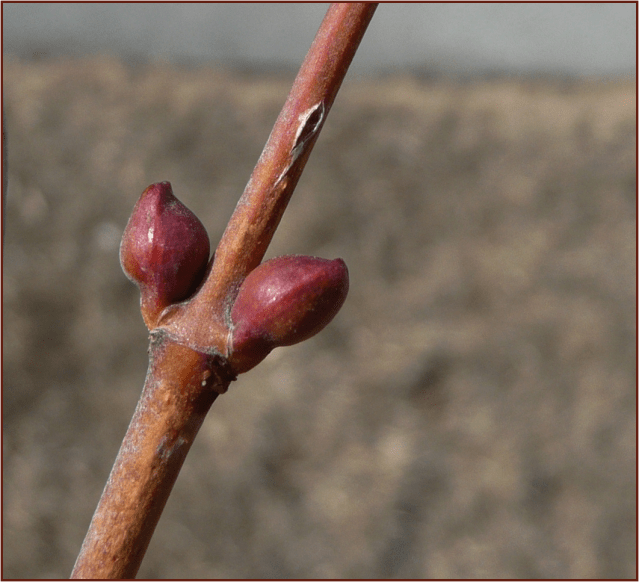
Shrubs too are showing life in their branches – rounded buds, like colored baubles, cling to each branch and everything takes on a rich layered appearance.

A shimmer of colour rests atop Salix pentandra on a March weekend at Confederation Park.
Photo: Pat Gaviller

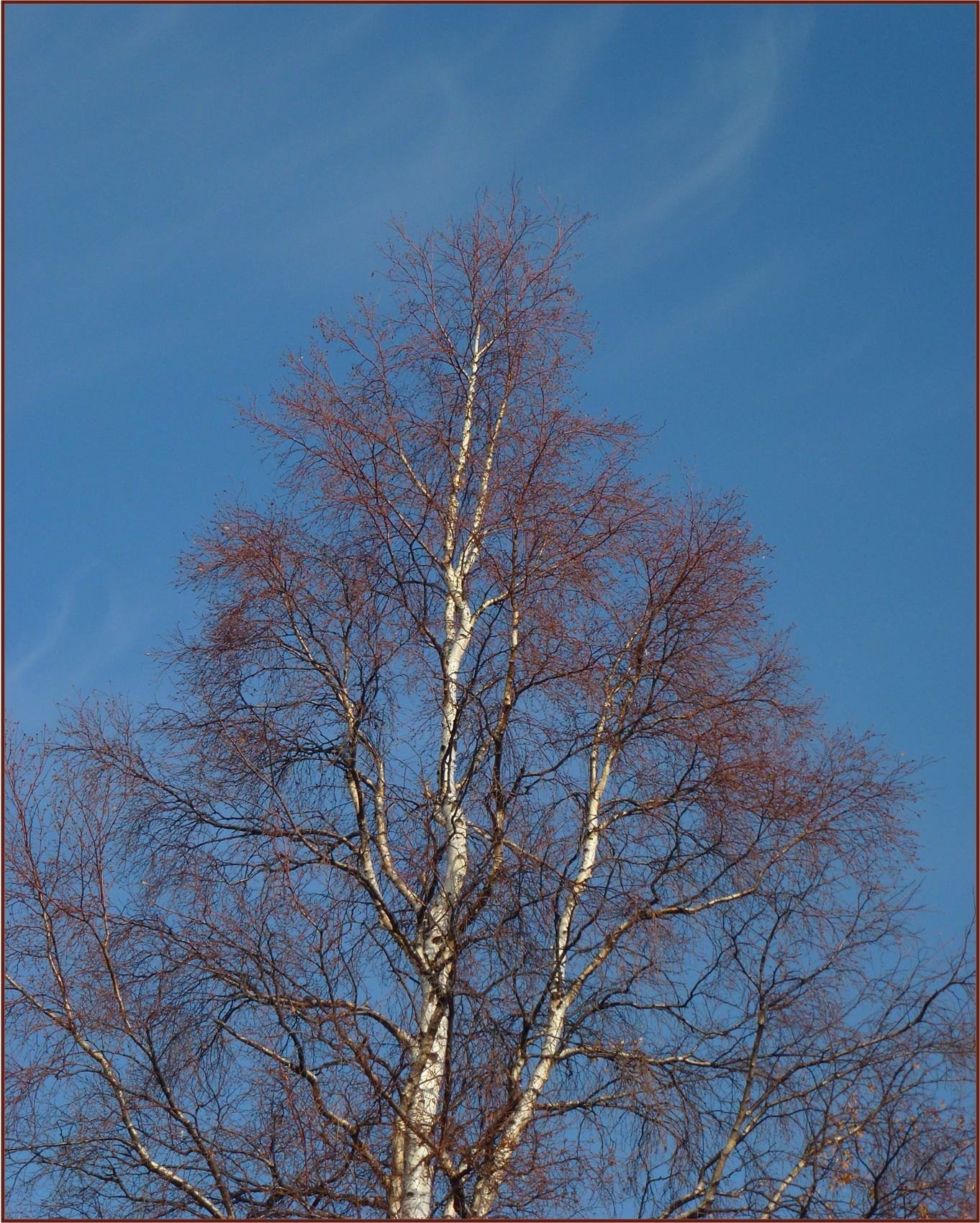
The deep red hue of Betula papyrifera branches intensifies as buds swell and life returns.
Photo: Pat Gaviller

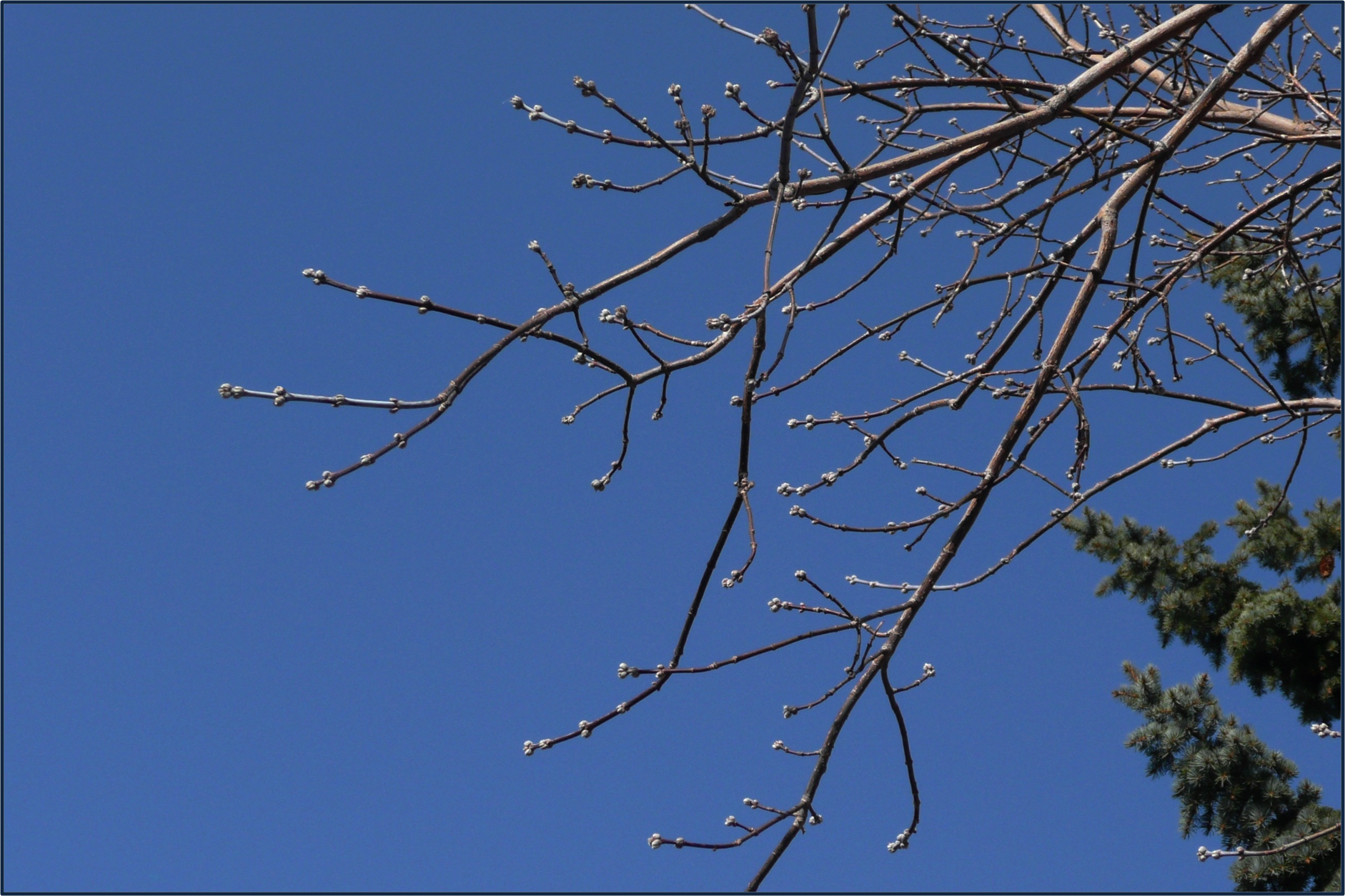
The buds on this Acer negundo look like tiny pearls against an ocean of sky. The Manitoba maple, often maligned for its weedy growth habit and tendency to aphid infestation, is one of the earliest trees to bud out in the spring. Photo: Sue Gaviller

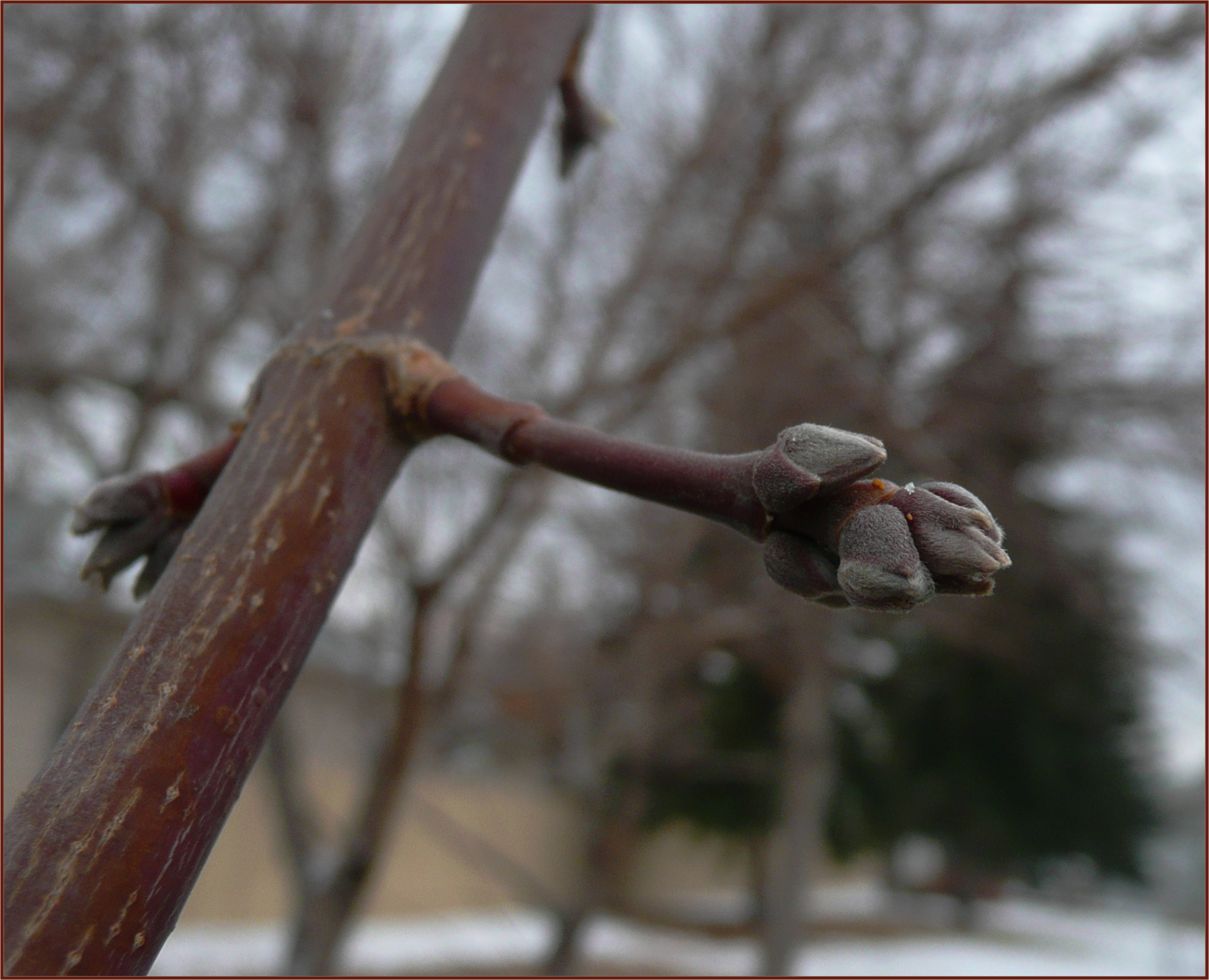
Acer negundo ‘Sensation’, a cultivar of the Manitoba maple, is a lovely tree with yearlong interest. Though debatably hardy here, this specimen has been growing in a protected spot in Northwest Calgary for many years. Viewed up close Manitoba maple buds are soft and fuzzy – this cluster of buds is reminiscent of puppy paws or bunny feet. Photo: Sue Gaviller

The ruby-red buds of Viburnum trilobum rival the colour of the berries that will be produced at season’s end. Photo: Sue Gaviller

Fat rounded buds like tiny soccer balls, line the branches of Larix sibirica. Photo: Sue Gaviller

The new growth on Crataegus mordenensis, both buds and branches, is rich plum red – shiny, supple and leathery in appearance. Photo: Sue Gaviller

Syringa buds almost ready to open: from left, Syringa meyeri, Syringa vulgaris, Syringa prestoniae Photos: Sue Gaviller

Ulmus pumila, the Siberian Elm, has pea-sized spherical buds – here they glow copper in the late day sun. Photo: Sue Gaviller

The enlarged buds of this Populus sp. embody the delicate colour and texture of spring. It won’t be long before these buds open to become the leaves of summer. Photo: Sue Gaviller

 Yes indeed spring is in the air.

Just look up – the birds are telling us it’s spring. Our red breasted friends are back – there are few sounds quite so heart warming as the first Robin’s chirp each spring. I heard it a couple of weeks ago, which seems quite early to me, though birding enthusiasts tell me that a few of these passerines actually overwinter here in Calgary. That may be true but I doubt many of us have witnessed this – for most of us the robin is still the quintessential sign of spring. Soon we will hear them singing their merry song each morn before dawn breaks, and little blue eggs will turn into tweeting baby robins – how very sweet that thought.

The American robin or Turdus migratorius (I dare you to say that with a straight face) is one of our country’s most beloved birds, likely because they herald the coming of warmer weather.
Photo: http://www.naturespicsonline.com/

Other birds have returned as well .

I’ve seen and heard Woodpeckers and Flickers hammering away on whatever hard surface will make the most noise – this is part of their courtship behaviour.  Merlins too, are squealing overhead as they call to potential mates. These are all such noisy birds, but so full of character and personality that one can easily forgive them the racket they make.

A male red-shafted flicker perches high up in a poplar tree in Centennial Park, Calgary
Photo: Pat Gaviller

Yes indeed spring is in the air.

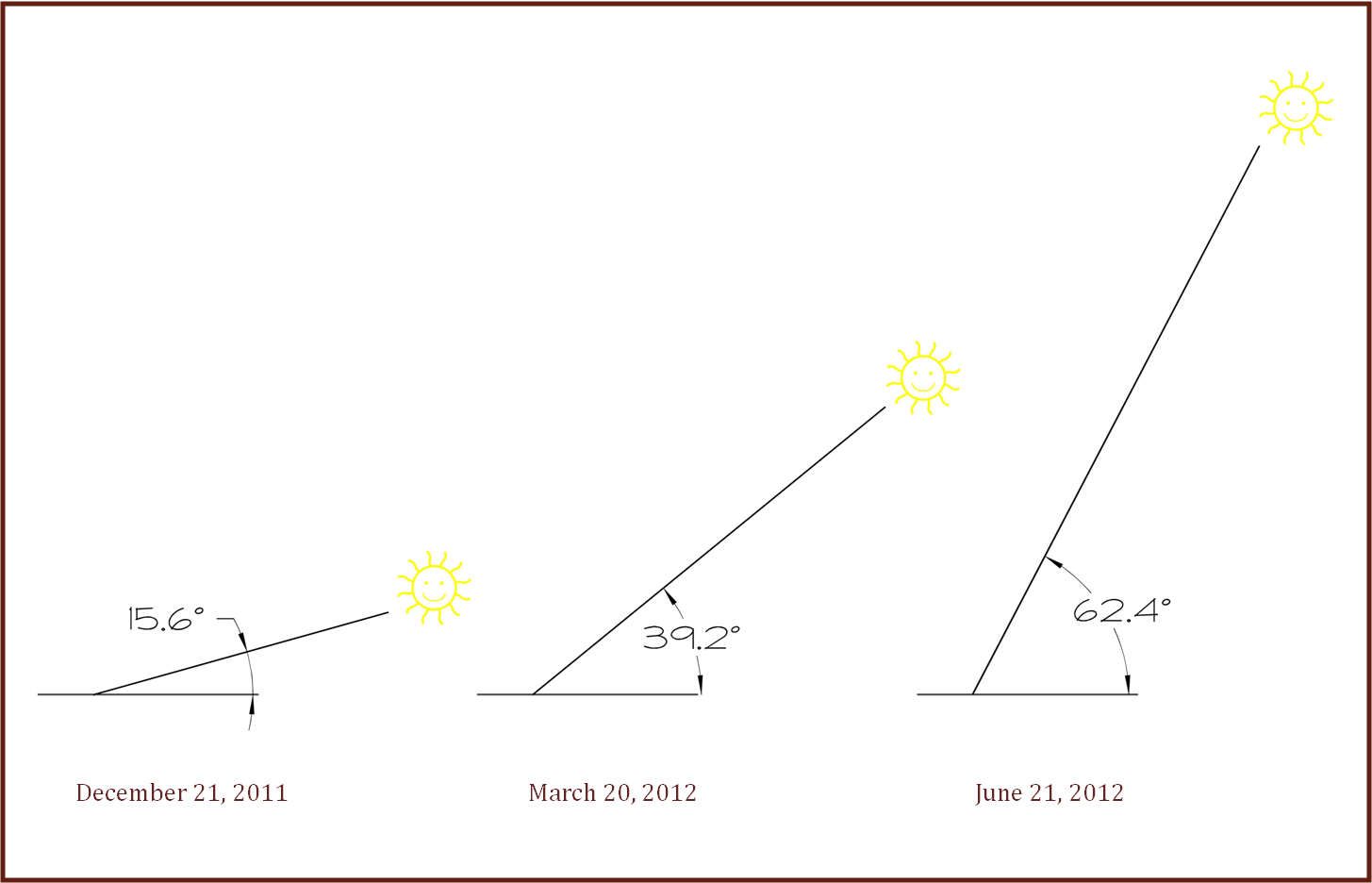
Just look up – the sky is telling us it’s spring. Well, more specifically the sun. Today, March 27th, the sun rose at 7:22 AM and will set at 8:02 PM. Tomorrow, sunrise will be at 7:20 AM and sunset at 8:04 PM. The following day – 7:17 AM and 8:05 PM. We  are currently gaining approximately 4 minutes of daylight every 24 hours, and the angle that the sun’s rays strike the earth is increasing daily.

Angle of sun at Winter Solstice, Vernal Equinox and Summer Solstice.

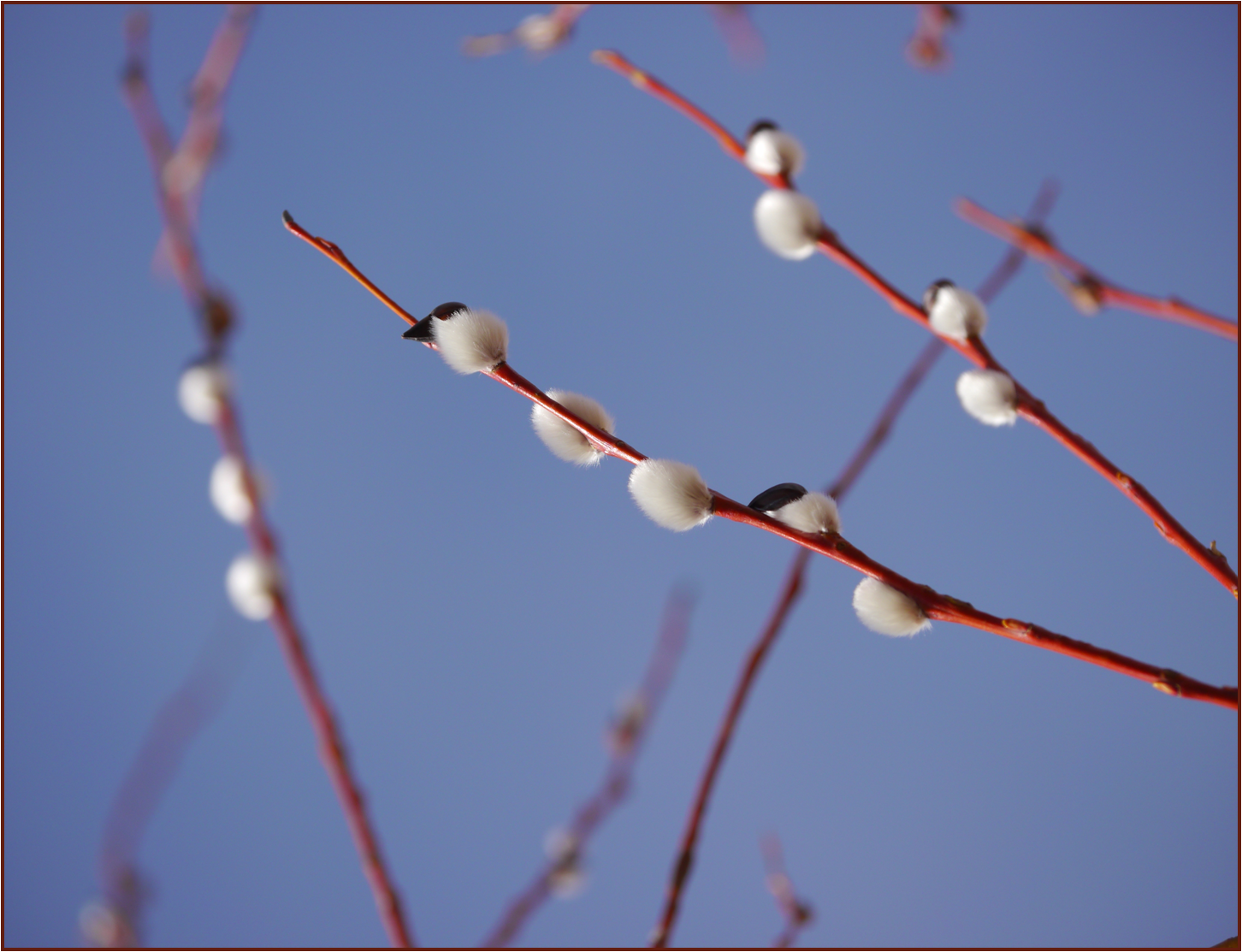
Of all the harbingers of spring, the native Salix discolor is for me the most poignant – this pussy willow resides in a school yard in Northwest Calgary and is covered in these sweet little fluff balls.
Photo: Pat Gaviller

The air is rich with new life and new possibilities – yes indeed spring is in the air.

Just look up!

Happy Spring,
Sue

© Sue Gaviller and Not Another Gardening Blog 2012.

Unauthorized use and/or duplication of this material without express and written permission from this blog’s author and/or owner is strictly prohibited. Excerpts and links may be used, provided that full and clear credit is given to Sue Gaviller and Not Another Gardening Blog with appropriate and specific direction to the original content.