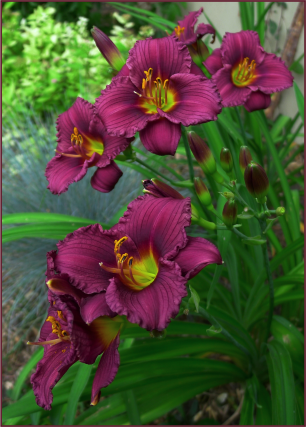
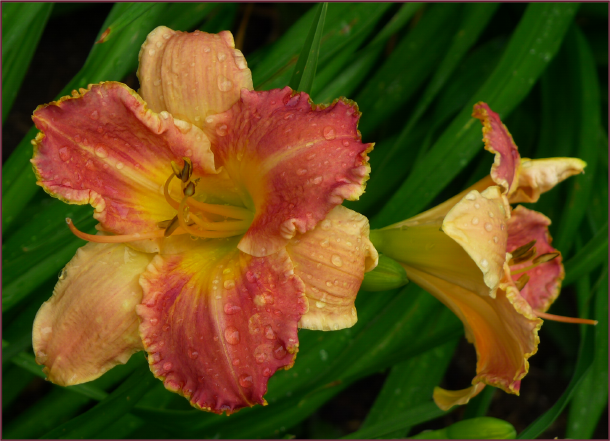
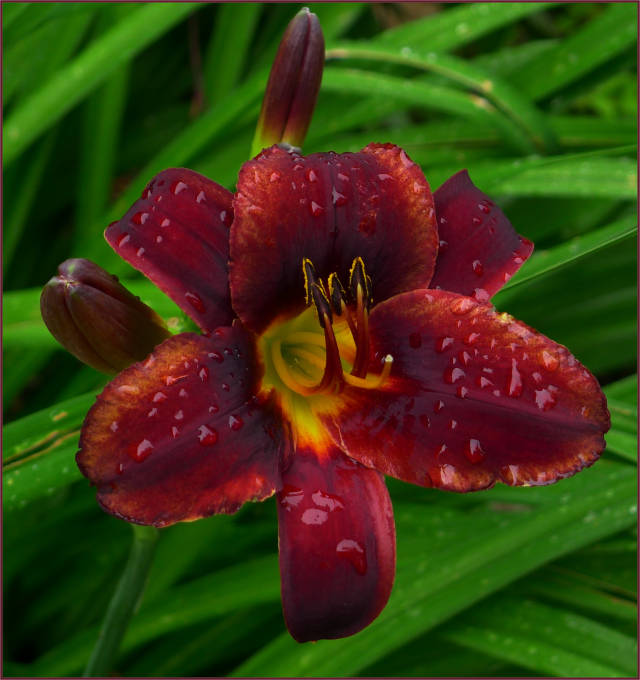
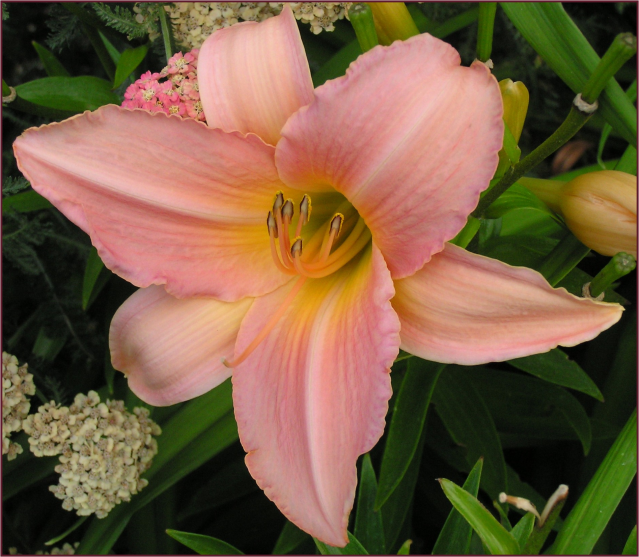
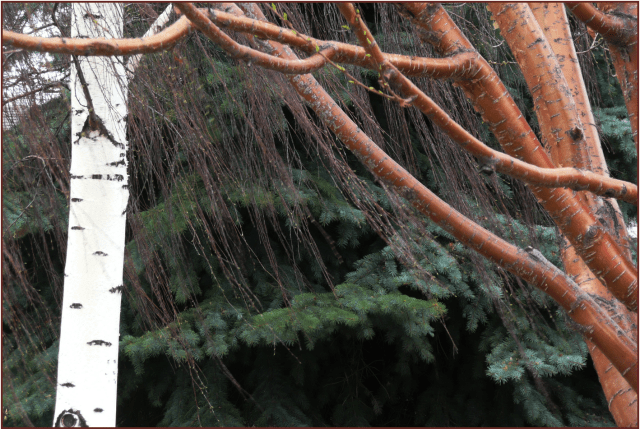
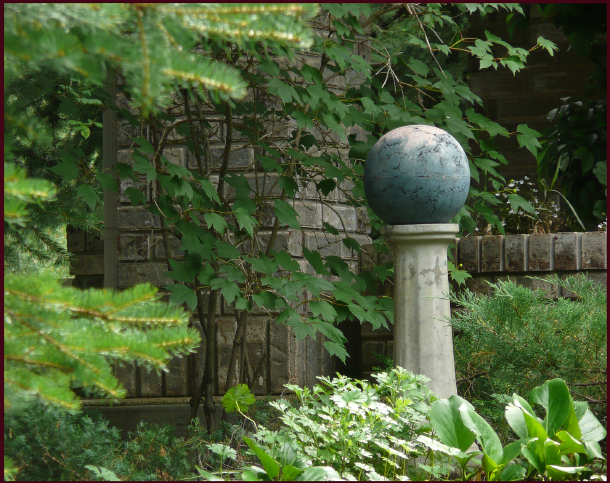
Barking up the Wrong Tree

They say dog is man’s best friend – well how about dogwood is gardener’s best friend? I don’t mean the graceful dogwood trees, Cornus kousa or Cornus florida  – I wish I could say I was referring to them, but sadly no, we can’t grow these lovely trees in our zone 3, chinook-challenged climate. We can however, grow some splendid cultivars of our native Cornus sericea (red osier dogwood), and the closely related Cornus alba (Tatarian dogwood). I recall a recent quip from an out-of-province industry professional in reference to these…….he snorted, “That’s a dogwood? Where I come from dogwoods are trees.” Yeah, yeah, I know – we’re horticulturally deprived here. But no need to feel sorry for ourselves – the dogwood shrubs I speak of, though not as ornamental in flower, have special characteristics that set them apart from their arboreal counterparts. Not only are they extremely hardy in our fierce climate, they have a beauty all their own and offer it up year round.

Let’s take a walk through the seasons and see what these dogwoods have to offer

Winter Bark

Both species have colourful bark which is very showy in winter. C. sericea has dark red bark, C. alba has brighter red bark, and each have numerous cultivars presenting additional bark colours of green, yellow, coral and purple-black.  Indeed it is this trait that makes dogwood so desirable in Northern climes – our winters are long and it provides a bright spot in a dreary landscape. The branches are often used in seasonal container arrangements as well, since they hold their colour well when cut.

Cornus sericea (red osier dogwood) lines the banks of the Bow River, its massive root system preventing erosion, and its colourful stems brightening the winter landscape. Photo: Pat Gaviller

The pliable branches are also useful for various crafts – basketweaving for example. Dream catchers too, were traditionally made of red osier dogwood, which some considered to be sacred.

Colourful bark makes dogwood branches useful in other landscape applications – the detail in the viewing window on the left is made from dogwood which I harvested from one of my very mature Cornus sericea ‘Flavirimea’. I then had my friend and colleague, Greg Booth of Sawback Developments, fashion this Japanese-style gate for a client. Photos: Sue Gaviller

Since it is the younger branches that are the most colourful, keeping old branches pruned out will ensure good bark colour. Very old, untidy specimens can be ‘rejuvenated’ by pruning them to the ground. Your efforts will be rewarded with lush new growth the following year.

Spring Flowers and Summer Berries

All of the C. Sericea and C. Alba cultivars have delicate white flowers in spring. Some years they flower abundantly, other years more sporadically, and while the blooms can’t compete visually with those of Malus or Syringa, they are nonetheless suitably pretty. In late summer these pretty white flowers become pretty white berries, which are especially attractive against the changing foliage colour.

Dogwood berries provide food for many species of birds – too numerous to list here. Suffice it to say that if you want to attract birds to your yard, include a native dogwood or two in your plan.

Dogwood flowers, though not particularly showy, still have ornamental value in the landscape. Left: Cornus sericea. Photo: Pat Gaviller. Right: Cornus alba ‘Aurea’. Photo credit: Wikipedia
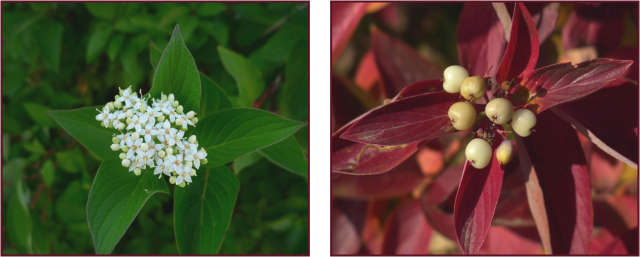
Cornus sericea: small white flower clusters become cream-coloured berries – stunning against the red fall foliage. Photos: Pat Gaviller

Foliage Colour All Season Long

Cornus sericea and Cornus alba contribute both texture and colour to the garden. Texturally they are medium-coarse – these coarser textures are desirable for providing moments of emphasis and contrast in the landscape. As for colour, there is increasing variety in available foliage colours – bright gold, bronze-green, variegated green and gold, variegated green and white, and of course basic green. With all these colours to choose from, the lowly dogwood shrub can make a real splash in your garden.

Cornus alba ‘Aurea’ has intense bright golden foliage – a real standout. Here it contrasts beautifully with the dark green of Syringa vulgaris and the rich wine-coloured Physocarpus opulifolius ‘Summer Wine’. With colour like this who needs flowers? Photo: Sue Gaviller

Cornus alba ‘Strawberry Daiquiri’ (left) has very white leaf margins and strawberry coloured bark, while Cornus alba ‘Cream Cracker’ has butter cream variegation and dark purple-red bark. Such yummy names aren’t they? Photos: Sue Gaviller

Cornus sericea ‘Silver & Gold’ has green and cream variegated leaves and bright yellow bark – an attractive addition to the landscape any time of year. Photo: Sue Gaviller

Dogwoods also have brilliant fall foliage colour – the red-barked cultivars turn varying shades of red, the yellow-barked cultivars turn golden and the variegated cultivars turn shades of peach, pink or orange.  These Cornus shrub species really do have something to offer in all four seasons – few plants have such versatility.
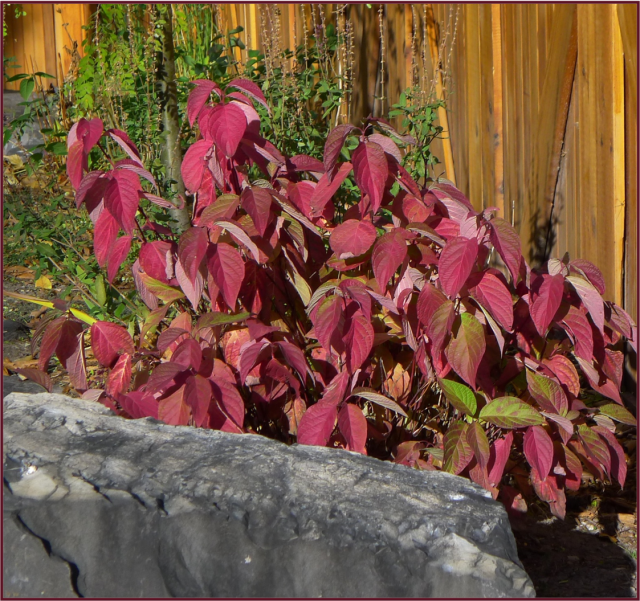
The bright red fall foliage of this small compact dogwood (which I suspect is Cornus sericea ‘Farrow’) looks stunning against the backdrop of a richly stained fence and the limestone boulder in the foreground. Photo: Sue Gaviller
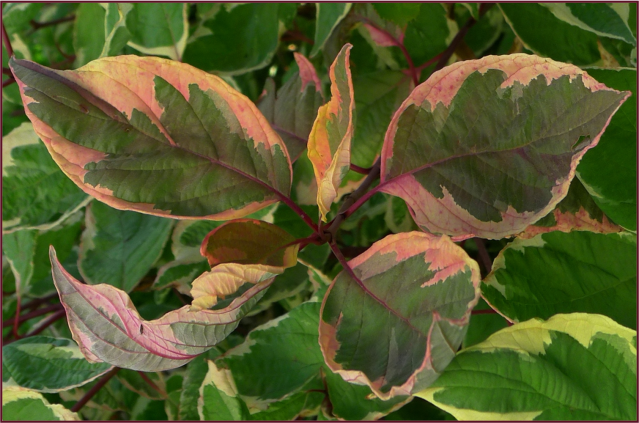
Cornus alba ‘Cream Cracker’ in late summer, just beginning to show its fall colours. Photo: Sue Gaviller

Size Matters

C. sericea and C. alba species are quite large – 2 to 3 meters height and spread. This is great if you have lots of room, but if not, there are many cultivars bred specifically for the smaller yard. Cornus sericea ‘Farrow’ (Arctic Fire dogwood) is a compact bushy cultivar with lush green leaves and intense red stems, reaching about 1 meter tall and wide. Cornus sericea ‘Kelseyi’ is a cute little dwarf variety growing only about ½ metre. For variegated cultivars, the very pretty Cornus alba ‘Cream Cracker’ is a great choice for small yards with a height and spread of about 1 metre.
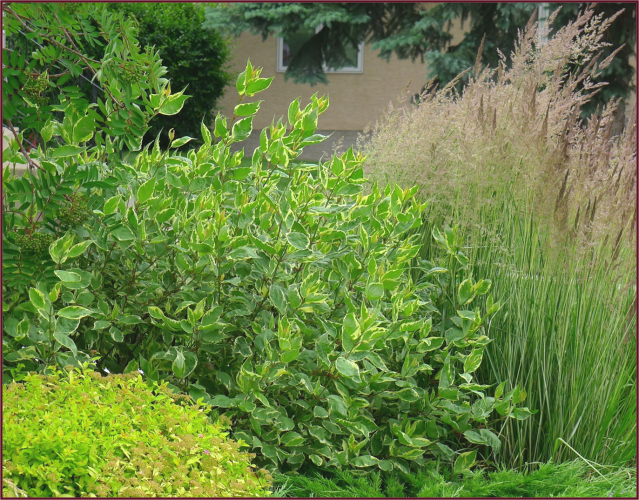
This client’s Northwest Calgary yard was one of the first designs in which I used Cornus alba ‘Cream Cracker’. I’ve been very happy with its performance – very little winterkill, bushy compact growth habit and beautiful warm variegated foliage has made it a great choice. Photo: Pat Gaviller

Dogwoods aren’t  picky about where you put them – I have 12 or 13 of them in my yard, numerous cultivars of both species, placed in every conceivable growing condition – shade, semi-shade, full sun, moist, dry, sheltered, exposed and several combinations thereof. I can’t say any particular specimen is doing markedly better than others – the one in full sun with supplemental water from the downspout has perhaps grown the fastest, but on the whole they’re all pretty happy.

So you see there’s a dogwood for everyone, for every site, and for every season. Indeed they are a gardener’s best friend.

Thank y’all for reading,
Sue
 
© Sue Gaviller and Not Another Gardening Blog 2012. Unauthorized use and/or duplication of this material without express and written permission from this blog’s author and/or owner is strictly prohibited. Excerpts and links may be used, provided that full and clear credit is given to Sue Gaviller and Not Another Gardening Blog with appropriate and specific direction to the original content.

The Colours of Harvest

If you looked up just around sunset last night, you may have seen the rising of the harvest moon – an early fall event that refers to the full moon nearest the Autumnal Equinox. It seems appropriate then, that I write something in honour of harvest. Of course we’ve been harvesting from our vegetable garden for a good part of the summer, but this weekend we’ll pull in the remainder of frost tender produce – green and yellow zucchini, pattypan squash, tomatoes and tender herbs. Apparently there is snow in the forecast this week!

It’s been a good year though, despite the cold wet start to the season which slowed germination, the hailstorms which set everything back, and the hot dry weather of July and August that left even heat loving plants looking scorched and wilted. However, we were still able to eat fresh produce from the garden from June onwards, so all in all we’ve been blessed with a fine harvest.

My husband is the veggie gardener in our family – it was my baby many years ago, but as I gained an interest in ornamental gardening, I lost interest in the vegetable garden. It makes sense that hubby would take it over – after all he is the superior cook, and I’m most grateful for his labour and the love with which he cultivates the garden. Although I don’t tend that garden anymore, I’m still delighted by its bounty.

Harvest is more than just a feast for the palate – it can be a feast for the eyes too. As a designer, I find the whole trend towards ‘Designer Veggies’ very appealing – purple and yellow carrots, orange, yellow and black(ish) tomatoes, golden beets, pink striped beets. There’s a whole new world of colour out there! Except it’s not new. In fact, many of these colourful vegetables are actually heirloom varieties that are now being reintroduced. As with many heirloom vegetables, the flavours are better and so is disease and pest resistance. While they may not be suited to large-scale agricultural production, they are perfect for the home garden or market garden.  And they make for a colourful feast that looks as good as it tastes.

Heirloom carrots lack the large size and uniformity of their more hybridized counterparts, but their sweet crunch makes them perfect for eating right out of the garden. Photo: Sue Gaviller

Left: Cherry, plum and pear tomatoes are small and sweet. Right: clockwise from top – Black Krim, Tangerine and St. Pierre heirloom tomatoes. Photos: Sue Gaviller

Left: Baby heirloom carrots glisten with the chicken ‘jus’ in which they were roasted.
Top: Green and yellow zucchini and pattypan squash tossed in olive oil and roasted.
Right: Baby heirloom potatoes are tender and flavourful – they’re best simply steamed and buttered….mmmmm. Photos: Sue Gaviller

Mother Nature too has been busy, readying her own colourful feast for our fine feathered friends – indeed the birds have already begun partaking of her bounty. The abundance of berries and pomes, hips and haws, provides fuel for birds preparing to embark on their migratory journey, as well as those needing winter long sustenance. These beautiful fruits have significant ornamental value as well – a bonus Mother nature didn’t really intend for us, but we’re happy to accept.

Many fruit bearing trees and shrubs have bright red fruit to attract the birds. Clockwise from top: Sorbus decora, Viburnum trilobum, Malus sp., Lonicera tatarica. Photos: Sue Gaviller

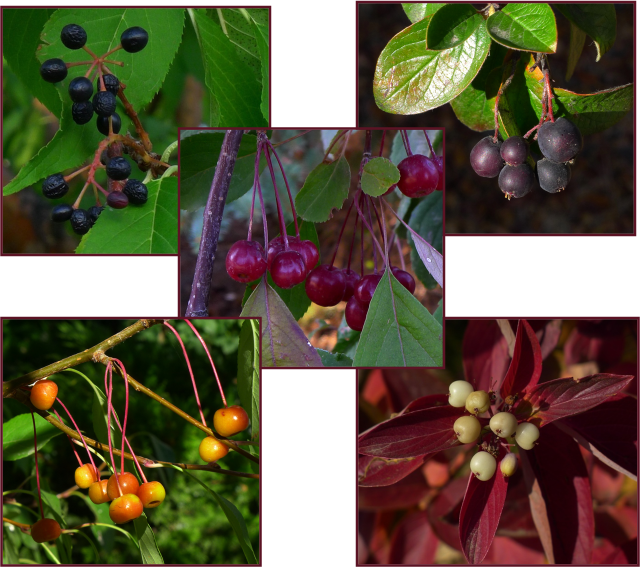
Not all fruit is bright and showy, but the birds manage to find it nonetheless. Clockwise from top left: Prunus mackii, Cotoneaster lucidus, Cornus sericea, Malus baccata ‘Rosthern’, Malus ‘Rosy Glo’. Photos: Pat Gaviller

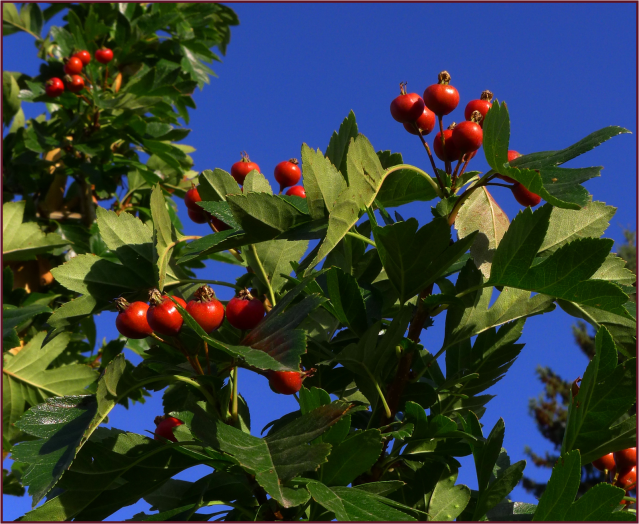
Crataegus mordenensis ‘Toba’ has very ornamental fall fruit, loved by birds. Photo: Pat Gaviller

The very showy fruit of Sorbus decora will remain on the tree until stripped by the huge amoeba-like flocks of Bohemian Waxwings. Photo: Sue Gaviller

Harvest Moon 2012. Photo: Pat Gaviller

It was a good summer – the fruits of our labour bear witness to this. But there is a chill in the air today – fall is definitely here, and it’s time to reap what we have sown. May your harvest be plentiful!

Til next time,
Sue

A Midsummer’s Daydream

If you could dream up the perfect perennial what would be on your wish list?

How about big beautiful blooms? Check.

Long blooming? Check.

Enormous selection of bloom colours, bloom-times, sizes etc.? Yes indeed.

Easy care? Definitely.

Tidy growth habit? For sure.

Handsome foliage? Yes please!

Anything else? Let’s see……..how about sweet but subtle fragrance? Yes definitely!

If only we could conjure up such a plant…..but alas it’s only a dream. Well maybe not; that dream plant sounds decidedly like Hemerocallis, the daylily – in fact this perennial has oft been called the ‘perfect perennial’. Hard to believe then, that there are those who claim not to like daylilies, scornfully referring to them as ‘ditch lilies’. Ouch, what a derisive term for such a beautiful, useful, reliable perennial!  As a designer, in a difficult climate, I can’t imagine the midsummer border without them. Some are even fragrant.  And they have few enemies, except for maybe hail but don’t get me started on that (I have yet to fully assess the damage from Sunday night’s storm). Granted, the daylily dissenters are likely referring to the tawny daylily, Hemerocallis fulva, that ubiquitous orange thing found in many a tired garden – but even it has its place.

Daylilies Reader Rock Garden resize

Hemerocallis fulva – that old garden variety daylily – can make a stunning statement when used effectively. Left: tawny daylilies line the sidewalk leading to Reader Rock Garden. Photo: Pat Gaviller. Right: beautifully paired with blue Delphinium. Photo: Sue Gaviller

This summer has been exceptional for Hemerocallis, at least in my own garden, which is home to numerous spectacular cultivars – every single plant is loaded with blooms.  But let’s revisit our wish list and see whether this ‘perfect perennial’ meets all of our expectations.

Big Beautiful Blooms

Generally speaking, daylilies are a large-flowered perennial – even the smaller cultivars have relatively big blooms compared to other perennials. Because the blooms are large, and profuse, the colour impact is significant, especially the brighter-hued selections. So don’t go wild with too many different colours blooming at once.

Strutter's Ball Daylily 2 resize

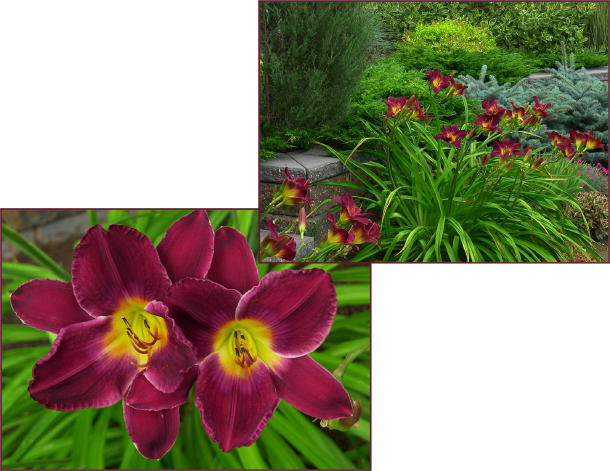
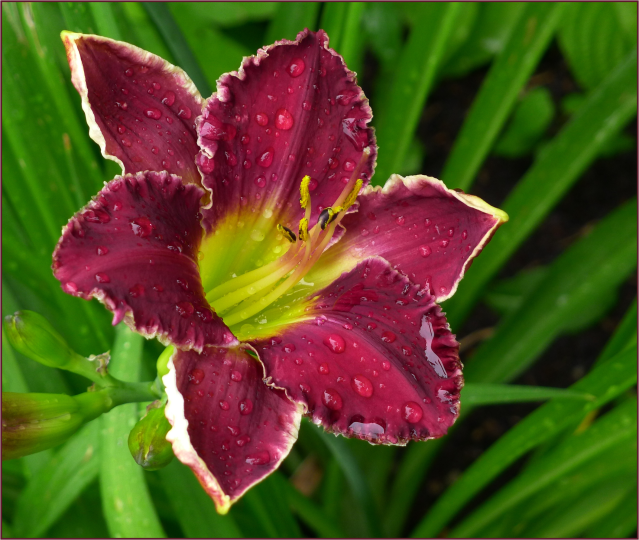
Hemerocallis ‘Strutter’s Ball’ is a big beefy daylily and can hold its own even when surrounded by mostly woody plant material. The velvety magenta flowers are huge and very showy.
Photos: Sue Gaviller

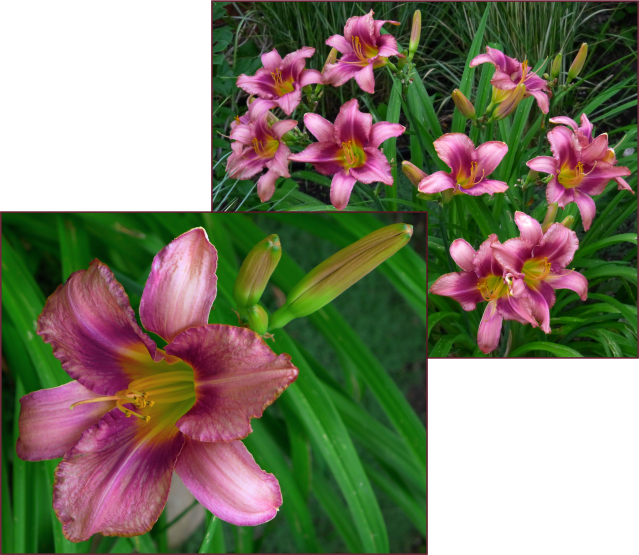
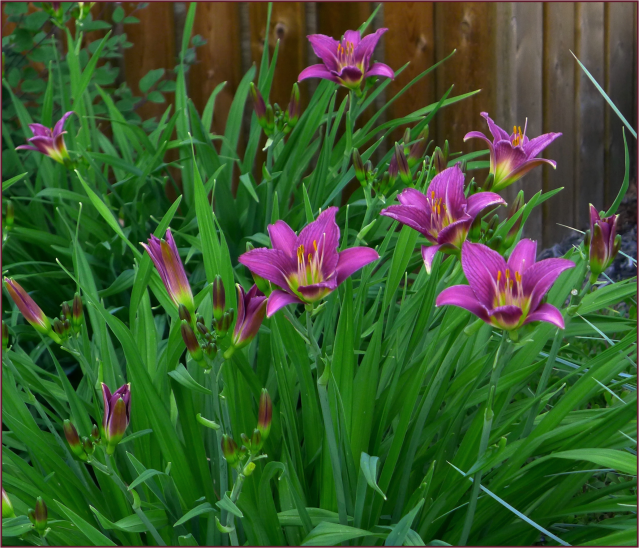
Hemerocallis ‘Purple Bicolour’ – a rather simplistic name for a stunningly unique cultivar. The soft rose-pink petals and sepals, and the wine-purple eye zone, merit a more exciting moniker. How about ‘Wine and Roses’ – a much more fitting name don’t you think? Photos: Sue Gaviller

Long Blooming

While each individual flower opens for only a day, there are so many buds on each branched scape that a single plant can bloom for weeks. And since there are early, mid-season, and late bloomers, daylily season is pretty much all summer long. As well, there are an increasing number of reblooming varieties that can rebloom several times throughout the summer.

‘Stella d’Oro’ was the first ever reblooming daylily cultivar. Her reliable bloom habit and dwarf form have made her a favourite of both gardeners and landscape professionals. Photo: Pat Gaviller.

Another reblooming cultivar, ‘Little Grapette’ is a dwarf selection. Though the blooms are smaller, they are profuse and richly coloured, so provide significant colour impact. Photo: Sue Gaviller

Enormous selection

Daylilies were once dismissed as pedestrian plants unsuitable for the sophisticated garden, but early in the last century they made a come-back with the introduction of new colours. This daylily renaissance marked the beginning of a new era in Hemerocallis hybridization, with cultivars now numbering in the tens of thousands – over 60,000 registered cultivars now exist! Breeding programs have produced a mind-boggling variety of colours – reds, oranges, yellows, golds, pinks, peaches, dark wines and purple-reds, near-whites and bicolours. Some have ruffled edges, some are fragrant, some dwarf and some huge. Early bloomers, mid-season bloomers, late bloomers and rebloomers……well you get the picture.

Much of the breeding has concentrated on producing new tetraploids – this refers to the number of chromosomes; 44 for a tetraploid, 33 for a triploid and 22 for a diploid. Those extra chromosomes result in stouter scapes and sturdier petals and sepals – thick and almost rubbery compared to the papery thin petals and sepals of non-tetraploids.

Chicago Antique Tapestry resize

Hemerocallis ‘Chicago Antique Tapestry’ – a rare find, this tetraploid is a really classy cultivar. Huge, ruffled and mildly fragrant blooms – a real stunner. Photo: Sue Gaviller

Another tetraploid, Hemerocallis ‘Starling’ is a regal addition to the midsummer border, pairing well with the above mentioned ‘Chicago Antique Tapestry’. Photo: Sue Gaviller

Hemerocallis ‘Kitten’s Paw’ is bright peachy pink – a lovely tetraploid with characteristic sturdy scapes and firm petals. Photo: Cathy Gaviller

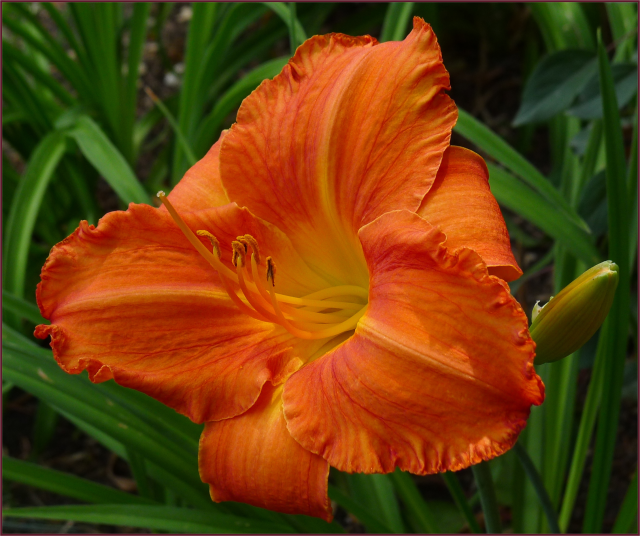
Ruffled, spicy orange Hemerocallis ‘Hot Embers’ – another stand-out tetraploid. Photo: Pat Gaviller

Easy Care

Daylilies aren’t fussy plants – they’ll be happy just about any place you put them. From zone 1 to zone 11, in sun or light shade, moist or dry, clay or sand, they will perform. They are sufficiently drought tolerant to be a staple in our semi-arid climate, but they will appreciate a little extra water when in heavy bloom.  Deadheading every day will keep the plants looking fresh – luckily this is an easy task as the spent blooms snap off easily. I can deadhead all of my 20+ plants in a matter of minutes. Hemerocallis is for the most part pest and disease free and requires dividing only occasionally. I’d call that pretty easy care.

Tidy Growth Habit

I’ve never owned a daylily that required staking or tying of any kind. Even the very tall cultivars like ‘Tetrina’s Daughter’ or ‘Autumn Minaret’ stand up nicely on stiff stems, despite being bloom laden.

Handsome Foliage

Hemerocallis has wide strap-shaped leaves that arch gracefully, so the plant has design value even when not in bloom. They are ideal for underplanting trees or focal points, edging around planting beds, massing, and filling in difficult areas.

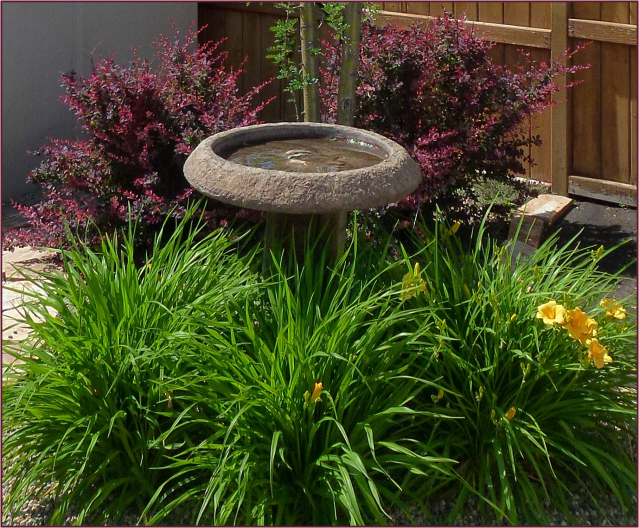
Grassy daylily foliage makes a nice underplanting, lending visual support to the bird bath. Photo: Sue Gaviller

A swath of dwarf reblooming Hemerocallis ‘Stella d’Oro’ is an effective way to plant a difficult space like this long narrow bed. When not blooming the arching daylily foliage still provides a simple elegant line. Photo: Pat Gaviller.

Sweet Subtle Fragrance

Many daylilies have a very pretty scent – some more so than others. It’s not overpowering, but if you’re standing or sitting nearby you’ll get a light bouquet on the nose.

Hemerocallis ‘Mary Reed’ is a dwarf cultivar with pretty mauve-pink blooms and a delicate scent. Photo: Sue Gaviller

Hemerocallis ‘Ivory Edges’ is by far the most fragrant daylily in my garden – strikingly beautiful as well. Photo: Sue Gaviller

When I awoke yesterday morning I peeked out the window to survey the devastation wrought by the previous night’s hail storm. Miraculously, what first caught my eye was cheerful daylily blooms – they seemed to be wishing me a beautiful day. How apt, since the word Hemerocallis comes from the Greek words hemera, meaning ‘day’ and kalos, meaning ‘beautiful’. May your day be beautiful – Hemerocallis!

Thanks for visiting – y’all come back now.
Sue
 
© Sue Gaviller and Not Another Gardening Blog 2012. Unauthorized use and/or duplication of this material without express and written permission from this blog’s author and/or owner is strictly prohibited. Excerpts and links may be used, provided that full and clear credit is given to Sue Gaviller and Not Another Gardening Blog with appropriate and specific direction to the original content.


Curtain Call – Farewell to Sweet Syringa

So y’all know how much I love lilacs. Well I’m sad to say they are nearing the end of their bloom period, so I wanted to give you a look at the closing act before the curtain is drawn on another season.  I know, enough with the lilacs already – I assure you though, today will be my last post on this loveliest of blossoms (at least for this year) and I promise to keep it short.

Syringa reticulata – Japanese Tree Lilac

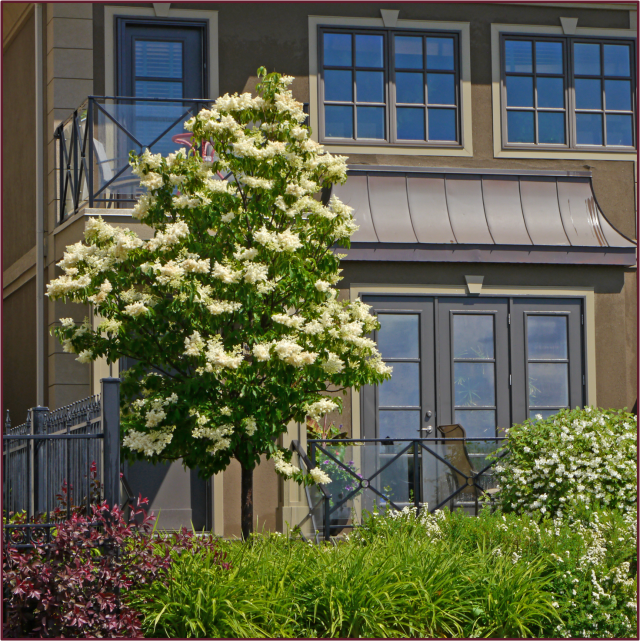
These gorgeous, very late bloomers have been flowering for a week or so in our part of the world. They weren’t in bloom for my June lilac post but they are so utterly stunning this year, that I had to bring them to your attention. The Japanese tree lilac is the last of the lilacs to bloom and has some unique characteristics not shared by others in the genus:

  • They are a true tree, as opposed to a large shrub that gardeners prune into a tree ‘shape’ and labour to maintain.
  • The bark is a dark chocolate-brown with very noticeable lenticels.
  • The flowers are borne in panicles like all other Syringa species but have much finer texture, their feathery appearance in striking contrast to the large shiny leaves.
  • The scent isn’t recognizably lilac; it’s hard to describe, but if you get a whiff of something sweet and a bit spicy, like vanilla with a hint of anise, look around – there’s likely a tree lilac in the vicinity. Their bright white blooms make them easy to spot.
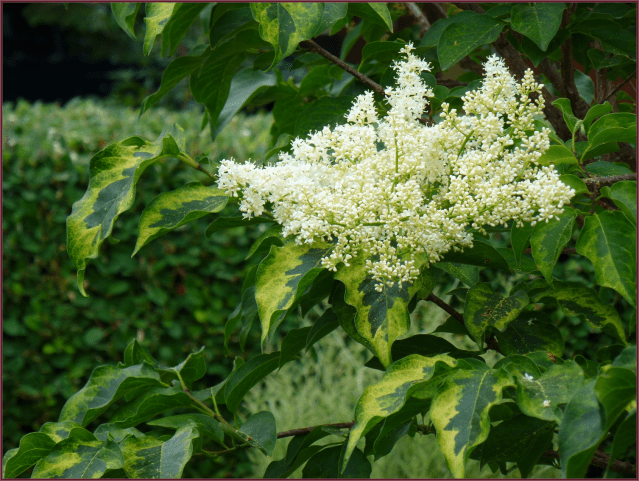
  • There is even a variegated cultivar which blooms later still (mine is just coming into bloom now) – ‘Golden Eclipse’ has large green and gold leaves.

Intense white blooms cover this compact tree. Photo: Pat Gaviller

Soft fluffy blooms, dark green foliage and richly textured, chocolate-coloured bark make the Japanese tree lilac a must-have in the urban landscape. Photo: Pat Gaviller

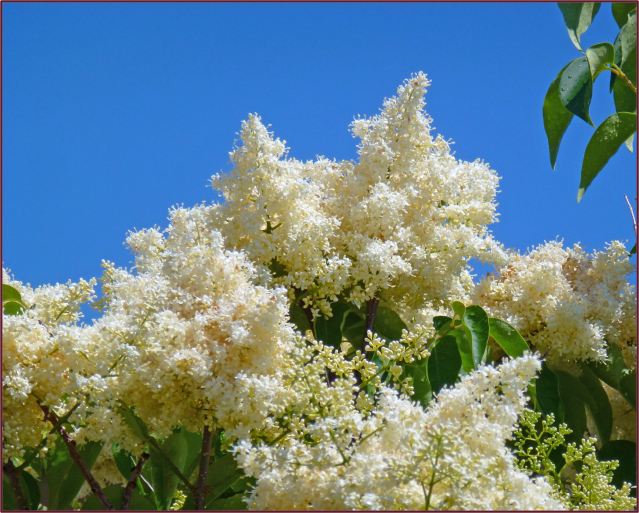
Full feathery plumes light up a sapphire sky. Photo: Sue Gaviller

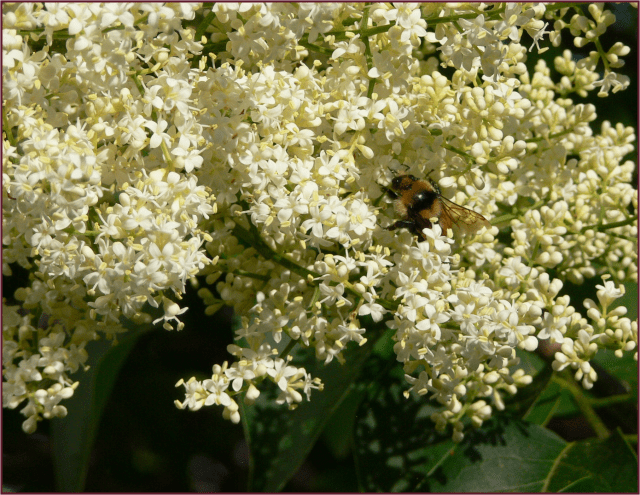
Syringa reticulata, with its honey-sweet scent is a favourite of bees and butterflies. Photo: Cathy Gaviller

Syringa reticulata 'Golden Eclipse' is a very hardy variegated cultivar - leaves on new growth emerge dark green splashed with lime and older growth has bright green and gold variegation. Photo: Sue Gaviller

Syringa reticulata ‘Golden Eclipse’ is a very hardy variegated cultivar – leaves on new growth emerge dark green splashed with lime and older growth has bright green and gold variegation. Photo: Sue Gaviller

Sum it all up and you have a great specimen tree – a tree with four season interest. The Japanese tree lilac has real design value and in my opinion is greatly underutilized in the landscape. It’s perfect for use as a dominant feature – for its elegant form (particularly if multistem), its colour (especially Golden Eclipse) and its coarse texture.

Syringa reticulata is a worthy closing act to a truly fine show that began 6 weeks ago – the lilac show.

So say goodbye to sweet Syringa – may their scent be with you.

Sue
© Sue Gaviller and Not Another Gardening Blog 2012.
Unauthorized use and/or duplication of this material without express and written permission from this blog’s author and/or owner is strictly prohibited. Excerpts and links may be used, provided that full and clear credit is given to Sue Gaviller and Not Another Gardening Blog with appropriate and specific direction to the original content.

Reasons to Celebrate

Today is the first day of summer and a lovely day it was. On days like today all seems right with the world, or at least with the garden. Our vegetables and herbs have been planted and despite the lack of any extended warmth, most seeds have germinated. Tomatoes are in, ornamental containers are done, and we’ve finally been able to determine whether those dead looking shrubs are actually dead or just really slow. Of course a gardener’s work is never done, but we’ve earned the right to rest for a bit, sit back with a glass of wine and appreciate our handiwork. If ever there were a reason to do just that it would be Summer Solstice – no weird rituals, just a really nice glass of Chardonnay, Viognier or…….okay I’m venturing into territory not my own. So please let me introduce to you, professional Sommelier, Len Steinberg as he explores why and what to sip while enjoying our gardens.

Any Excuse Will Do

…….by Len Steinberg

We all live busy lives – work, school, households and just stuff. Sometimes we just have to make time to sit back and experience the moment. Today is June 21st – summer is finally here and the longest day has just passed. It is a perfect time to sit outside on the patio after dinner with a glass of wine and enjoy the early spring excitement in the garden.  My point – any excuse is a good excuse.

In Calgary our summers can be challenging so we have to take advantage of every opportunity to spend time outdoors. While beer is always a summer favorite, along with some amazing choices for cocktails, wine always has a place on the patio, and with dining  ‘al Fresco’. Tonight when Sue gets home we have a date to sit on the patio and taste some of the open wines left over from a recent tasting. It would be a shame to let it go to waste.

We have a choice of an Argentinean Torrontes by Mauricio Lorca, Jackson Estate Marlborough Sauvignon Blanc, or a Prado Rey Verdejo from Rueda Spain. All are fresh and crisp, perfect for summer sipping. The open reds are a Merlot based Bordeaux Superior Chateau l’Esperance that has matured nicely, a Sangiovese from Amador Foothills Winery in Northern California and one of my favourites, Truchard Napa Valley Cabernet Sauvignon – a very nice selection with some aged cheese.

Entrance to the caves at Truchard Vineyards. Photo: S Gaviller

Entrance to the caves at Truchard Vineyards. Photo: Sue Gaviller

I recently finished a contract for a wine competition, The International Value Wine Awards, sponsored by Wine Access Magazine. During the competition 1100 wines were tasted over five days. The selection of styles and varietals in the competition is staggering. This inspires me to expand my tasting experience and to try new wines from all over the world. Don’t be shy, if you don’t like it you can always use it for cooking.

One of my favourite reasons to open a bottle of wine is dinner or any meal. While the meal is being prepared I take a look at what we have in the cellar and choose a wine that will pair well with the menu. Not everyone has a wine cellar but a local wine shop is usually not far away. This is especially nice if the warm summer weather is enticing you to dine al Fresco. We can talk about wine pairing another day.

Here are some of my favourite excuses to sip on wine in the garden:

My good friend Tom Firth of Wine Access really needs no excuse except, “It’s already in the fridge” or, “I think this would be fun to drink with……..works as good as any”.

Shelly Boettcher, wine writer and editor says “any night that it isn’t snowing and that I don’t have to drive my kids anywhere”.

I think we can all relate to these reasons for a sip of magic surrounded by the wonders of nature.

What’s your excuse?

To your Health,
Len

Harbingers of Spring

HAPPY SPRING!

March 20th marked this year’s Vernal Equinox – better known as ‘The First Day of Spring’!

I don’t need a calendar to tell me it’s spring though. There may still be frost in the ground, but spring is in the air – literally. Just look up – the trees are telling us it’s spring. You can see the subtle flush of colour, a slight aura emanating from their branches – leaf buds are beginning to swell. As spring gathers momentum the buds continue to swell, thousands on each branch, so when backlit by late day sun the trees appear adorned with jewels.  Closer inspection will show the buds to be plump and fleshy – life will soon burst forth. This multitude of bulging buds adds a dazzling texture to our skyward view.

Shrubs too are showing life in their branches – rounded buds, like colored baubles, cling to each branch and everything takes on a rich layered appearance.

A shimmer of colour rests atop Salix pentandra on a March weekend at Confederation Park.
Photo: Pat Gaviller

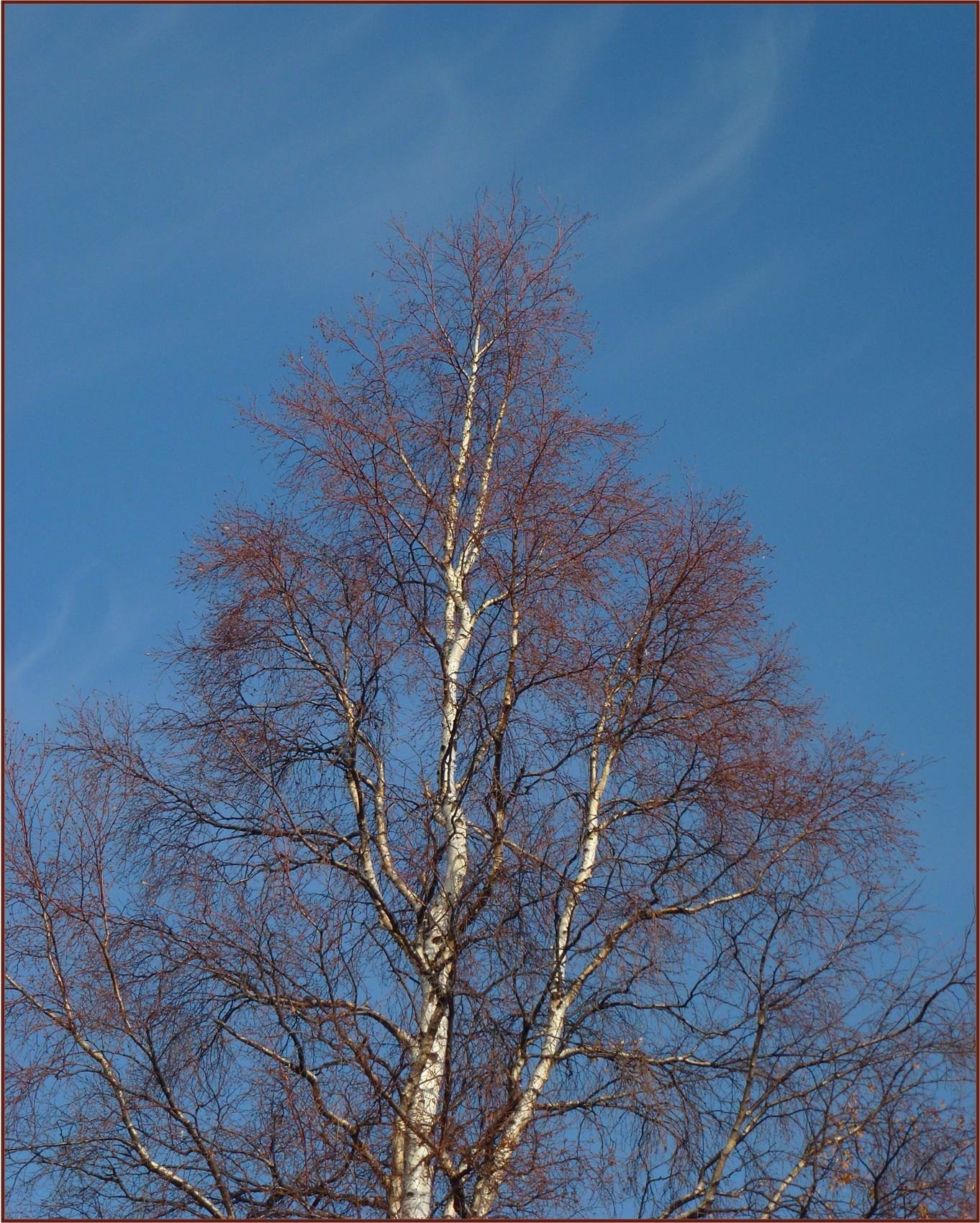
The deep red hue of Betula papyrifera branches intensifies as buds swell and life returns.
Photo: Pat Gaviller

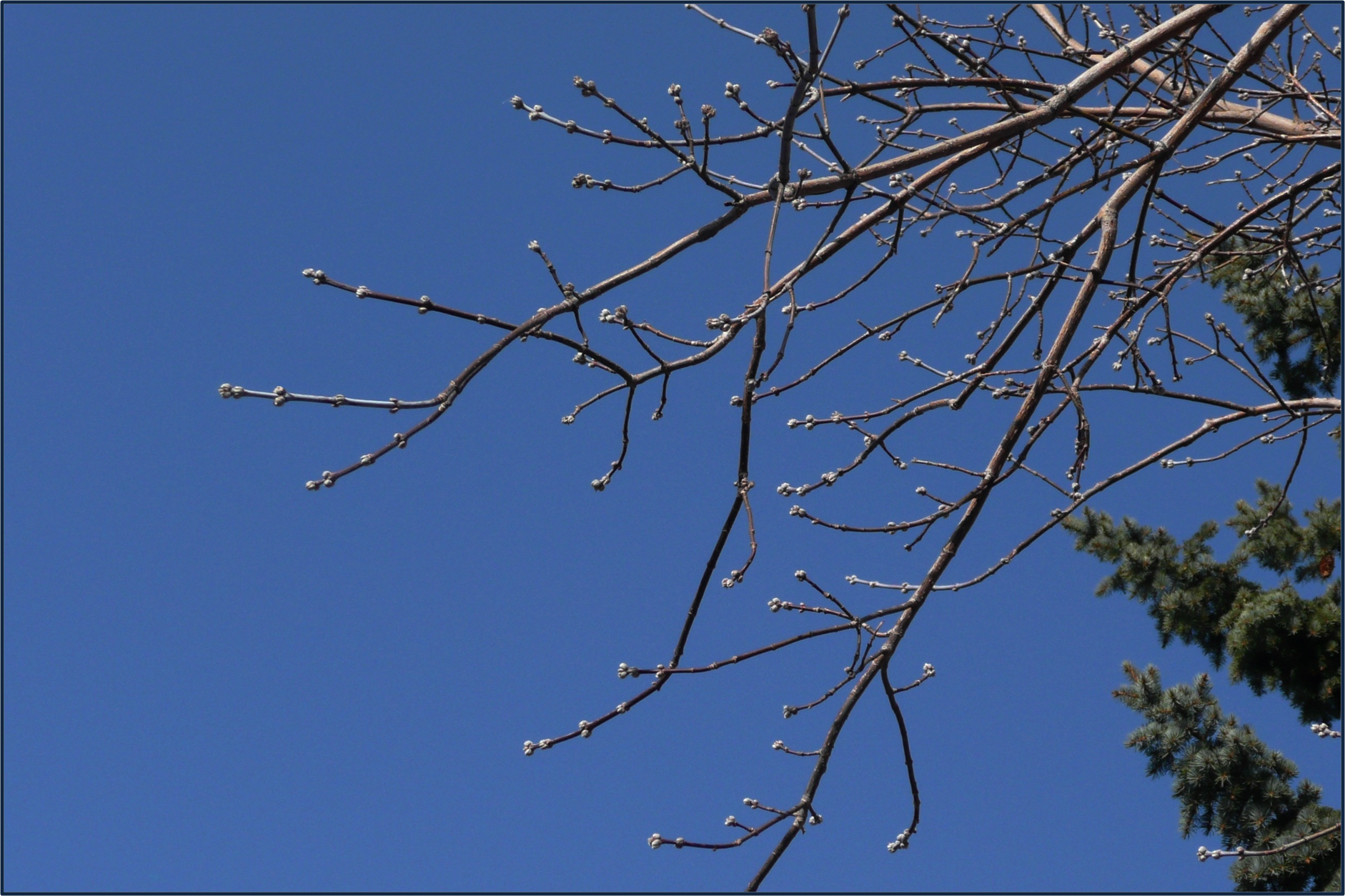
The buds on this Acer negundo look like tiny pearls against an ocean of sky. The Manitoba maple, often maligned for its weedy growth habit and tendency to aphid infestation, is one of the earliest trees to bud out in the spring. Photo: Sue Gaviller

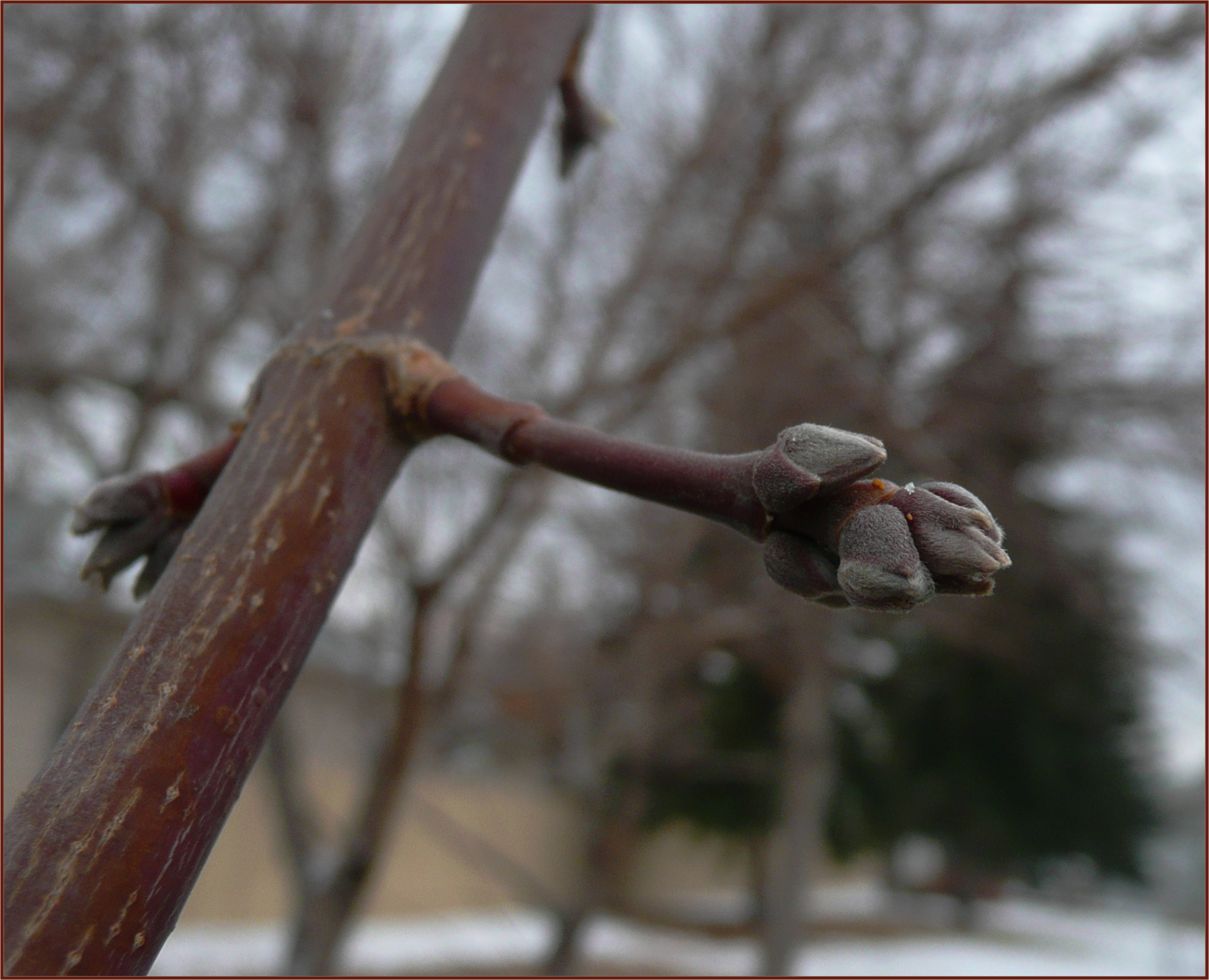
Acer negundo ‘Sensation’, a cultivar of the Manitoba maple, is a lovely tree with yearlong interest. Though debatably hardy here, this specimen has been growing in a protected spot in Northwest Calgary for many years. Viewed up close Manitoba maple buds are soft and fuzzy – this cluster of buds is reminiscent of puppy paws or bunny feet. Photo: Sue Gaviller

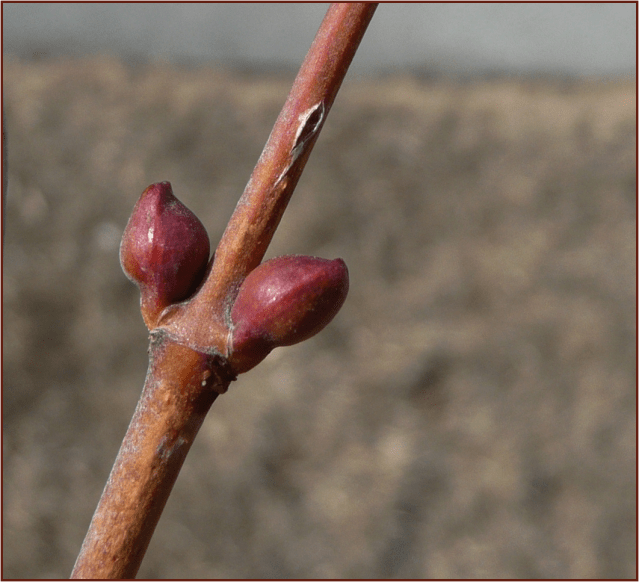
The ruby-red buds of Viburnum trilobum rival the colour of the berries that will be produced at season’s end. Photo: Sue Gaviller

Fat rounded buds like tiny soccer balls, line the branches of Larix sibirica. Photo: Sue Gaviller

The new growth on Crataegus mordenensis, both buds and branches, is rich plum red – shiny, supple and leathery in appearance. Photo: Sue Gaviller

Syringa buds almost ready to open: from left, Syringa meyeri, Syringa vulgaris, Syringa prestoniae Photos: Sue Gaviller

Ulmus pumila, the Siberian Elm, has pea-sized spherical buds – here they glow copper in the late day sun. Photo: Sue Gaviller

The enlarged buds of this Populus sp. embody the delicate colour and texture of spring. It won’t be long before these buds open to become the leaves of summer. Photo: Sue Gaviller

 Yes indeed spring is in the air.

Just look up – the birds are telling us it’s spring. Our red breasted friends are back – there are few sounds quite so heart warming as the first Robin’s chirp each spring. I heard it a couple of weeks ago, which seems quite early to me, though birding enthusiasts tell me that a few of these passerines actually overwinter here in Calgary. That may be true but I doubt many of us have witnessed this – for most of us the robin is still the quintessential sign of spring. Soon we will hear them singing their merry song each morn before dawn breaks, and little blue eggs will turn into tweeting baby robins – how very sweet that thought.

The American robin or Turdus migratorius (I dare you to say that with a straight face) is one of our country’s most beloved birds, likely because they herald the coming of warmer weather.
Photo: http://www.naturespicsonline.com/

Other birds have returned as well .

I’ve seen and heard Woodpeckers and Flickers hammering away on whatever hard surface will make the most noise – this is part of their courtship behaviour.  Merlins too, are squealing overhead as they call to potential mates. These are all such noisy birds, but so full of character and personality that one can easily forgive them the racket they make.

A male red-shafted flicker perches high up in a poplar tree in Centennial Park, Calgary
Photo: Pat Gaviller

Yes indeed spring is in the air.

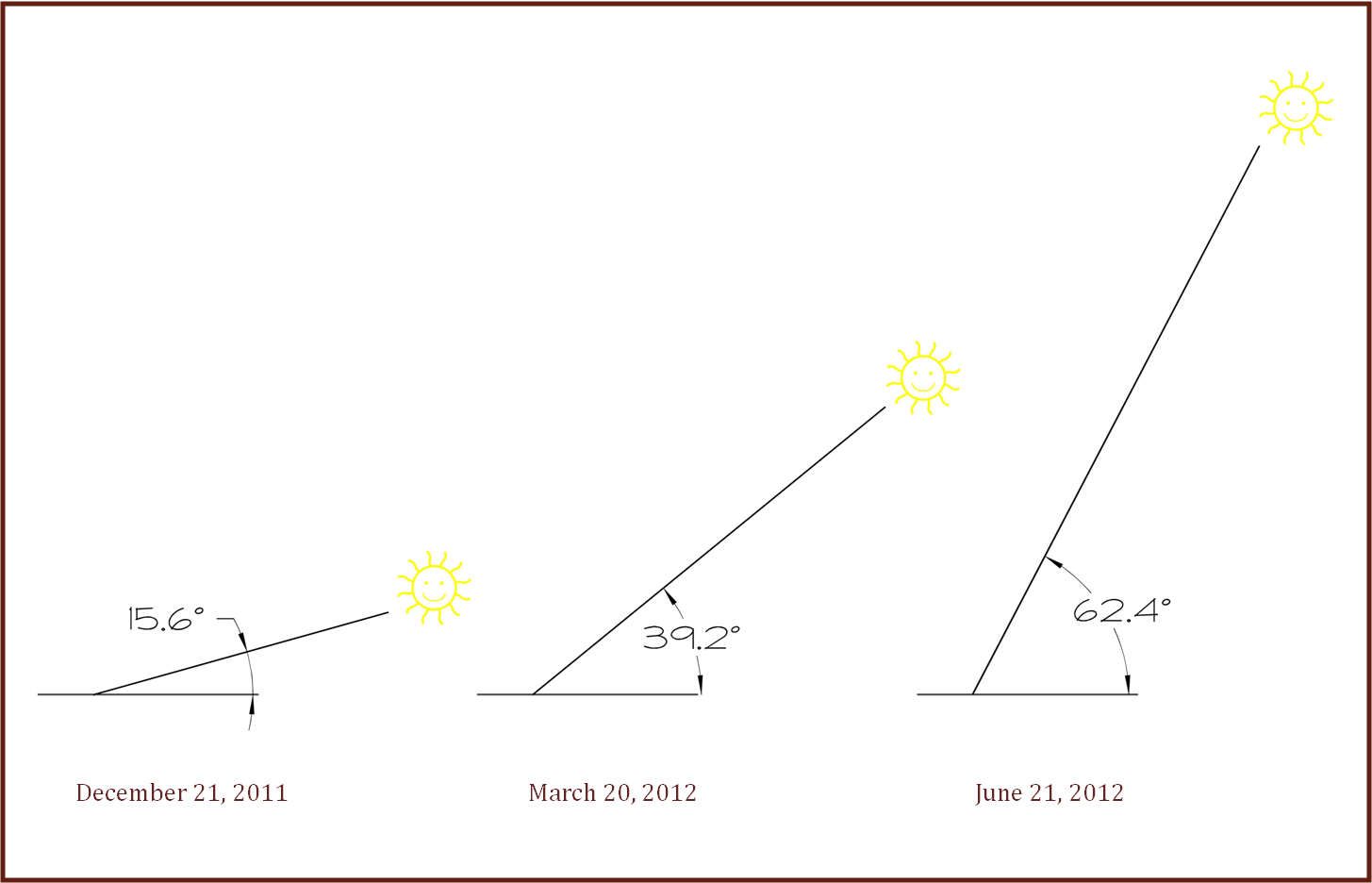
Just look up – the sky is telling us it’s spring. Well, more specifically the sun. Today, March 27th, the sun rose at 7:22 AM and will set at 8:02 PM. Tomorrow, sunrise will be at 7:20 AM and sunset at 8:04 PM. The following day – 7:17 AM and 8:05 PM. We  are currently gaining approximately 4 minutes of daylight every 24 hours, and the angle that the sun’s rays strike the earth is increasing daily.

Angle of sun at Winter Solstice, Vernal Equinox and Summer Solstice.

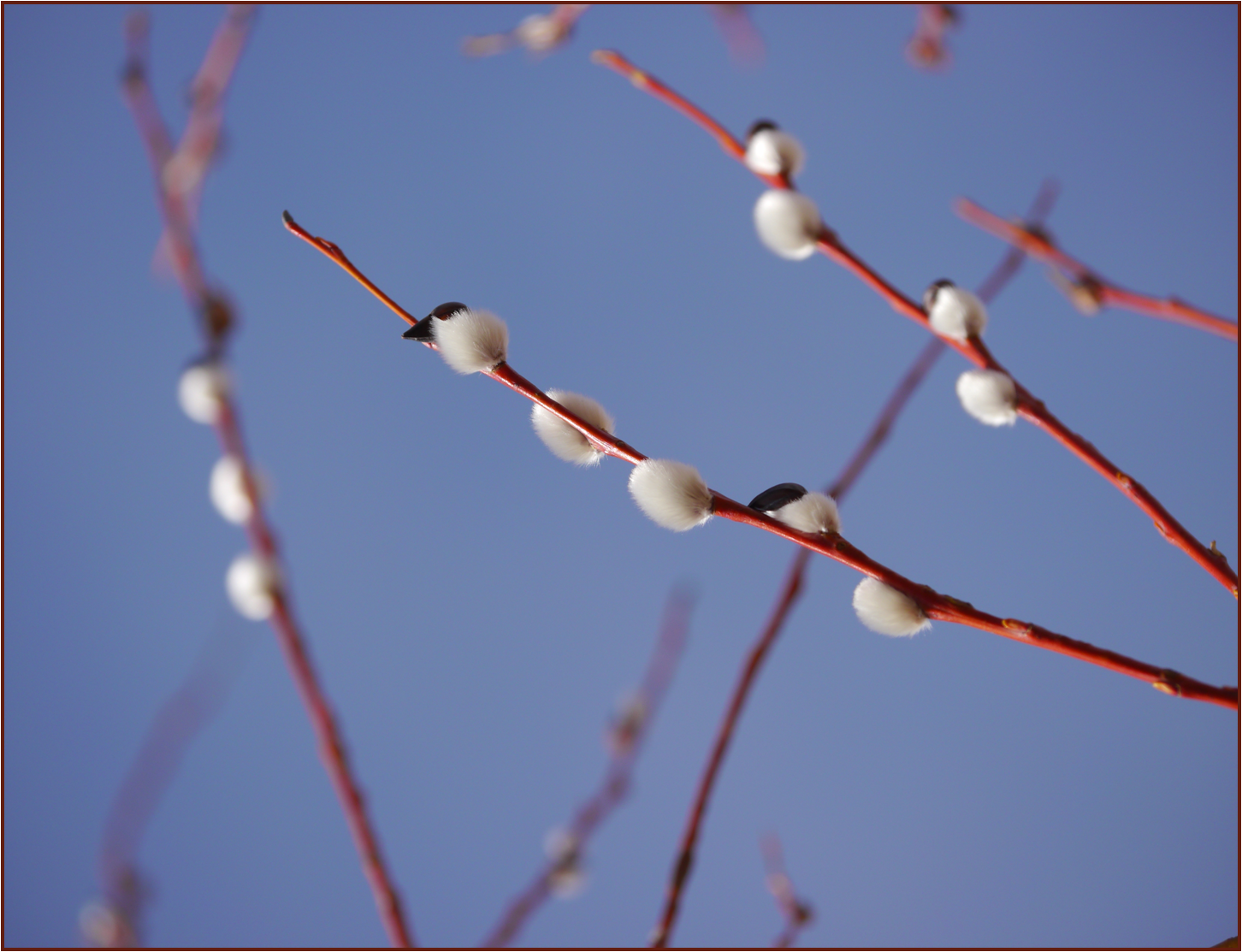
Of all the harbingers of spring, the native Salix discolor is for me the most poignant – this pussy willow resides in a school yard in Northwest Calgary and is covered in these sweet little fluff balls.
Photo: Pat Gaviller

The air is rich with new life and new possibilities – yes indeed spring is in the air.

Just look up!

Happy Spring,
Sue

© Sue Gaviller and Not Another Gardening Blog 2012.

Unauthorized use and/or duplication of this material without express and written permission from this blog’s author and/or owner is strictly prohibited. Excerpts and links may be used, provided that full and clear credit is given to Sue Gaviller and Not Another Gardening Blog with appropriate and specific direction to the original content.

Form, Colour and Texture in the Winter Garden

I had hoped to follow up with this second post on “Winter in the Garden” before now, but photo shoots take time, especially for a beginner photographer like me. However, this is Calgary and winter will be sure to hang around for a bit longer, so the topic is still timely.

In my last post I discussed Focal Points and their value in the winter garden. You’ll recall from that discussion, that a focal point refers to a ‘hard’ or non-living feature that draws the eye. We can also employ ‘soft’ or living elements in the garden to create winter interest – plant material that contributes form, colour and texture.

Form

Plants with strong architectural form offer a unique kind of winter interest – naked of foliage from fall through spring, their distinctive silhouette draws the eye in much the same way as a focal point, hence many of the same guidelines would apply: don’t overuse, make sure they are planted perfectly upright (they will sometimes lean over time so need to be straightened periodically) and stage them for maximum visual impact.

So what constitutes ‘strong architectural form’? There are a number of plant shapes that fit the bill.  I find that ‘weeping standards’ are among the most dominant of plant forms – small weeping ‘trees’ which are developed by grafting a pendulous or prostrate form onto a standard, e.g. Malus ‘Rosy Glo’, Betula pendula ‘Youngii’. These little beauties bring real elegance to a composition. Not surprising then that gardeners often make the erroneous assumption that because one looks awesome, two will look even better. More is better? This may be a great philosophy – when it comes to lobster, or cheesecake, but not here. I made this mistake in my own front yard a few years ago. On one side of the yard a Royal Beauty weeping crab took centre stage and I wanted something interesting to balance it on the other side. Off I went to the nearest greenhouse to look for the perfect garden addition. A beautiful Young’s weeping birch caught my eye. Oh yes, I thought, that will be perfect for that spot. I should really know better – in fact even as I stood in line I was having an internal dialogue: “Sue, you already have a weeping standard in the front yard – another one would be overkill”… “But, but it’s such a perfect specimen and the bark will look lovely against the cedar fence in the winter”. Well, the gardener won out over the designer – I bought it and had it planted within an hour. I guess it looked okay, but it didn’t take my breath away. The real effect was that each of the two similarly strong features diminished the impact of the other, even though they were 40 feet apart.

As I scrutinized this over the next few weeks, I eventually decided that it wasn’t ideal but it would have to do … for awhile anyway. It has of course, now been replaced – like I said I should know better. Weeping standards are definitely best used as single specimens. But enough about my garden challenges.

This attractive little Caragana arborescens ‘Walker’s Weeping’ has been nicely staged by underplanting with a Juniperus sabina cultivar and framing with 2 Juniperus scopulorum specimens – likely Wichita Blue. Photo: Sue Gaviller

Additional plant forms that are distinctive and provide winter appeal would be:

  • other top grafted standards, e.g. top-graft Syringa meyeri
  • columnar trees, e.g. Populus tremula ‘Erecta’
  • vase shape trees e.g. Caragana arborescens ‘Sutherland’, Malus ‘Pink Spires’
  • tall upright grasses e.g. Calmagrostis acutiflora ‘Karl Foerster’ or ‘Avalanche’
  • evergreen topiary e.g. Juniperus chinensis ‘Mint Julep’(pom-pom)

These can be used as single specimens, and with the exception of certain topiary forms (e.g. pom-poms), they can also be grouped, used to frame entrances/views or planted sequentially to direct visual movement and reinforce design lines. And while more than one can be used in a composition, they too if overused, will create visual unrest.

This ‘pom-pom’ topiary pine is appropriately used as a single specimen. Here, it needs very little staging as the detail on the house is an effective backdrop. The upright blue juniper supports visually too, although appears to have once been a topiary specimen itself – it would be best if allowed to revert to natural form so as not to compete with the pine. Photo: Pat Gaviller

This grouping of spire-like Populus tremula ‘Erecta’ creates a stately feel in an otherwise informal landscape. Photo: Sue Gaviller

The upright form of these Calamagrostis acutiflora ‘Avalanche’, effectively directs visual movement along the pathway in one of my client’s front yards. Photo: Sue Gaviller

Top-grafted standards like this Syringa meyeri, provide strong form while allowing a view beneath it to what lies beyond.

You can get away with using numerous strong forms if they aren’t all the same shape. For example when I removed the Young’s weeping birch, I replaced it with a Pink Spires Crabapple – a lovely vase shape tree. In front of this I placed a bird bath – these two together created a co-dominant ‘focal vignette’, completely different in appearance from the weeping crab. Hence the effect is that they support rather than compete with each other.

For the average gardener it can be hard to predict how certain plant forms will work together – just keep in mind that the more striking or unusual its form, the more likely it is that it will need to stand alone.

I will be discussing plant form in more detail in a later post, but in the meantime the best advice I can give you is to practice some restraint. (Really? Is that even possible for a gardener?)

Colour

There is of course a limited palette available to us at this time of year – let’s see, gray, brown, grayish brown, brownish gray, sometimes white, some green, a bit of blue. Anything else? Well yes actually – take a look:

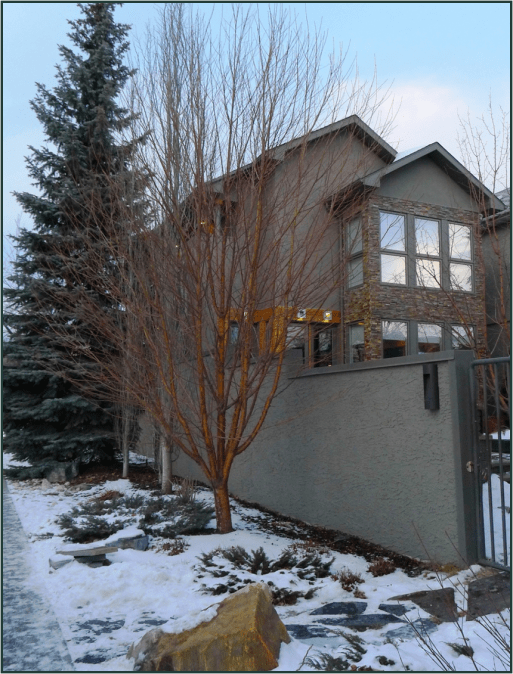
Many trees have colourful bark, in varying hues of green, yellow, orange, red and purple. These colours may be less saturated than the colours of summer, but because they are exhibited by an entire tree or shrub, the effect can be quite dramatic. Photos: Sue Gaviller

The beautiful bronze bark of this Prunus mackii picks up the warm hues of the wood and stone on the house. These same colours are seen again in the boulder in the foreground. Photo: Pat Gaviller

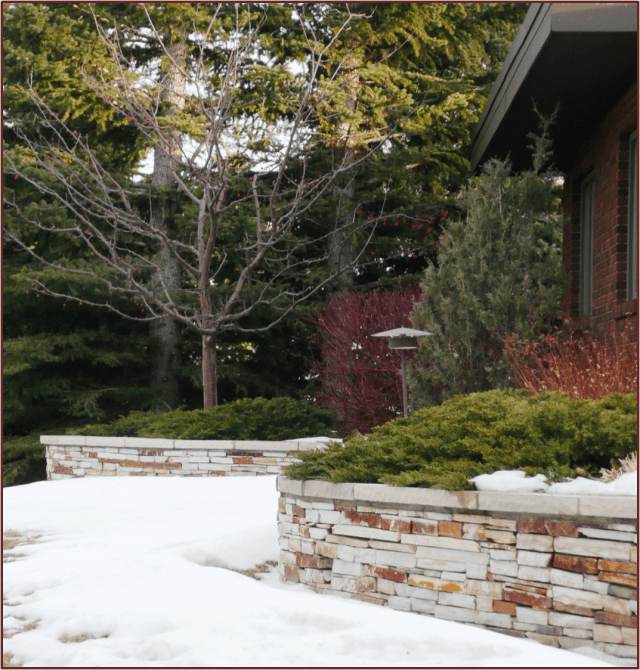
This landscape was also featured in my last post. I’ve included another photo, (minus the lopsided light fixture), because it’s an excellent example of how colourful a winterscape can be. Photo: Sue Gaviller

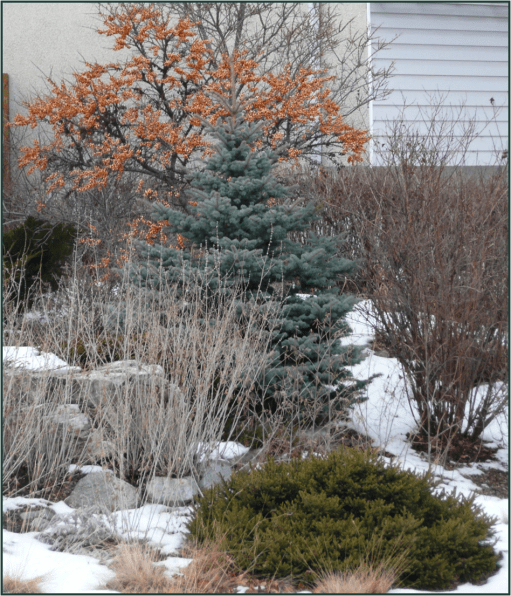
Berries too can provide winter appeal. The visual impact will be determined by the amount of fruit and it’s size – this may vary from year to year. As well, berries with little water content, like the above examples, will retain colour better through the winter than juicier fruits.

The abundance of Hippophae rhamnoides berries caught my eye when driving by this landscape – a good illustration of the use of form, colour and texture to provide winter interest. Photo: Sue Gaviller

While all conifers provide winter interest, it is the rich green of several Pinus mugo that enlivens this scene. Imagine how drab it would appear without them. Photo: Pat Gaviller

Evergreen Colour

I aim for at least 1/3 of the plant material in a composition to be evergreen – and I mean evergreen, not everblue. Not that I don’t love blue spruces and blue junipers – I do, and they should be used, but not to the exclusion of green. Blue-grey foliage has less pigment than green foliage, hence can contribute to the washed-out look of a winter landscape, especially in the absence of snow. If you’ve ever been to one of my Colour Theory lectures, you know my thoughts on green – it’s the most important colour in your landscape, the colour which allows other colours to have significance.

Green is the colour of life (plant life that is). It can tame the most unruly of hues, add visual depth and infuse richness into your landscape year round. So for every blue conifer you use, plant a few green ones. You’ll see how much more alive your garden will look in the dead of winter.

Texture

Textural contrast is another important consideration when planning your garden. Texture can be fine or coarse – during the growing season, fine texture generally refers to small leaves or flowers that are grouped closely together, and coarse texture would be large leaves or flowers spaced further apart. During the winter months though, we need to look at texture differently. Since most herbaceous perennials have little or no presence in the winter, and most deciduous trees and shrubs lose their foliage entirely, then it is the texture of their bark and branches we see. Spiraea and Potentilla, for example are fine textured – their branches are small, twiggy and tightly spaced. Syringa and Fraxinus (especially males) have much coarser texture – their branches are beefier, and more widely spaced. At any time of year too much tiny, tightly packed foliage, flowers or branches will end up looking busy, so punctuating with some coarse texture will create both emphasis and contrast.

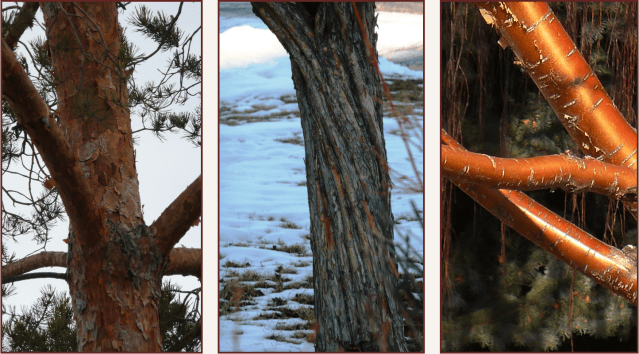
Texture can also refer to the surface of something – is it rough or smooth, shiny or matte. In the winter this will refer mostly to the bark of trees and shrubs.

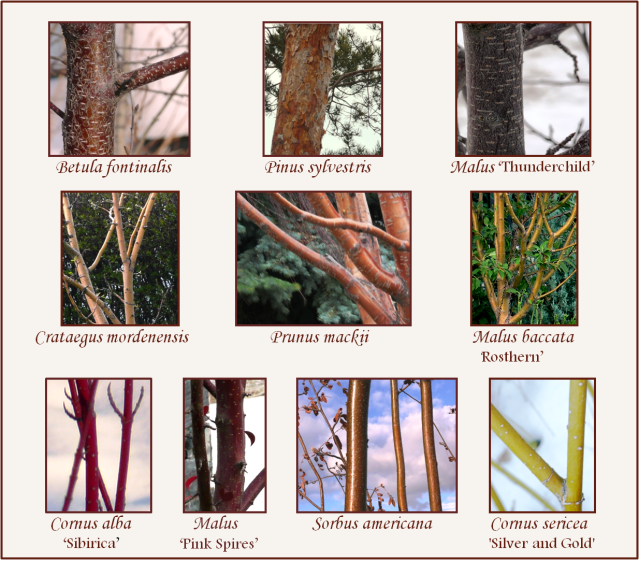
Compare the very different texture of the above three trees – the oddly flaking bark of Pinus sylvestris (left), the twisted striated bark of Crataegus mordenensis ‘Toba’(centre), and the shiny peeling bark of Prunus mackii (right). Photos: Sue Gaviller

Evergreen Texture

All evergreen foliage is considered fine textured – narrow needles spaced closely, and yet they appear texturally quite different. Some appear weightier than others – they may be denser or the needles longer, or stiffer. Use of contrast in this regard will produce superior results to utilizing a single type of evergreen. Yet another example of me not practicing what I preach – I have too many junipers in my backyard, with few other evergreen foliage types (that and my Rosy Glo has developed quite a lean).

These conifers are all fine textured, but they differ in perceived weight. The lacy foliage of Juniperus chinensis ‘Mint Julep’ (right), appears lighter and airier than the stiff needled Pinus mugo (left) and Picea pungens ‘Globosa’ (middle). Photo: Sue Gaviller

The beauty of winter is that it offers us a glimpse of colour and texture combinations that would be obscured in other seasons by branches clothed in foliage. Photo: Sue Gaviller

I invite you to open your eyes to the beauty that is winter – at least for a few more weeks.

Spring is coming.

Til then,
Sue

© Sue Gaviller and Not Another Gardening Blog 2012.

Unauthorized use and/or duplication of this material without express and written permission from this blog’s author and/or owner is strictly prohibited. Excerpts and links may be used, provided that full and clear credit is given to Sue Gaviller and Not Another Gardening Blog with appropriate and specific direction to the original content.

ANOTHER GARDENING BLOG … seriously?

Yes indeed – another gardening blog. Bear with me though, as I present a designer’s perspective of what is for some, a minor hobby, and for others an obsession so grand they forget to eat, bathe or feed their children: The Garden.

My intention had been to start blogging on Jan 1st – New Year, new endeavour. But honestly, I just couldn’t get excited about garden writing when the darkest days of winter were still upon us, regardless of the above average temperatures we’d been experiencing. Then when winter truly hit and we plunged into the deep freeze, so did any ambition to write about all things spring and summer.

Temperatures have since moderated – in fact the days are again unseasonably warm and the promise of spring is actually believable. There are still weeks of winter ahead of us though – Balzac Billy saw his shadow. Sooo… what better to write about than the garden in winter!

Many gardeners don’t see winter as a “gardening season” and I guess, considering nothing is growing at this time of year, we don’t really garden. But that doesn’t mean we can’t, or shouldn’t, design our gardens with winter in mind. In fact as a designer, when I‘m choosing plant material for a landscape plan, I always start with winter appeal – evergreen plant material, trees /shrubs with colourful bark or berries, plants with strong form or interesting texture. All these things allow us to extend the beauty of our garden-scapes beyond the growing season to fill much of the rest of the year.

These first blog posts then will address how we might plan our gardens for winter interest.

Focal Points in the Winter Garden

A Focal Point refers to an element in the garden that is constant, unchanging. This means it is a “hard” feature, i.e. non-living. A non-living element doesn’t grow, or change colour, or lose its leaves. It simply remains the same – drawing the eye and giving it a place to rest, throughout the seasons. Never is the importance of focal points more evident though, than during the dreary winter months when there is often little else to capture our attention. A well placed bird bath or piece of sculpture in the dead of winter can be as lovely as any summer garden scene, albeit more subtle. The presence of a focal point reminds us that the garden is still here, still beautiful in its simplified form.

But just plopping the aforementioned feature anywhere in the yard will not necessarily create the postcard winterscape we’re after – a focal point is most effective when properly staged. Too often I see a unique garden element with no visual support – stuck out in the middle of the lawn or a part of the garden that is completely barren from fall through spring. Of course everything is picture pretty when covered in snow, but in the austerity of a snowless landscape (as is often the case in Calgary), more artful planning is required. Plant material that maintains a presence throughout the year will provide an effective prop for your garden ornament. This means using woody plant material (trees and shrubs), ideally some of it evergreen, in the vicinity of or surrounding your focal point.

I drove by this garden recently while taking an alternate route home - this charming lady presents an elegant focal point and would be equally lovely even in the absence of snow. Photo: Sue Gaviller

I drove by this garden recently while taking an alternate route home – this charming lady presents an elegant focal point and would be equally lovely even in the absence of snow. Photo: Sue Gaviller

A single boulder, ideally with a unique shape and textural interest, can serve as a focal point. Photo: Pat Gaviller

A single boulder, ideally with a unique shape and textural interest, can serve as a focal point.
Photo: Pat Gaviller

Containers are a valuable addition to the winter landscape - the container itself serves as the focal point and also allows for the use of seasonal arrangements, as this homeowner has created. In this example the rocks play a supporting role rather than focal. Photo: Sue Gaviller

Containers are a valuable addition to the winter landscape – the container itself serves as the focal point and also allows for the use of seasonal arrangements, as this homeowner has created. In this example the rocks play a supporting role rather than focal. Photo: Sue Gaviller

This wintry scene as viewed from my back window illustrates how a focal point can be so well merged with its setting that it appears to have ‘grown there all by itself’. Photo: Sue Gaviller

This wintry scene as viewed from my back window illustrates how a focal point can be so well merged with its setting that it appears to have ‘grown there all by itself’. Photo: Sue Gaviller

Another photo taken by my sister on one of our walks - not sure if the colour of the gazing ball was purposefully chosen to echo the golden inflorescence of the reed grasses in the background, but the result is quite effective. Photo: Pat Gaviller

Another photo taken by my sister on one of our walks – not sure if the colour of the gazing ball was
purposefully chosen to echo the golden inflorescence of the reed grasses in the background, but the result is quite effective. Photo: Pat Gaviller

A focal point, in any season, can pull together an otherwise nondescript scene. This gazing ball is surrounded by woody and evergreen plant material surround, so will have the same effect in winter as well. Photo: Sue Gaviller

A focal point, in any season, can pull together an otherwise nondescript scene. This gazing ball is surrounded by woody and evergreen plant material, so will have the same effect in winter as during the growing season. Photo: Sue Gaviller

Bear in mind that your focal point needs to be level. If your bird bath is leaning, get out your level and straighten it, otherwise it just looks sloppy.

And don’t be tempted to overuse focal points – this is probably the most common mistake gardeners make with garden decor. Too many of these in close proximity will create competition for the viewer’s attention, hence visual unrest. So how many is too many? Unfortunately there is no formula for this – it depends on the particular focal point, the overall landscape design and the size of the area.  Generally speaking though, for an average size front yard, one bold focal point can deliver sufficient visual punch – there will be other “soft” (i.e. living) features drawing the eye as well. I’ll discuss these in my next post.

Consider too that there are superfluous elements in the garden that may inadvertently serve as focal points, e.g. a couple of my personal pet peeves – bright blue security system signs and outdoor lighting fixtures.  I don’t mean elegant post lamps or subtly placed spot lights – rather I’m referring to the cheesy sets of lights gardeners poke haphazardly into the ground, forgetting that the purpose of garden lighting is to draw attention to the lovely light that is cast, not the fixture that is casting the light. But more on garden lighting another time. As for security system signs, I appreciate that they serve an important purpose and hence need to be visible, but to me they are beyond visible, they are visually distracting– just keep this in mind when placing them.

I often pass by this well done landscape on my neighbourhood walks – though it’s especially attractive at this time of year, I doubt the homeowners intended for the light fixtures to be the focal point in this composition, especially since one is noticeably lopsided. Photo: Sue Gaviller

I often pass by this well done landscape on my neighbourhood walks – though it’s especially attractive at this time of year, I doubt the homeowners intended for the light fixtures to be the focal point in this composition, especially since one is noticeably lopsided. Photo: Sue Gaviller

Well, so ends my inaugural blog post. I realized when writing this that I ought to practice what I preach – the bird bath in my front yard could use some evergreen plantings around it. That will be my first purchase come spring. Ah yes, spring – so close … yet so far.

Till next time,
Sue

© Sue Gaviller and Not Another Gardening Blog 2012.

Unauthorized use and/or duplication of this material without express and written permission from this blog’s author and/or owner is strictly prohibited. Excerpts and links may be used, provided that full and clear credit is given to Sue Gaviller and Not Another Gardening Blog with appropriate and specific direction to the original content.