The Principled Gardener Part 4 – Unity by Interconnection

Over the last several months I’ve been discussing the Design Principle of Unity and how it can be incorporated into our landscapes and gardens. We’ve looked at Unity by Repetition, Unity by Dominance and Unity of Three. Today I wrap up this discussion with a look at one last way we can create unity in our gardens, with the use of Interconnection.

Interconnection refers to the practice of connecting or physically joining all landscape elements and spaces. Now you’d think that since the definition of Unity is oneness, that the idea of interconnection or joining would be a no-brainer, but I have trouble convincing gardeners of this one. It’s certainly harder to achieve if the basic layout of your landscape is already in place, especially the hardscapes (patios, walkways, etc.), but if you have the opportunity to physically connect all your landscape spaces, the result is very pleasing. So what do I mean by this? Let’s look at the example below. In the image on the left, a number of different landscape features – a deck with a hot-tub, patio with a fire-pit, and kidney-shaped island beds – are all floating disconnected in a sea of lawn. This composition lacks interconnection. The image on the right includes the same landscape features but the spaces are now all linked together, hence this landscape has been unified through interconnection.

Left: landscape lacks unity. Right: landscape is unified through interconnection. Note how the lawn in the composition on the left, is ‘negative’ space, i.e. the space between the landscape elements. In the image on the right, the lawn has become a landscape element and the planting space is now the negative space.

What this means fellow gardeners, is – brace yourselves – no island beds. I suspect therein lies the gardener’s grievance with interconnection – we do love our island beds don’t we? But think about it, the word ‘island’ by definition means disconnected. Just to be clear though, this rule doesn’t apply to acreages where very large island plantings are often employed as spatial definers – perhaps to separate the landscaped area around the house, from the ‘back forty’.  In this case the plantings are large enough that the eye doesn’t experience them as islands, so unity isn’t compromised. Neither would it apply to botanical gardens, or show gardens – again the plantings are too large to be seen as island beds, and are planned in such a way as to facilitate foot traffic for maximum viewing potential.

Interconnection can also be utilized to unify an individual planting space – disparate groupings of trees, shrubs and perennials can be underplanted with a single type of groundcover or other low growing plant. This connecting plant material brings the dissimilar groups into relationship with each other, therefore unifying the whole planting composition.

A mass of Arctostaphylos uva-ursi (kinnickinnick) covers this entire bed thereby connecting the plant material and creating unity. Photo: Pat Gaviller

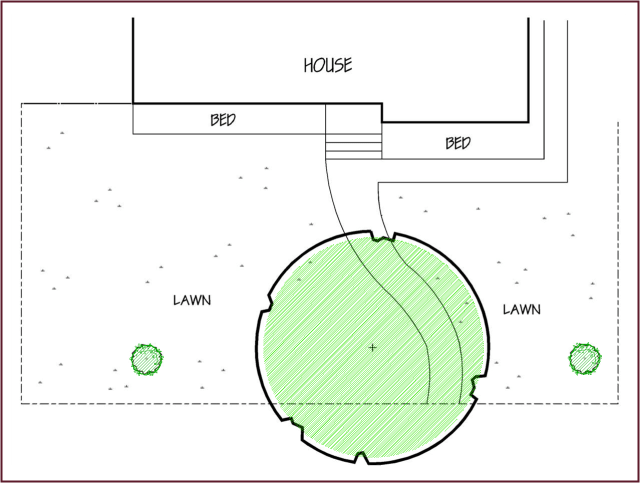
The idea of Interconnection is really underscored for me when I look at the evolution of my own garden. When we purchased our house almost 25 years ago, the only growing things in the front yard were two Cotoneaster shrubs, which the previous owner had tried in vain to kill, and a green ash tree, all of which were on city property. The only garden beds were small strips of soil against the foundation:

front yard 1

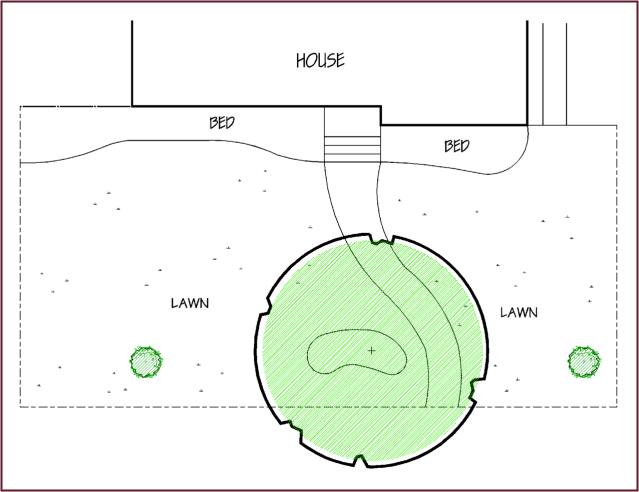
Over the next few years, I built upon these beds, first expanding the beds adjacent to the house and carving out a kidney-shaped bed around the ash tree:

front yard 2

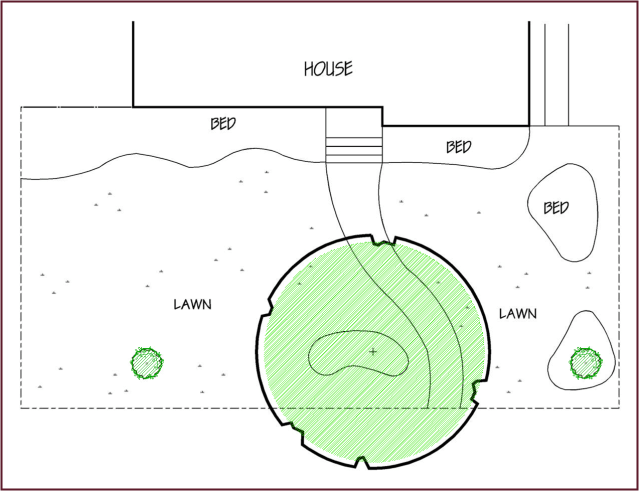
A year or so later I decided to make the bed in front of the house a little curvier and I added a couple more island beds:

front yard 3

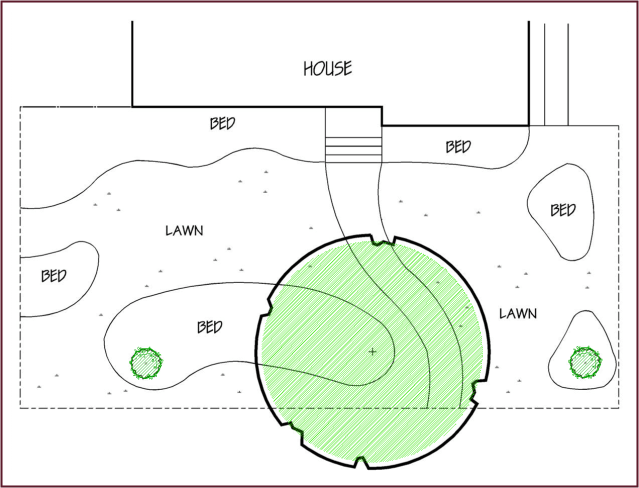
I kept adding and expanding until eventually it looked something like this:

front yard 4

I was never really happy with the design as a whole, even though each individual bed was nicely planted. When I’d stand back and try to take the whole thing in, what I saw was a bunch of scattered puzzle pieces – a disjointed picture, as if the puzzle was yet to be assembled. It wasn’t until I became a student of design that I discovered what the problem was; none of the beds were linked or touching, hence no interconnection = disunity. A number of years ago I decided to correct this and proceeded to join all of the beds.

front yard interconnected

It’s an improvement to be sure, but there are still flaws – a couple of acute angles which as you know is a design no-no. As well, due to the positioning of the sidewalk, the two sides are still unbalanced – but that’s a whole other story. In fact it’s a whole other design principle, that being the Principle of Balance which we’ll look at next month. Stay tuned.

Til next time,
Sue
 
© Sue Gaviller and Not Another Gardening Blog 2012. Unauthorized use and/or duplication of this material without express and written permission from this blog’s author and/or owner is strictly prohibited. Excerpts and links may be used, provided that full and clear credit is given to Sue Gaviller and Not Another Gardening Blog with appropriate and specific direction to the original content.
 

Has It Been Six Months Already?

Six months ago today I launched this blog – I didn’t mean to. I’d been preparing my first post – writing, inserting photos etc. I hadn’t even finished it, and I certainly hadn’t edited it for spelling or grammar, when I accidentally hit the Publish button. Oops! Lucky I hadn’t told anybody about the blog yet or that could have been really embarrassing. A month or so later I did the same thing – by that time though, I actually had some followers who get notification by email the moment I press Publish, and in some cases the email contains the actual post. Yikes, that is embarrassing! Anyways, in both cases I trashed the posts immediately, then finished them, edited and reposted. I also managed to trash some things I hadn’t intended to – good thing most of these were retrievable from the trash folder.

After a number of these little mishaps I thought to myself, ‘Maybe blogging is not for me’. My husband suggested I persevere and re-evaluate in 6 months – so here we are 6 months later and I’m doing just that. So what have I gained? Well for one, a hard-drive that’s almost full with the photos I’ve taken for this blog, not to mention the photos my sister has taken for me. And when I ask Pat to take a photo of a particular garden or vignette, she does so with zeal – from every conceivable vantage point, and at least 20, maybe 50 of each.  I have learned to do this as well – the more pictures I take of one thing, the better chance there is that I’ll get at least one that works……or not. So I go and take some more. One thing’s for sure – I’m becoming a better photographer. My eyes still glaze over when my sister talks about f-stops and apertures, shutter speeds and iso settings, but I know that I must learn about these if I want to continue to improve.

So what else have I gained? Of course some faithful readers and a handful of followers – to all of you, I say thank-you.  And to the bloggers who follow me, or ‘like’ me on Facebook, ‘ping’ me, or mention me in your blogs, I really do appreciate it. I can’t always repay the favour, but please know that every time I see that you have liked me, pinged me, followed me, or referred readers to my blog, I go right to your blog and visit for a while.

As for site stats, the number of daily views is growing, but it certainly isn’t boast-worthy. It’s enough though, that I know my efforts are appreciated. What I find particularly curious is the ‘Views by Country’ statistics – there have been views from over 70 countries, across 6 continents! Perhaps this isn’t noteworthy, but I just find it remarkable.  That someone from a culture and a climate vastly different from my own would find their way to this blog is, like I said, remarkable. I often wonder what these readers think (many of them garden in the best gardening climates in the world) when they read the humble ramblings of a Canadian prairie garden designer.

So why do I do this, this blogging thing? It’s hugely time-consuming, I don’t earn a living doing it and I’ve chosen not to accept new clients through it. It’s true I needed an on-line presence of some kind – I was never interested in advertising my design services on a traditional website, preferring instead to take clients by referral only. Nevertheless, as a landscape designer, instructor and speaker, I wanted to be able to refer students, prospective clients or workshop participants to my……….my what. Yes that’s it – my blog!

Still…….none of this is what motivates me to write. The truth is I write to give voice to the internal dialogue – that endless stream of  words that fills my head from morning ’til night. Those who know me know that I can be a tad verbose – indeed I always have so much to say.  I mean really, it’s taken me six paragraphs just to say, “I like to write. Thanks for reading!”

I know many of you visit this blog for design ideas and pretty pictures. Sorry, no design advice today – come back Monday though, for Part 4 of The Principled Gardener, as I conclude my discussion on Unity in Landscape Design. But just so you don’t leave disappointed, here’s a few pretty pictures.

Mid August in the garden. Photo: Sue Gaviller

A nice place to sit – one of those brake-stomping vignettes I periodically drive by. Photo: Sue Gaviller

A rainbow after today’s brief sunshower – it appeared just as I was about to publish this post. I’ll take that as a sign! Photo: Sue Gaviller

Thanks so much for reading,
Sue
 
© Sue Gaviller and Not Another Gardening Blog 2012. Unauthorized use and/or duplication of this material without express and written permission from this blog’s author and/or owner is strictly prohibited. Excerpts and links may be used, provided that full and clear credit is given to Sue Gaviller and Not Another Gardening Blog with appropriate and specific direction to the original content.

A Midsummer’s Daydream

If you could dream up the perfect perennial what would be on your wish list?

How about big beautiful blooms? Check.

Long blooming? Check.

Enormous selection of bloom colours, bloom-times, sizes etc.? Yes indeed.

Easy care? Definitely.

Tidy growth habit? For sure.

Handsome foliage? Yes please!

Anything else? Let’s see……..how about sweet but subtle fragrance? Yes definitely!

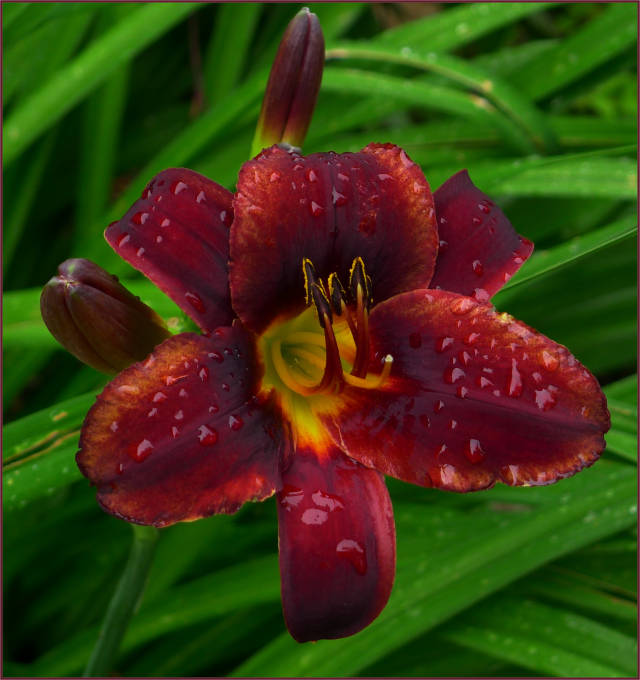
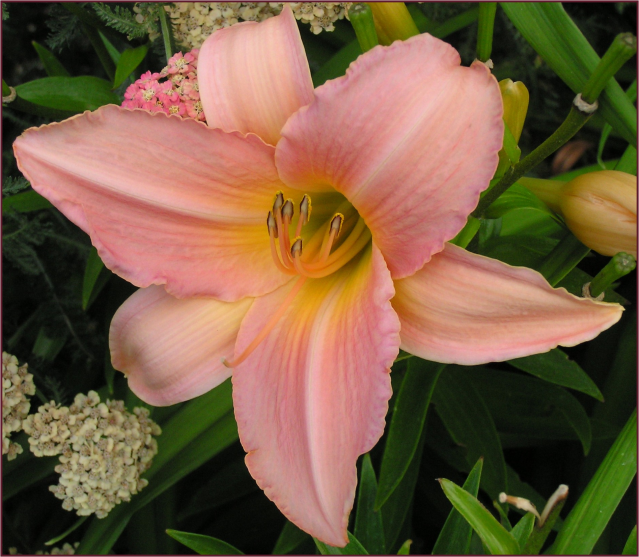
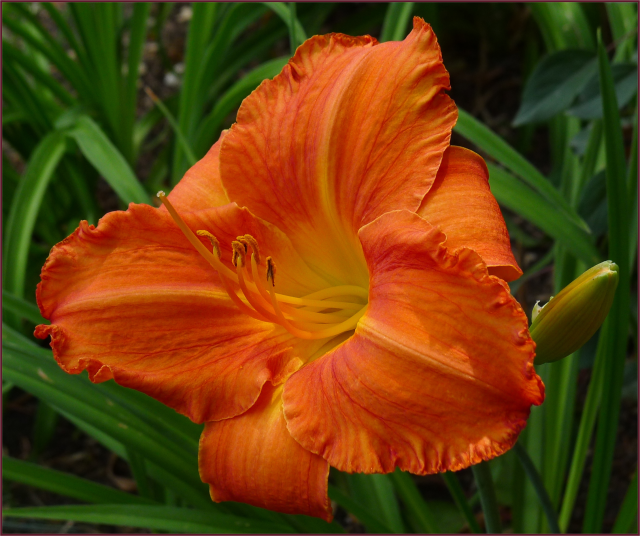
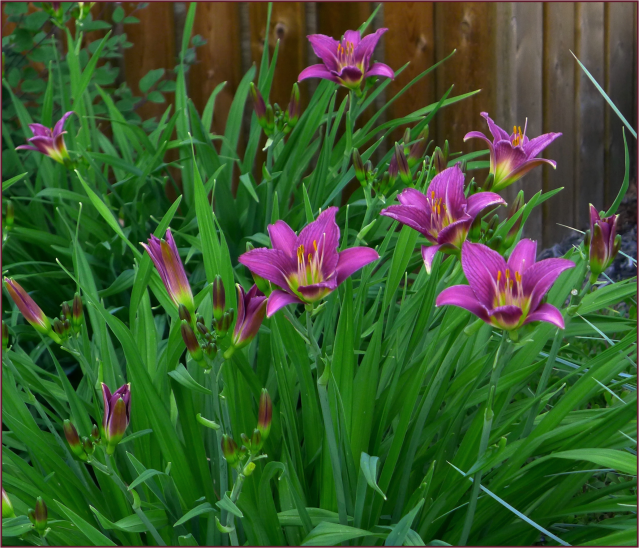
If only we could conjure up such a plant…..but alas it’s only a dream. Well maybe not; that dream plant sounds decidedly like Hemerocallis, the daylily – in fact this perennial has oft been called the ‘perfect perennial’. Hard to believe then, that there are those who claim not to like daylilies, scornfully referring to them as ‘ditch lilies’. Ouch, what a derisive term for such a beautiful, useful, reliable perennial!  As a designer, in a difficult climate, I can’t imagine the midsummer border without them. Some are even fragrant.  And they have few enemies, except for maybe hail but don’t get me started on that (I have yet to fully assess the damage from Sunday night’s storm). Granted, the daylily dissenters are likely referring to the tawny daylily, Hemerocallis fulva, that ubiquitous orange thing found in many a tired garden – but even it has its place.

Daylilies Reader Rock Garden resize

Hemerocallis fulva – that old garden variety daylily – can make a stunning statement when used effectively. Left: tawny daylilies line the sidewalk leading to Reader Rock Garden. Photo: Pat Gaviller. Right: beautifully paired with blue Delphinium. Photo: Sue Gaviller

This summer has been exceptional for Hemerocallis, at least in my own garden, which is home to numerous spectacular cultivars – every single plant is loaded with blooms.  But let’s revisit our wish list and see whether this ‘perfect perennial’ meets all of our expectations.

Big Beautiful Blooms

Generally speaking, daylilies are a large-flowered perennial – even the smaller cultivars have relatively big blooms compared to other perennials. Because the blooms are large, and profuse, the colour impact is significant, especially the brighter-hued selections. So don’t go wild with too many different colours blooming at once.

Strutter's Ball Daylily 2 resize

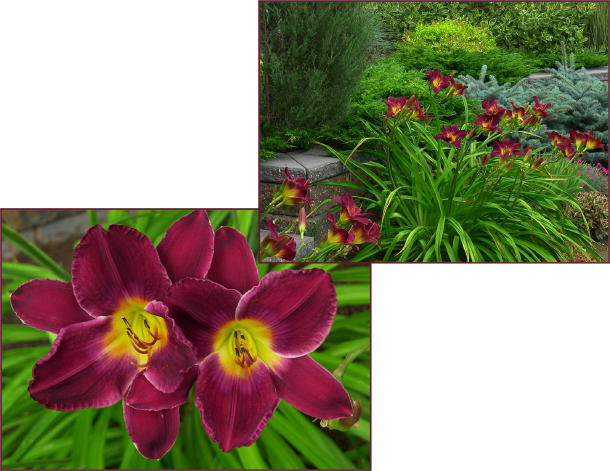
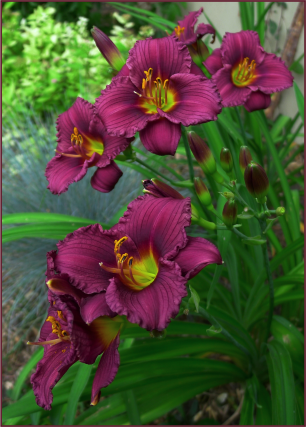
Hemerocallis ‘Strutter’s Ball’ is a big beefy daylily and can hold its own even when surrounded by mostly woody plant material. The velvety magenta flowers are huge and very showy.
Photos: Sue Gaviller

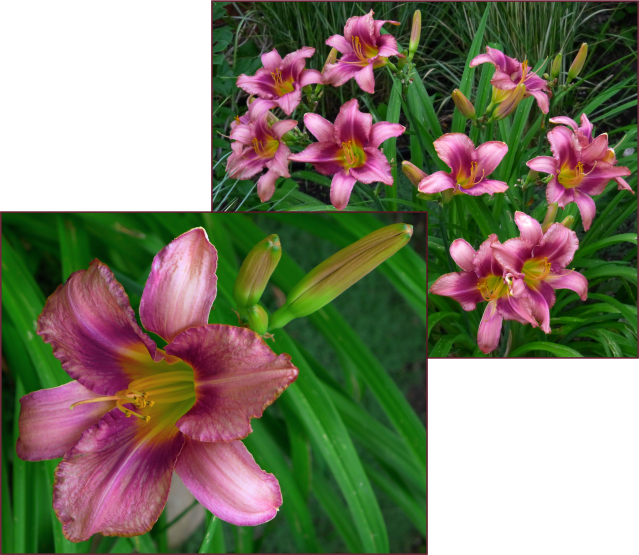
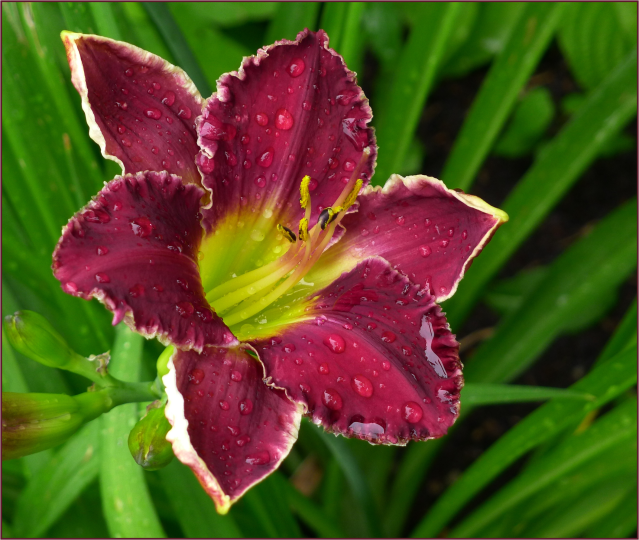
Hemerocallis ‘Purple Bicolour’ – a rather simplistic name for a stunningly unique cultivar. The soft rose-pink petals and sepals, and the wine-purple eye zone, merit a more exciting moniker. How about ‘Wine and Roses’ – a much more fitting name don’t you think? Photos: Sue Gaviller

Long Blooming

While each individual flower opens for only a day, there are so many buds on each branched scape that a single plant can bloom for weeks. And since there are early, mid-season, and late bloomers, daylily season is pretty much all summer long. As well, there are an increasing number of reblooming varieties that can rebloom several times throughout the summer.

‘Stella d’Oro’ was the first ever reblooming daylily cultivar. Her reliable bloom habit and dwarf form have made her a favourite of both gardeners and landscape professionals. Photo: Pat Gaviller.

Another reblooming cultivar, ‘Little Grapette’ is a dwarf selection. Though the blooms are smaller, they are profuse and richly coloured, so provide significant colour impact. Photo: Sue Gaviller

Enormous selection

Daylilies were once dismissed as pedestrian plants unsuitable for the sophisticated garden, but early in the last century they made a come-back with the introduction of new colours. This daylily renaissance marked the beginning of a new era in Hemerocallis hybridization, with cultivars now numbering in the tens of thousands – over 60,000 registered cultivars now exist! Breeding programs have produced a mind-boggling variety of colours – reds, oranges, yellows, golds, pinks, peaches, dark wines and purple-reds, near-whites and bicolours. Some have ruffled edges, some are fragrant, some dwarf and some huge. Early bloomers, mid-season bloomers, late bloomers and rebloomers……well you get the picture.

Much of the breeding has concentrated on producing new tetraploids – this refers to the number of chromosomes; 44 for a tetraploid, 33 for a triploid and 22 for a diploid. Those extra chromosomes result in stouter scapes and sturdier petals and sepals – thick and almost rubbery compared to the papery thin petals and sepals of non-tetraploids.

Chicago Antique Tapestry resize

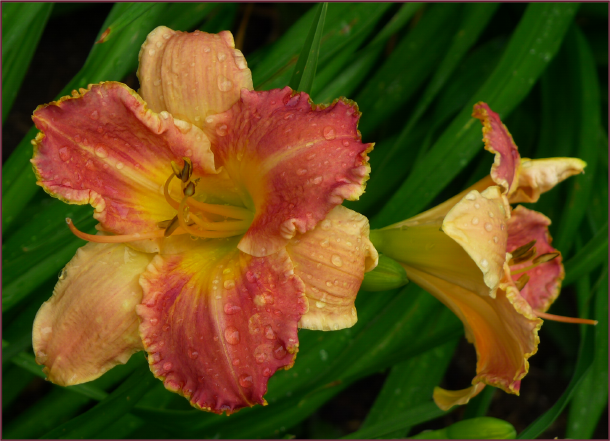
Hemerocallis ‘Chicago Antique Tapestry’ – a rare find, this tetraploid is a really classy cultivar. Huge, ruffled and mildly fragrant blooms – a real stunner. Photo: Sue Gaviller

Another tetraploid, Hemerocallis ‘Starling’ is a regal addition to the midsummer border, pairing well with the above mentioned ‘Chicago Antique Tapestry’. Photo: Sue Gaviller

Hemerocallis ‘Kitten’s Paw’ is bright peachy pink – a lovely tetraploid with characteristic sturdy scapes and firm petals. Photo: Cathy Gaviller

Ruffled, spicy orange Hemerocallis ‘Hot Embers’ – another stand-out tetraploid. Photo: Pat Gaviller

Easy Care

Daylilies aren’t fussy plants – they’ll be happy just about any place you put them. From zone 1 to zone 11, in sun or light shade, moist or dry, clay or sand, they will perform. They are sufficiently drought tolerant to be a staple in our semi-arid climate, but they will appreciate a little extra water when in heavy bloom.  Deadheading every day will keep the plants looking fresh – luckily this is an easy task as the spent blooms snap off easily. I can deadhead all of my 20+ plants in a matter of minutes. Hemerocallis is for the most part pest and disease free and requires dividing only occasionally. I’d call that pretty easy care.

Tidy Growth Habit

I’ve never owned a daylily that required staking or tying of any kind. Even the very tall cultivars like ‘Tetrina’s Daughter’ or ‘Autumn Minaret’ stand up nicely on stiff stems, despite being bloom laden.

Handsome Foliage

Hemerocallis has wide strap-shaped leaves that arch gracefully, so the plant has design value even when not in bloom. They are ideal for underplanting trees or focal points, edging around planting beds, massing, and filling in difficult areas.

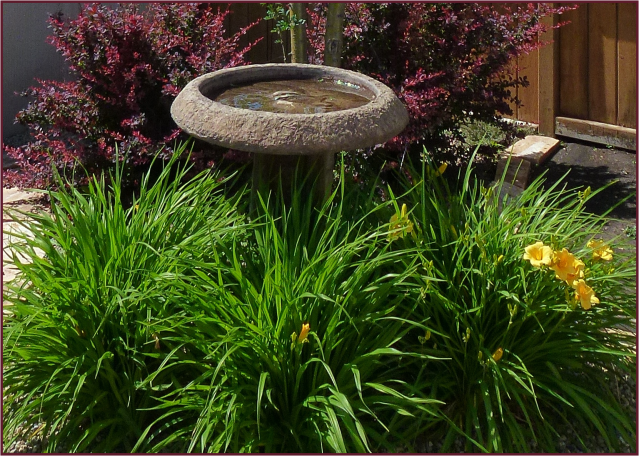
Grassy daylily foliage makes a nice underplanting, lending visual support to the bird bath. Photo: Sue Gaviller

A swath of dwarf reblooming Hemerocallis ‘Stella d’Oro’ is an effective way to plant a difficult space like this long narrow bed. When not blooming the arching daylily foliage still provides a simple elegant line. Photo: Pat Gaviller.

Sweet Subtle Fragrance

Many daylilies have a very pretty scent – some more so than others. It’s not overpowering, but if you’re standing or sitting nearby you’ll get a light bouquet on the nose.

Hemerocallis ‘Mary Reed’ is a dwarf cultivar with pretty mauve-pink blooms and a delicate scent. Photo: Sue Gaviller

Hemerocallis ‘Ivory Edges’ is by far the most fragrant daylily in my garden – strikingly beautiful as well. Photo: Sue Gaviller

When I awoke yesterday morning I peeked out the window to survey the devastation wrought by the previous night’s hail storm. Miraculously, what first caught my eye was cheerful daylily blooms – they seemed to be wishing me a beautiful day. How apt, since the word Hemerocallis comes from the Greek words hemera, meaning ‘day’ and kalos, meaning ‘beautiful’. May your day be beautiful – Hemerocallis!

Thanks for visiting – y’all come back now.
Sue
 
© Sue Gaviller and Not Another Gardening Blog 2012. Unauthorized use and/or duplication of this material without express and written permission from this blog’s author and/or owner is strictly prohibited. Excerpts and links may be used, provided that full and clear credit is given to Sue Gaviller and Not Another Gardening Blog with appropriate and specific direction to the original content.


The Principled Gardener Part 3 – Unity of Three

We all know three’s a crowd right? Right, but in design-speak that’s not a bad thing – in fact it’s a very good thing. Massing or grouping plants in threes or other odd numbers is good design – there’s something very pleasing about this configuration because it creates unity.

How so you ask?

Well first let’s look at what happens when we use even numbers – the eye wants to divide these in half…because it can. This visual division disrupts unity. If, on the other hand, we group elements in odd numbers the eye can’t divide this group and unity is therefore maintained.

Three Hemerocallis  ‘Stella D’oro’ and a bird bath make a lovely vignette. Photo: Sue Gaviller

Five Hosta sp. nestled amongst ferns and daylilies in this woodland garden. Photo: Sue Gaviller

Generally speaking odd numbers are preferable, but with larger groups (8 or more) this ceases to be important – the eye will automatically view these as a unified mass. So if you live on an acreage and have a shelterbelt consisting of 100 spruces, I’m not going to insist that you should have 99.

With larger plant groupings odd numbers are no longer required – the eye sees this grouping of Hemerocallis sp. as a unified mass, as it does the Heuchera sp. behind. Photo: Sue Gaviller

Don’t get carried away with threesomes though – if all your plant groups are trios, the composition will lack visual credibility and look somewhat contrived. Instead, use some groups of three, some fives or sevens and some singles.

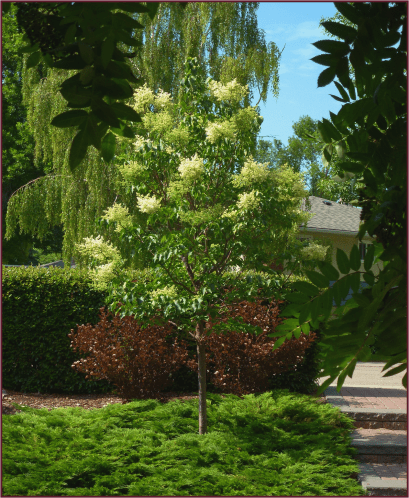
Two Physocarpus opulifolius ‘Summer Wine’ flank Syringa reticulata, creating a symmetrical backdrop. Photo: Sue Gaviller

So is there ever an occasion when even numbers are appropriate? Yes – as with all the design principles, it’s acceptable to periodically ignore a particular guideline, providing you know why. In other words it must be done with purpose. For example, if you want to ‘stage’ a feature tree, it could be flanked on either side by two smaller shrubs to create a moment of symmetry – this will draw attention to the more dominant feature.

Another example would be when plantings are used to reinforce a design line – in this case it doesn’t matter if even or odd numbers are used since the resulting visual movement trumps any tendency of the eye to break groups in two.

This planting plan contains several even-numbered plant groupings – in this scenario unity isn’t compromised because the plantings follow the design lines, hence the eye follows the same lines resulting in good flow.

Sometimes a group of three consists of three similar but not identical features, for example a grouping of boulders or containers.

This trio of containers, though not all the same size or shape, still provide unity of three because they’re all black ceramic and planted in a similar fashion. I chose the colour scheme based on the coral-coloured stucco and the black trim on my client’s house. This too provides unity – by repetition.  Photo: Pat Gaviller

Yes indeed three’s a crowd – ‘oddly’ satisfying isn’t it?

Yours,
Sue
 
© Sue Gaviller and Not Another Gardening Blog 2012. Unauthorized use and/or duplication of this material without express and written permission from this blog’s author and/or owner is strictly prohibited. Excerpts and links may be used, provided that full and clear credit is given to Sue Gaviller and Not Another Gardening Blog with appropriate and specific direction to the original content.
 

Yikes! Yellow Spots on my Lawn!

Well not yellow I guess – more like dead brown (is that a colour?) Those of you with dogs know of what I speak – we eloquently refer to these as ‘pee spots’. Since we garden in a dry climate in heavy clay soil, most of us have accepted that a lawn of putting greens quality is unrealistic, but the unsightly patches of dead lawn can undermine the beauty of an entire yard. So what can we do?

The Design Solution

Designing an area for Fido to ‘go’, whether a dog run, or a small space with a pea gravel surface (pardon the pun), may help keep the offending substance off your lawn. This space should be situated where it can be screened from view by either a fence or plantings. And for the sake of the neighbours make sure it is screened from their view too – and please clean up solid waste regularly (daily is best).

The amount of space you allot for lawn in your design can impact both the degree of urine burn as well as how you manage it. For example, having a large lawn space can potentially lessen the severity of damage because it is less concentrated in one spot. However, you will then have brown spots spread over a large area, thus the visual effect will be fairly broad. A small lawn area on the other hand, will sustain more concentrated damage but a smaller area of your design will be visually affected.

This circular lawn space is small and well delineated so resodding monthly is relatively easy.
Photo credit: Prairie Outpost Design

As well, a small lawn area lends itself easily to reseeding or resodding – a colleague of mine with a very large dog has a small circular lawn space which she resods once a month, when her lawn is more brown than green. Because the sod never puts down very deep roots it’s easy for her to roll up when it’s time to resod. In addition her lawn is bordered on one side by a low wall and the rest by an edging of pavers, so there’s no guess-work as to where the design lines are. She tells me it was designed this way purposefully – a small and well delineated lawn that’s easily replaceable so, in her words, “the whole yard doesn’t always look like sh**!”

The Horticultural Solution

Dog urine kills lawn because it is rich in urea, a nitrogenous waste product of protein metabolism. The effect is therefore akin to pouring full strength or insufficiently diluted fertilizer on your lawn, causing nitrogen burn. This is why there is a dead spot encircled with lush green – at the edges the urine is more dilute so the lawn responds as it would to properly mixed fertilizer.

If Fido does happen to relieve himself on your lawn you can prevent the ensuing dead patch by simply watering it down, thus diluting the nitrogen. You don’t have to water your whole lawn, just take note of where doggie pee’d and dump a watering can full of water on the area within 24 hours. Of course the bigger the dog the larger it’s liquid waste capacity. This will in part determine how much water you’ll need to effectively mitigate the damage, as will the overall water content of the soil at the time – you’ll notice that during rainy periods the incidence of ‘pee spots’ is somewhat reduced.

The Culprit – hard to believe this sweet brown beauty is responsible for so much damage to my back lawn.
Photo: Pat Gaviller

Since we can’t always be on guard to witness all dog spots in the making, we will invariably still find ourselves gazing upon dead patches on our lawns. There are a number of remedies for this:

  • Zeolites – have the ability to absorb nitrogen, hence can bind the excess. This can work preventatively as well.
  • Sugar – sugar is a source of carbon for denitrifying bacteria in the soil, hence sprinkling a bit on the dead spot may aid these bacteria in removing the excess nitrogen.

Depending on the type of grass and the severity of the damage the above two suggestions may be enough for the grass to rejuvenate or fill in fairly quickly. Otherwise you can do one of the following:

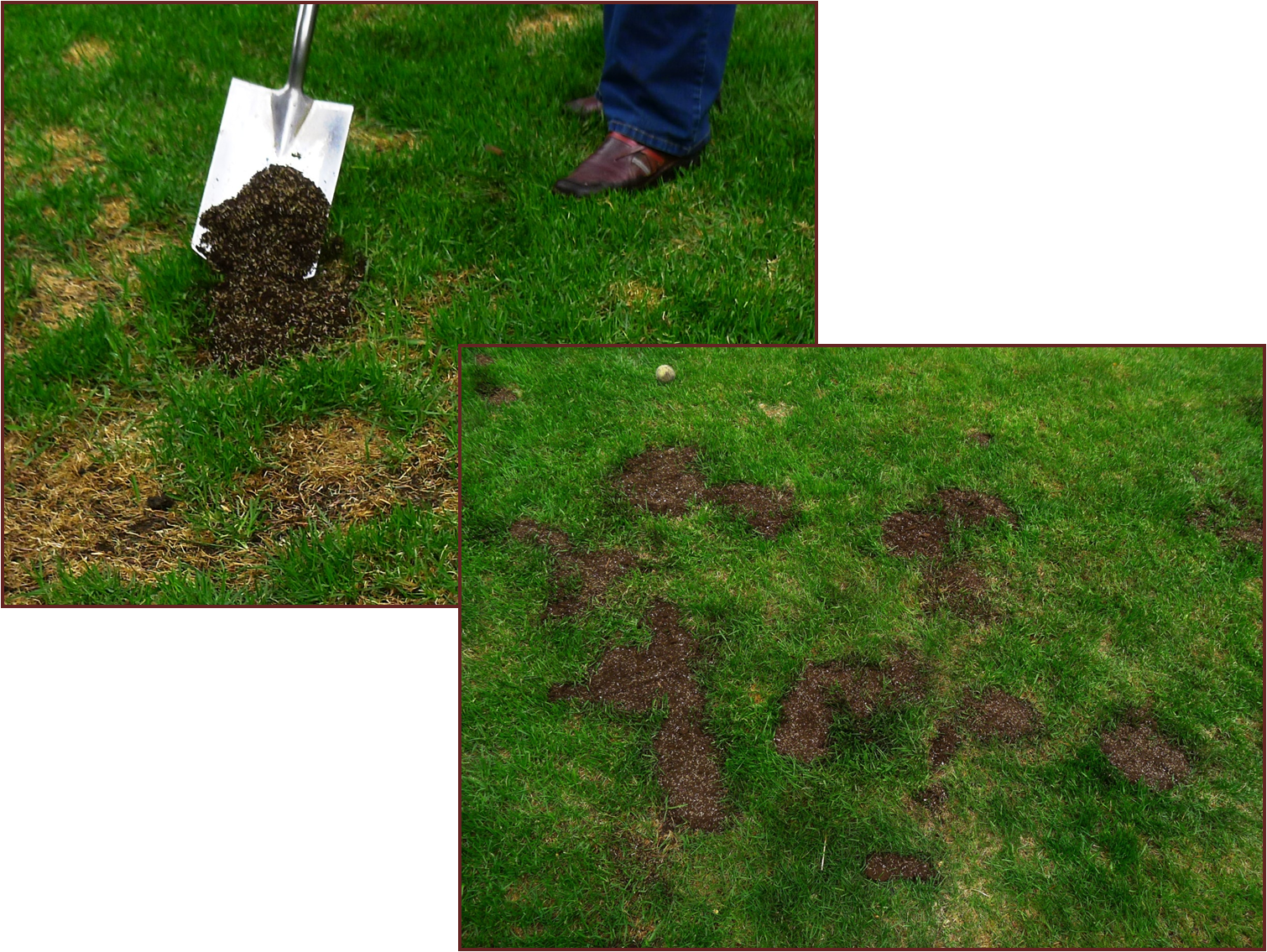
  • Reseed the area – I mix loam and grass seed 2 to 1 and apply the mixture to each spot. Seed germinates within 7 to 10 days. I repeat this process whenever there are a number of spots.
  • Resod – this doesn’t have to be the wholesale resodding I mentioned earlier in the post. Just cut out the dead patches and replace with a piece of sod cut in the same shape.

A mixture of grass seed and loam is applied to dead patches, gently tamped, and watered daily – seed should germinate within 2 weeks. Photo: Pat Gaviller

2 weeks later – grass seed has germinated and is filling in nicely.

The Other Solution

In addition to the above-mentioned preventative and remedial actions, Fido himself can be part of the solution. This of course requires an expert’s take, in a field other than my own. Enter Pat Gaviller, veterinarian and self-proclaimed ‘dog advocate’. Please read on for more ideas on facilitating a peaceful coexistence between our lawns and our four-legged friends.

Yours,
Sue
 

GOOD BOY FIDO

by Pat Gaviller

How does Fido become part of the solution? With your help of course – for Fido to be a good boy (or Fifi to be a good girl), you have to step up and do some training. Luckily this is quite easy, especially if you start young. However even an old dog can learn new tricks.

The Training Solution

First it helps to know that puppies develop substrate preference – the surface on which they prefer to pee – at the age of 8 ½ weeks. So, think ahead and right from the start have your puppy peeing on the same surface you’ll want him (or her) peeing on in the long run – it will make training easier. It can be a bit of a challenge if during this narrow time window the ground is covered with snow (there’s not much snow around in the middle of July). But necessity trumps preference, and dogs can be retrained – have you ever seen a dog frantically looking for that last patch of melting snow to pee on? Now you know why!

Step 1: you’ve chosen what you want your dog to pee on. Step 2: decide where – dogs also become habituated to a general bathroom location. Step 3: take your puppy to the chosen bathroom area – frequently – practice makes perfect. To quote Jean Donaldson from the book The Culture Clash, (a highly recommended read for anyone wanting a well-trained, well-socialized dog): one requires a “solid history of rewarded trials in the desired location, the yard”, or the run, or wherever you’ve sited his bathroom. This brings us to Step 4 – the reward. Of course for reward one can use the obvious – food; but don’t forget that simply relieving the full bladder is also a reward in itself, and going for a walk afterwards is yet another. Vary your rewards for the best chance of success. For those who are highly motivated you can now move to step 5 – elimination on command. Although for perfect execution the command should be given the moment before the dog starts to pee, for most of us this is can be a somewhat daunting challenge with a new puppy. Not to worry – from personal experience it works pretty well if you just say the command the moment you notice your puppy (or grown dog for that matter) start to pee, i.e. “Go Pee”; wait til he/she’s done; “Good Dog”. Repeat every time puppy pees – of course preferably in the desired location…. This is classical conditioning. After a couple of weeks of saying “Go Pee” when puppy is peeing, you can try saying it before puppy pees, but when you know he/she has a full bladder. Voila – puppy will likely perform. This comes in quite handy in a variety of other situations too – and you’ll be sure to impress your friends!

A word of caution here: once Fido & Fifi are dutifully eliminating on command, do be careful on how you phrase a question to them. In other words, if the command is “Go Pee” and you ask them “Do you have to Go Pee?” they will only understand the words they know. And they may simply ‘Go Pee’ instead of waiting ‘til they get to the chosen bathroom area. To avoid confusion use phrases like “Do you need to go outside?”, or don’t ask, just take them. Truth be told we natter away at our pets far too much as it is and like our kids, they learn to tune us out after awhile.

And I feel compelled to add a few comments on dog run etiquette for those who choose to use this option.

  • Please don’t abandon Fido & Fifi in the run for long periods of time while the rest of the family enjoys the comforts of the house. They need and want your companionship.
  • Don’t leave Fido & Fifi out in the run all day while you’re at work – this is asking for trouble with barking problems. Respect your neighbours and avoid noise-bylaw fines.
  • Clean up after your pet daily. Feces left in the run create more than just odour issues for you & your neighbours. As the feces dry up, small bits of fecal material and the bacteria & parasites they may contain, can blow around in the wind resulting in health hazards for both humans and dog. Gives a new perspective on ‘dust devils’ now doesn’t it?

Mars vs. Venus

It’s time to put to rest once and for all the myth that female dog urine burns the grass and male dog urine doesn’t. The only difference between male and female dog urine is the presence of a few hormones and pheromones, which have absolutely no effect on our grass. Fido & Fifi are very interested in these minute differences because they can smell them. And I’m sure they can also figure out what each other had for dinner via the same method…..but I digress. The reason Fifi’s urine is typically more damaging to our lawns is purely a volume and directional issue. Fifi usually goes all in one spot, directly on the ground. Meanwhile, Fido is on a mission marking his territory. He’s lifting one hind leg & spraying his urine, a little here, a little there – some of it hitting the ground, but much of it on more vertical surfaces like trees, shrubs, gates, fences, or the proverbial fire hydrant. This makes it easy for any other dog passing by to catch a whiff close to nose height. And Fido only does a little in each spot to make sure he has enough to go around. It’s Fido’s behaviour that spares your lawn, (and kills your junipers…) not some magical difference in his urine.

Given that Venus is at various times either the morning star or the evening star, I might as well also address here the ‘difference’ between morning and night urine. Yes, there can be a difference, though it will vary from dog to dog depending on diet, time of feeding, and kidney function. Typically the first urination of the morning has the potential to be more damaging for 2 reasons: 1) It’s usually a large volume – the dog hasn’t been out all night and hence has a full bladder; and 2) most dogs sleep through the night, without drinking any water and therefore the kidneys concentrate the urine to prevent dehydration. A high volume of concentrated urine is a recipe for lawn damage. When Fido & Fifi eat, they also drink more. And if they’re lucky the day’s activities have also allowed both an increased water intake plus more access to outdoor elimination areas. Increased water intake lowers urine concentration, and increased frequency of elimination may lower urine volumes, both of which give our lawns a bit of a break.

There’s an App for That

Yes, for those with neither the time nor the inclination to deal with this issue in any of the aforementioned ways, or even as an adjunct to the above methods – there’s always Greenum. Greenum is a commercially available, natural supplement available at your local vet clinic as well as many pet stores. Made by “Mark & Chappell” the tablets contain Brewers Yeast, Flaxseed Oil, DL-Methionine (an amino acid), and Yucca schidigera extract. It is the last 2 ingredients that help reduce the ‘lawn-burn’ effect of dog urine. DL Methionine acidifies the urine (don’t think vinegar, just less alkalinity), and the Yucca extract binds the ammonia in the urine. Less alkalinity + less ammonia (less nitrogen source) = less lawn burn.

Greenum is available in a beef-flavoured tablet form as well as tasty treats. There is a spray too – but the spray is applied to the lawn, whereas the tablets and treats are given to Fido & Fifi. Greenum is safe for pets and the environment. In fact if you overdose by 2x you simply nullify the effect. The tablets are available in different sizes for different size dogs; treats come in 1 size only. As with any supplement – natural or otherwise – you should still consult your vet before starting your pet on Greenum, especially if the pet is already on other medication.

So there you go – greener lawns and a peaceful coexistence with Fido & Fifi.

Have fun,
Pat
 
© Sue Gaviller and Not Another Gardening Blog 2012. Unauthorized use and/or duplication of this material without express and written permission from this blog’s author and/or owner is strictly prohibited. Excerpts and links may be used, provided that full and clear credit is given to Sue Gaviller and Not Another Gardening Blog with appropriate and specific direction to the original content.

Curtain Call – Farewell to Sweet Syringa

So y’all know how much I love lilacs. Well I’m sad to say they are nearing the end of their bloom period, so I wanted to give you a look at the closing act before the curtain is drawn on another season.  I know, enough with the lilacs already – I assure you though, today will be my last post on this loveliest of blossoms (at least for this year) and I promise to keep it short.

Syringa reticulata – Japanese Tree Lilac

These gorgeous, very late bloomers have been flowering for a week or so in our part of the world. They weren’t in bloom for my June lilac post but they are so utterly stunning this year, that I had to bring them to your attention. The Japanese tree lilac is the last of the lilacs to bloom and has some unique characteristics not shared by others in the genus:

  • They are a true tree, as opposed to a large shrub that gardeners prune into a tree ‘shape’ and labour to maintain.
  • The bark is a dark chocolate-brown with very noticeable lenticels.
  • The flowers are borne in panicles like all other Syringa species but have much finer texture, their feathery appearance in striking contrast to the large shiny leaves.
  • The scent isn’t recognizably lilac; it’s hard to describe, but if you get a whiff of something sweet and a bit spicy, like vanilla with a hint of anise, look around – there’s likely a tree lilac in the vicinity. Their bright white blooms make them easy to spot.
  • There is even a variegated cultivar which blooms later still (mine is just coming into bloom now) – ‘Golden Eclipse’ has large green and gold leaves.

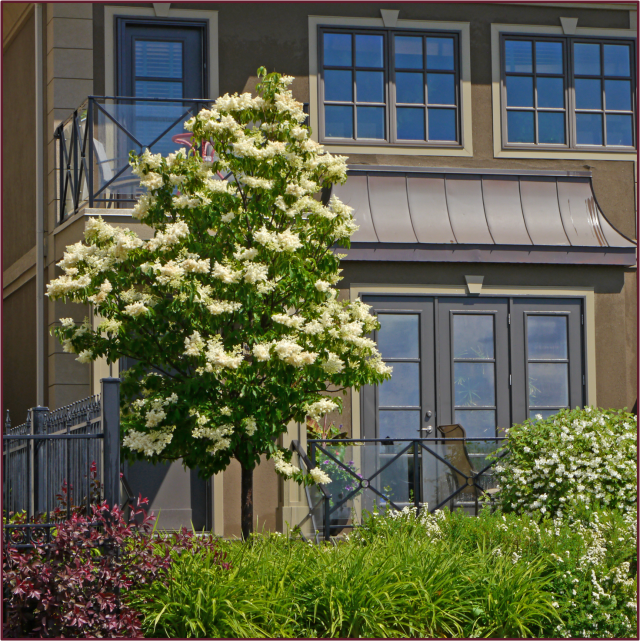
Intense white blooms cover this compact tree. Photo: Pat Gaviller

Soft fluffy blooms, dark green foliage and richly textured, chocolate-coloured bark make the Japanese tree lilac a must-have in the urban landscape. Photo: Pat Gaviller

Full feathery plumes light up a sapphire sky. Photo: Sue Gaviller

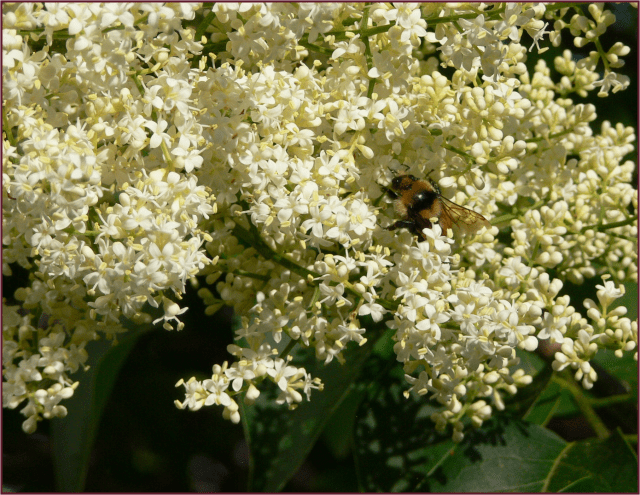
Syringa reticulata, with its honey-sweet scent is a favourite of bees and butterflies. Photo: Cathy Gaviller

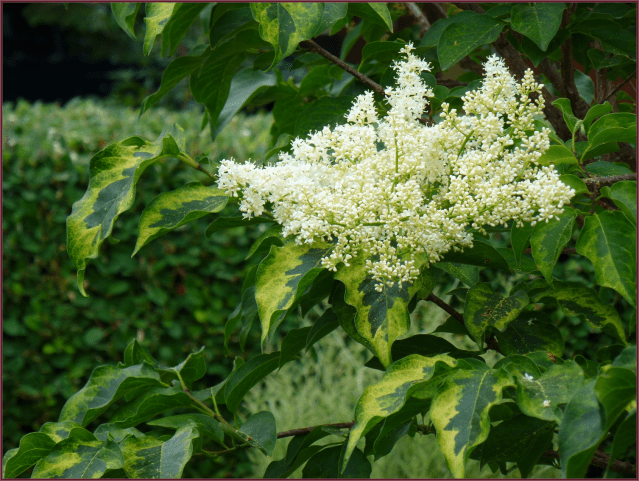
Syringa reticulata 'Golden Eclipse' is a very hardy variegated cultivar - leaves on new growth emerge dark green splashed with lime and older growth has bright green and gold variegation. Photo: Sue Gaviller

Syringa reticulata ‘Golden Eclipse’ is a very hardy variegated cultivar – leaves on new growth emerge dark green splashed with lime and older growth has bright green and gold variegation. Photo: Sue Gaviller

Sum it all up and you have a great specimen tree – a tree with four season interest. The Japanese tree lilac has real design value and in my opinion is greatly underutilized in the landscape. It’s perfect for use as a dominant feature – for its elegant form (particularly if multistem), its colour (especially Golden Eclipse) and its coarse texture.

Syringa reticulata is a worthy closing act to a truly fine show that began 6 weeks ago – the lilac show.

So say goodbye to sweet Syringa – may their scent be with you.

Sue
© Sue Gaviller and Not Another Gardening Blog 2012.
Unauthorized use and/or duplication of this material without express and written permission from this blog’s author and/or owner is strictly prohibited. Excerpts and links may be used, provided that full and clear credit is given to Sue Gaviller and Not Another Gardening Blog with appropriate and specific direction to the original content.

The Principled Gardener Part 2 – Unity by Dominance

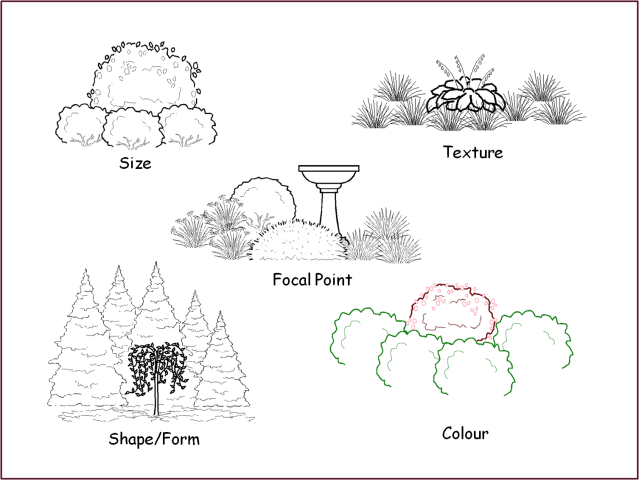
Well here we are the last Monday of the month and time for your monthly measure of design doctrine. Last month, in Part 1 of this series, I discussed Unity in the garden and how it can be achieved using repetition. Continuing our discussion on Unity then, let’s look at the use of Dominance. By this I don’t mean standing over your plants, whip in hand, ordering them to behave themselves – nope, in fact a plant may get to do the dominating. Dominance occurs when one element or group of elements stands out or is more prominent than others.  The dominant feature may be a plant, a design line or space, or a non-living element. It can be dominant by way of its size, its shape, its colour, its texture or because it is a Focal Point (a Focal Point refers to a non-living element such as a bird bath or fountain.)

Dominance in the landscape can result from larger size, coarser texture, stronger form, stronger colour or the existence of a focal point.

Dominance in the landscape can result from larger size, coarser texture, stronger form, stronger colour or the existence of a focal point.

The arching purple branches of Berberis thunbergii ‘Rose Glow’ stand out against the softer greens of surrounding foliage. Photo: Pat Gaviller

A good design concept will have a hierarchy of spatial sizes with one dominant space. Here the lawn area in the centre is dominant as it is the largest design space.

A good design concept will have a hierarchy of spatial sizes with one dominant space. Here the lawn area in the centre is dominant as it is the largest design space.

The circular lawn area is the dominant space here because it contains the only arc in an otherwise angular concept.

The circular lawn area is the dominant space here because it contains the only arc in an otherwise angular concept.

The symmetrical planting (Hosta ‘Guacamole’ and Heuchera ‘Plum Pudding’) around this bird-bath enhances its role as focal point. Photo: Sue Gaviller

A garden devoid of any moments of emphasis can be visually unrestful as the eye tends to just wander. A dominant feature however will draw the eye and steady it, allowing it to rest. This is another concept that gardeners often intuit early on, but lose sight of later – myself included. When I purchased my first bird-bath and placed it in the garden, I indeed noted a more cohesive, restful composition – so I bought another. Then I found a beautiful earthenware bowl, filled it with water and nestled it amongst some groundcover in my shade garden. My husband asked me “What is it with you and round things filled with water?” Good question. The truth is I’d given in to the gardener’s favourite mantra “more is better” and rendered ineffective the dominance I’d unknowingly applied with the initial bird-bath. A single strong feature demands attention. Too many strong features compete for attention.  This too can create unrest in the garden as the eye bounces around between competing elements.

Unfortunately there’s no dominance metre to tell us when enough is enough. Just keep in mind that the stronger the colour and/or the form, the more dominant it will be, hence the fewer of these elements your garden can support.  For example, weeping standards such as Young’s weeping birch or Walker’s weeping Caragana, have very strong architectural form thus should always be used as single specimens, whereas vertical accents like columnar aspens or tall reed grasses, though still fairly dominant, can be repeated a couple of times or used in small groups. Warm vibrant colours like bright yellow or lime green will really draw the eye so should be used with some restraint whereas cooler, less intense colours can be used more generously.

The key is to use elements within your garden composition that are dominant for different reasons – maybe one has brilliant colour, another is a small group of very coarse textured plants and another has unique form. Or maybe there are several that are dominant because of their unique form but they are very different forms. While each one will draw the eye, they tend to lead the eye from one to another rather than rival each other. As well, a single dominant feature will often stand out for several reasons, for example it may be larger and more colourful and have unique form, making it particularly dominant. And you can help your focal point or feature tree take centre stage by surrounding it with more subdued elements.

Good placement of dominant features is also important. Anywhere the eye is naturally drawn, like the deepest part of a curve or through a visual opening, is an obvious spot to situate a strong feature. The space where design lines form a visual frame is another good location, as is an area you want to draw attention to – your front door for example. Remember too, that some of these elements – focal points or feature trees and shrubs – will have a presence in the winter as well, so make sure they are visually supported by other woody plant material. For more ideas on Focal Points and dominant plant forms as they are experienced in the winter months, check out a couple of my earlier posts: Focal Points in the Garden and Form Colour and Texture in the Winter Garden.

Malus ‘Rosyglo’, with its elegant form, takes centre stage in the foreground while Syringa prestoniae dominates the background. Note the placement of the two features – Malus is framed by the curving design line and Syringa is situated at the deepest part of the curve. Both are well staged by subdued plantings of Juniperus sabina cultivars. The junipers will serve as visual props for these features in the winter. Photo: Sue Gaviller

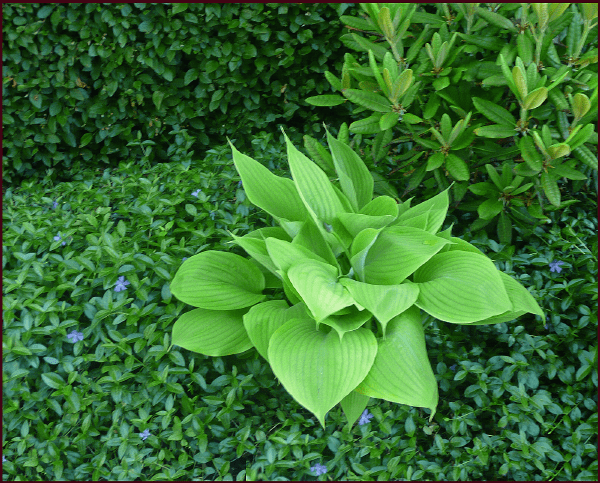
Hosta 'Sum and Substance' stands out because of its very coarse texture (large leaves) and its bright lime green colour. Photo: Sue Gaviller

Hosta ‘Sum and Substance’ stands out because of its very coarse texture (large leaves) and its bright lime green colour. Photo: Sue Gaviller

While too many dominant elements in close proximity is bad design, there are scenarios where several strong features can be present together in a co-dominant relationship – for instance a vase shape tree with a bird bath in front of it. One may be slightly more dominant than the other but the effect is that they appear as a single focal vignette, not two competing entities.

A container filled with brightly coloured annuals is quite dominant on its own, as is the top graft Picea pungens 'Glauca Globosa', however because they are so different, their proximity to each other is mutually supportive rather than conflicting. Photo: Sue Gaviller

A container filled with brightly coloured annuals is quite dominant on its own, as is the top graft Picea pungens ‘Glauca Globosa’, however because they are so different, their proximity to each other is mutually supportive rather than conflicting. Photo: Sue Gaviller

The dominant feature brings unity to the garden by subduing all other elements in its presence, hence unifying them in their shared secondary status.

A dominant feature like this gazing ball focal point, can pull together an otherwise nondescript scene, thus creating unity and harmony in the garden. Photo: Sue Gaviller

So go out and buy yourself a graceful weeping standard like Malus ‘Royal Beauty’ – but just one. Indulge yourself with that beautiful bird bath – but just one. You’ll see how creating areas of emphasis can bring about peace and harmony in your garden.

Yours,
Sue
© Sue Gaviller and Not Another Gardening Blog 2012. Unauthorized use and/or duplication of this material without express and written permission from this blog’s author and/or owner is strictly prohibited. Excerpts and links may be used, provided that full and clear credit is given to Sue Gaviller and Not Another Gardening Blog with appropriate and specific direction to the original content.

Father’s Day Plant Pick

Syringa vulgaris  ‘Ludwig Spaeth’

Syringa vulgaris ‘Ludwig Spaeth’. Photo: Sue Gaviller

After my last post extolling the virtue of lilacs, it should come as no surprise that my plant pick for this past week was a lilac. This handsome fella was also featured in that post. Why so enamoured am I? Well for one, the colour – intense, dark red-violet buds open to gorgeous, slightly softer hued florets. As well, Ludwig Spaeth is a very early bloomer – in my garden the first florets open up about the time the earliest of the flowering crabs are blooming. The blossoms are still going strong several weeks later when the blue oat grasses are sending up their arched inflorescence. And they will still offer robust splashes of colour well after most other cultivars of this species have faded.

The only deficiency is that the scent is so reserved – while it has the classic lilac aroma, one must have the nose buried right in it to experience it. Now as you know, the scent of lilacs makes me positively giddy, weak in the knees even, so the lack of fulsome fragrance was a bit of a disappointment for me. And this is precisely why I’ve chosen Mr. Spaeth as my Father’s Day Plant Pick – for my husband, father of my children, who loathes the smell of lilacs – this one’s for you.

To Dad’s Everywhere, Happy Father’s Day!

Sue

Mmmmm…. Love those Lilacs

On a gorgeous June evening, as I drive home from a client appointment, I notice a couple of young ladies walking down the street giggling, their faces pressed deep into big bunches of freshly picked lilacs. I smile, remembering a humorous moment of my youth – I was 20 years old and I’d come to Calgary to work for the summer.  A couple of friends and I had gone out on a Friday evening. Sometime in the wee hours of the morning, we found ourselves taking shelter from the rain under a huge stand of lilacs. As we stood there breathing in the heady scent, I commented that the aroma of lilacs was purported to induce feelings of euphoria and/or relaxation. Within seconds the three of us were giggling uncontrollably, convinced that this power of lilacs was real. Of course it may have had something to do with the other ‘herbals’ we’d just inhaled (what can I say – before I became a responsible parent, I was a bit of a party girl).

My love affair with lilacs actually began many years earlier. As a young girl visiting my grandparents’ acreage every Sunday, I would eagerly await the blooming of the huge bank of lilacs that bordered a portion of their long driveway – I’d pick big bouquets to take home. Later we inherited this property and for several weeks each spring I brought fresh lilacs into my bedroom every night. Falling asleep to their sweet perfume was so very peaceful.  Hmmm, maybe there is something to this lilac lore. When I came to Calgary I was thrilled with their abundance – on boulevards, in city parks, residential yards and vacant lots. I felt a little less homesick with the familiar scent wafting through open windows.

My affection for lilacs isn’t all about nostalgia though – they have legitimate design value, especially in our harsh climate. I’m always surprised when a client says ‘I don’t like lilacs’. My first thought is always ‘What’s not to like?’ Granted there are those who have a justifiable beef with them – for allergy sufferers, the intense fragrance can be an assault on already challenged olfactory systems. However, it’s not usually the scent that my clients object to; it’s the growth habit. Invariably I discover that the lilacs they have such strong distaste for are the big ol’ sprawly things that are really old, never pruned (or badly pruned) and positioned inappropriately.  Some of these babies get big, so they need some elbow room, and even if left to develop naturally into their loosely globose form, they need periodic pruning to remove deadwood.

The Syringa genus consists of many species, cultivars within those species, and interspecific hybrids. The resulting selection in terms of colour, size and bloom-time is considerable. In addition, the foliage (shape and size) is quite variable, as are the flowers and even the scent. This all adds up to a designer’s choice plant – if I seem determined to convince you of the lilac’s design worth, indeed I am. Here’s why:

Colour

These fragrant  beauties have been putting on a real show for the last couple of weeks – bold masses of colour in pale mauves and pinks, icy blues, intense violets and crisp whites. It started with Syringa vulgaris (common lilac) and Syringa hyacinthiflora (Hyacinth Lilac), followed by Syringa meyeri (dwarf Korean lilac) and hybrids thereof (eg. Fairytale series). Syringa prestoniae (Preston lilac) is beginning to bloom as I write. Syringa patula (Manchurian lilac) will soon follow and Syringa reticulata (Japanese tree lilac) will close the show with white feathery blooms.

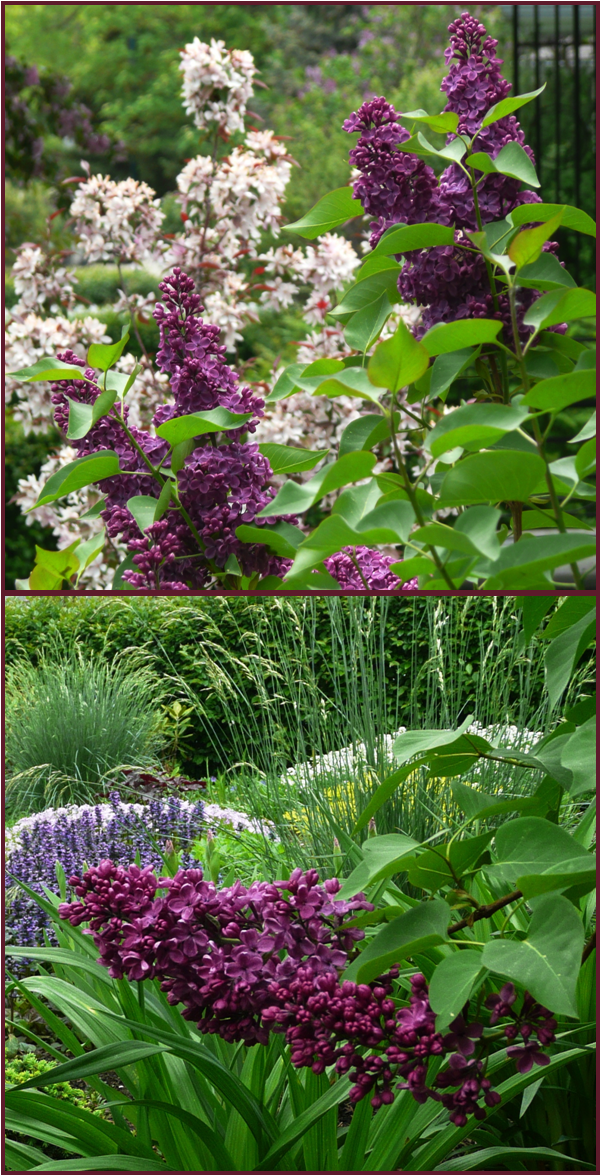
Cool spring colours – the Sryringa genus with its many species, cultivars and hybrids, can be used to create lovely soft colour combos. Photos: Sue Gaviller

Syringa vulgaris ‘Katherine Havemeyer’ has large luscious blooms and is particularly fragrant – photographing her was sheer bliss. Photo: Sue Gaviller

Hot pink buds open to soft pink blooms on Syringa ‘Tinkerbelle’, the first of the Fairytale series. Spicy fragrance, dwarf habit and winter hardiness, make this an ideal choice for any garden. Photo: Sue Gaviller

It’s hard not to be impressed with these floriferous specimens,  but what about when they’re finished blooming – then they’re just boring green things right? Well they are indeed green but they’re not boring. Most lilac foliage is dark saturated green, as opposed to much of the other deciduous foliage in the garden, which is medium green, sometimes with slight yellow or blue undertones. The dark green Syringa foliage provides stunning contrast to other foliage colours, especially lime green or variegated. It also creates a lush backdrop for the whole garden throughout the season – since lilacs are very drought tolerant, they continue to look fresh and green when the foliage on many plants is fading, wilting or browning in the dry heat of late summer. As well, there are a couple of lilacs with green and gold variegated leaves – Syringa reticulata ‘Golden Eclipse’ and Syringa vulgaris ‘Aucubaefolia’. And if that weren’t enough, Syringa patula and Syringa hyacinthiflora have great fall colour. So now you know – lilacs have colour value through most of the growing season.

Syringa vulgaris ‘Ludwig Spaeth’ is an older cultivar, well-behaved with dark violet blooms and subtle fragrance. When finished blooming, the handsome dark foliage still provides striking contrast to the bright gold foliage of its neighbour Cornus alba ‘Aurea’. Photo: Sue Gaviller

Syringa reticulata ‘Golden Eclipse’ has very large beautifully variegated leaves. Despite the tendency for variegated cultivars to be less hardy than the species, this tree is very hardy in our climate, with no winterkill on my own or client’s trees in the five years since they were planted. There have been reports that the leaves lose their variegation – this may happen, but only in the second year after planting. Subsequent years show a return of full variegation. Photo: Sue Gaviller

Texture

The large leaves of Syringa vulgaris contrast nicely with the tiny needles of Picea abies ‘Nidiformis’. Photo: Sue Gaviller

The larger Syringa species, for example S. vulgaris, S. prestoniae and S. reticulata are relatively coarse textured, meaning their leaves are quite large. Much of our garden foliage tends to be medium to fine textured, hence coarser texture is invaluable for creating emphasis and contrast. Syringa patula is a midsized shrub with medium size leaves and Syringa meyeri and hybrids are more compact shrubs with smaller foliage. The leaves, though smaller, still present interesting texture as they have a bit of a wave to them.

Compare the very different leaf shapes in the above three examples – the leathery heart-shaped leaves of S. vulgaris, the puckered ovate leaves of S. prestoniae and the smaller round, wavy leaves of S. meyeri. Photos: Sue Gaviller

Form

All members of this genus, with the exception of S. reticulata, are roundish or oval. However, when purchased at the nursery, they are upright vase-shaped plants and gardeners mistakenly assume they will continue to grow this way. They do for a while but then begin putting out growth from the bottom and are hence accused of ‘suckering’. These are not really suckers, they are basal shoots and they aren’t necessarily bad.  To some degree this is how shrubs grow – they grow from the bottom as well from the top. The problem is, when allowed to grow naturally, many lilacs form very large round or oval figures so need to be situated with their generous future size in mind.

Syringa vulgaris can get quite large, some cultivars larger than others. When left to develop naturally they may get too large for a small city lot but they are useful in providing intermediate scale, relating larger trees to their smaller neighbours. Here two mature lilac cultivars, together with the spruce, create a well proportioned trio. Photo: Sue Gaviller

This mature Preston lilac has been planted too close to the fence to grow naturally. It has thus been pruned into the familiar arching vase so often associated with the genus. Despite the need for constant pruning, the effect is quite attractive. Photo: Sue Gaviller

Since they are rarely given the kind of room needed to reach full spread, they are often pruned heavily to create tree-like forms. While this can be quite elegant, it will require a commitment to maintaining the shape or the end result will be sloppy and misshapen. Many of us opt to prune this way because we’ve ‘inherited’ a mature, but inappropriately placed specimen, and must maintain it within the bounds of its available space.

Keep in mind too, that lilacs prefer full sun. They will lose their full-bodied form if they don’t get enough, becoming leggy and bare. This also happens with age as the lower branches become shaded by full crowns of foliage – pruning out of older stems will encourage new growth from the bottom.

Scent

If like me, the scent you yearn for is that old-fashioned lilac fragrance, then Syringa vulgaris, the common lilac, is the finest aroma there is. Remember though, that not all cultivars have equally strong scent – I usually stick my nose into a bloom at the greenhouse to check it out before purchasing.

Syringa hyacinthiflora has a scent very similar to Syringa vulgaris so is a close second. Syringa meyeri is incredibly sweet-scented, some would say sickly sweet, but I quite enjoy its robust perfume. Syringa patula ‘Miss Kim’ is also strongly fragrant, but a little less sweet and Syringa Prestoniae, while strongly scented, seems slightly more vegetal than floral – but still pleasant.
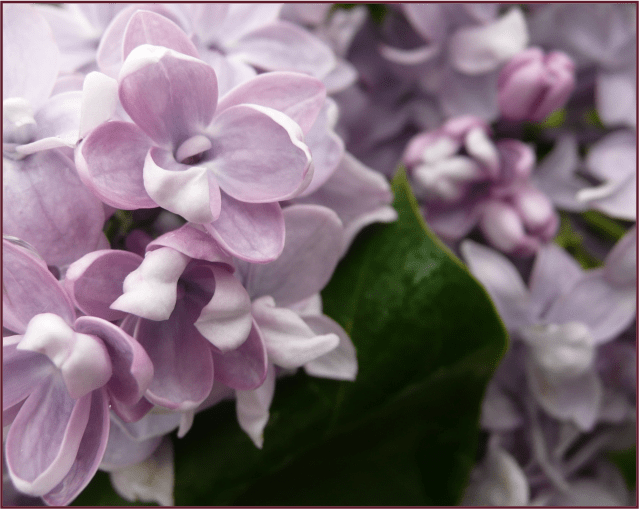
Mmmmmm – can’t you just smell it? Photo: Sue Gaviller

My husband doesn’t like lilacs – he says they smell like little old ladies. I remind him it won’t be long before I’m a ‘little old lady’, but he assures me I’ll still smell good. And while he has admitted on several occasions that lilacs can look magnificent when in bloom, he remains unrepentant in his disdain for them. I doubt I’ve yet convinced him. How about you?

Yours,
Sue

© Sue Gaviller and Not Another Gardening Blog 2012.

Unauthorized use and/or duplication of this material without express and written permission from this blog’s author and/or owner is strictly prohibited. Excerpts and links may be used, provided that full and clear credit is given to Sue Gaviller and Not Another Gardening Blog with appropriate and specific direction to the original content.


The Principled Gardener

No, I don’t mean the gardener who has principles (though I’m sure you do); I’m referring to the gardener who uses principles – design principles that is. Last month (Good Lines Mean Good Designs Part 1 and Part 2) I discussed the first two stages of the design process – functional drawings and concept drawings. The final stage is a Planting Plan, but before we can complete this design process, a look at the principles that guide it is in order.

So what are design principles anyways?

Design principles are guidelines that help create pleasing relationships between the various elements of a composition. If you’ve ever picked up a garden design magazine or attended a garden design lecture, you will no doubt have been introduced to the concepts – they may not always be presented in exactly the same framework or use exactly the same terminology, but the constructs are nevertheless the same. I like to think of Design Principles not so much as rules that must be followed, but rather as a way of understanding how the human eye perceives its surroundings and using that to its best advantage.

Gardeners don’t always recognize when they’ve utilized a design principle. Though it may happen by accident, a well designed garden will most certainly have some or all of these principles incorporated in it. It would be so much easier though, if we knew what they were and how to use them, instead of the trial and error approach that most of us employ.

So let’s get started. As I mentioned, Design principles can be organized or categorized in numerous ways, but for the sake of simplicity I’m going to call these principles Unity, Balance, Movement, Scale and Proportion.

UNITY

According to the Canadian Oxford Dictionary, Unity is defined as:  Oneness, being one, interconnection of parts, coherence of parts. So how do we bring that ‘oneness’, that ‘coherence of parts’ into our gardens? There are several ways we can achieve this – repetition, dominance, unity of three and interconnection. Unity then, is an umbrella principle for all of these concepts. Today I look at Repetition.

UNITY by REPETITION

Repetition refers to the repeated use of the same or similar elements throughout a composition.

Plant Material

One of the easiest things to repeat in your landscape is plant material – gardeners often do this unknowingly in their early gardening years, and then abandon it. For many of us our first gardening ventures are somewhat tentative and often constrained by budget limitations. We gladly accept our next door neighbour’s offer of perennials that she’s dividing or discarding. We take a few clumps of each, and spread them around the garden; hence many plants are repeated several times. As we get more adventuresome, we want to try all manner of new things and before we know it we’ve arrived at the ‘one of this and one of that’ scenario, which is anything but coherent.  It’s an expensive mistake and wasteful at that – in order to repeat you now have to reduce. Restraint people, restraint – you don’t need one of every plant in order to attain beauty and diversity in your garden. So, the next time you have some perennials that need dividing, don’t discard the extras, or give them away –  repeat them!
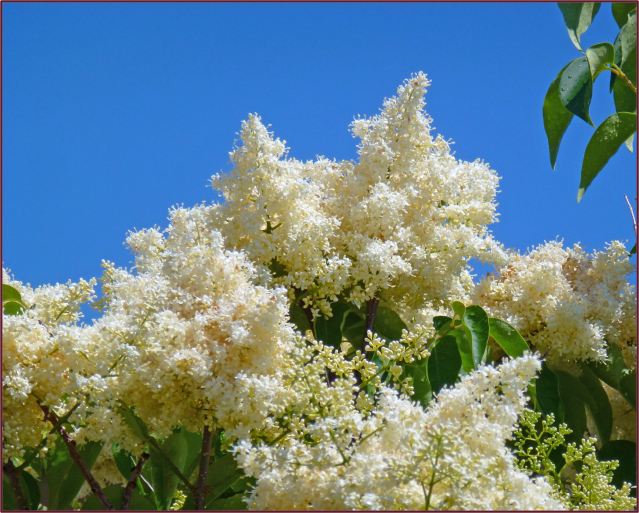
Photo: Sue Gaviller

Numerous plants, including creeping thyme, Goldmound spirea, blue oat grass and bugleweed, are repeated throughout my front garden beds. Photo: Sue Gaviller

Photo: Marg Gaviller

Hosta and red Astilbe are the recurring plant theme in this mature garden.
Photo: Marg Gaviller

Building Material

The repeated element can also be a building or hardscape material, for example; brick, wood or stone. Repeating this in the landscape allows house and landscape to appear as one entity. Conversely, using a material in the landscape that doesn’t also occur on the house, can result in a visual disconnect between house and landscape.

Incorporating a building material from the house, into the surrounding landscape, unites house and landscape. Photo: Sue Gaviller

Incorporating a building material from the house, into the surrounding landscape, unites house and landscape. Photo: Sue Gaviller

Stone pillars echo the stone facing on the house. Photo: Sue Gaviller

Architectural Features

You can also repeat an architectural line or feature. For example, the shape of an arched window could be repeated in the shape of a garden bed or in the arching branches of a weeping tree. A unique detail on the house could be the inspiration for a fence or arbour design.

repetition - line

The arches on the house are repeated in the arching form of this Caragana arborescens ‘Walker’s Weeping’. Photo: Sue Gaviller

The diamond shape detail on the windows was the inspiration for the fence I designed for a client’s home. The fence is being installed as I write this, hence the computer generated image.

Colour

A colour can be repeated as well – bringing a colour from the house into the landscape or using a recurring colour within a garden composition, can unify your whole outdoor space. A purposeful colour scheme will allow you to do this with some real finesse (more on colour schemes in another post). Keep in mind that choosing a plant for its flower colour will provide colour repetition, but only when it’s in bloom – to achieve this throughout the season, choose plants with colourful foliage too.

The colour of the front door is seen again in the Chrysanthemums. Black is also repeated, as is the architectural detail of the columns, which is repeated in the planter pedestal. Photo: Pat Gaviller

Repeating a colour within a planting composition is very unifying – here the dark wine colour of emerging Acer palmatum leaves picks up on the same hue in the tulips.
Photo: Jane Reksten

By repeating elements that are the same, or have similar characteristics, the eye posits each recurrence into visual memory and ties them all together in one coherent theme – voila Unity!

Yours,
Sue

© Sue Gaviller and Not Another Gardening Blog 2012.

Unauthorized use and/or duplication of this material without express and written permission from this blog’s author and/or owner is strictly prohibited. Excerpts and links may be used, provided that full and clear credit is given to Sue Gaviller and Not Another Gardening Blog with appropriate and specific direction to the original content.