The Form of Things to Come – Part Four

Top o’ the mornin’ to all ye lads and lasses. Today is St. Patrick’s Day – a good day to celebrate all things green don’t ya think?  Not so green ’round here though is it?

Well soon enough my friends, soon enough. Spring will come – in the meantime we still have a ways to go in our study of plant form, texture and colour. I’ll try to have you ready in time for the frenetic plant-shopping sprees that will begin in the next month or so.

Continuing our exploration of plant form then…. next up are grafted standards and topiary forms.

Grafted Standards

A grafted standard is essentially a shrub grafted onto a stem or “standard” – also called a top-graft, the overall effect is that of a stick with a ball on top. If that sounds disparaging, it isn’t intended to – they’re actually very attractive additions to the landscape. Many different shrubs can be grafted this way, but the ones that work best are those that are smallish with a naturally round(ish) growth habit – this means minimal pruning will be required. Dwarf Korean lilac, globe spruce and globe Caragana are all commonly used and available in grafted form at most nurseries.

Depending on the particular shrub used, the height of the standard, and how it is pruned, this form can have several landscape or garden applications. They work well as linear plantings to emphasize a design line – both curving and straight design lines can be planted this way.

I designed this fence/wall combo to prevent weed encroachment from a neighbouring property onto my client’s property. It nicely showcases these three top-graft globe spruce. Photo: Sue Gaviller
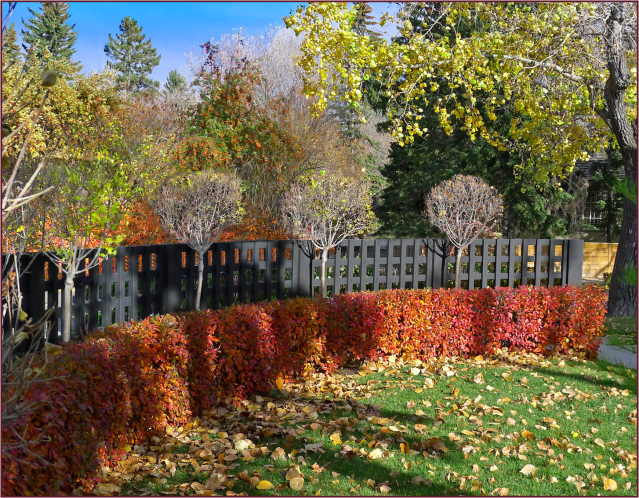
Rhythmic repetition of grafted Syringa meyeri standards reinforce movement along this uniquely curving fence. Photo: Sue Gaviller

A row of grafted Syringa meyeri standards accentuates a curving fence line. Photo: Sue Gaviller

Euonymus fortunei standard

This oddly shaped Euonymus fortunei standard makes a unique feature tree. Photo: Pat Gaviller

If they’re tallish and not too wide, two top-grafted standards on either side of an entryway, can make an attractive frame – not so much, if they’re short and stout though; these are best used as single specimens.

I find this form to be especially useful when designing certain theme gardens, most notably Mediterranean, Colonial and English Landscape Style.
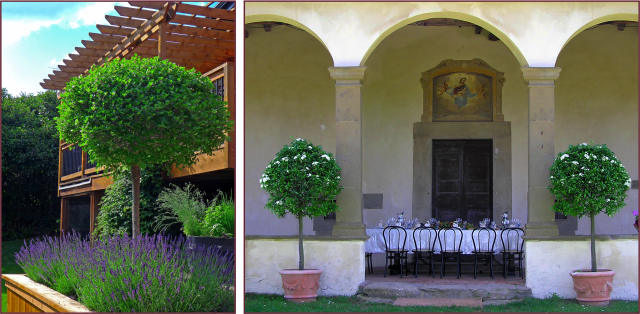
Mediterranean Theme

Left – Top-graft Syringa meyeri is underplanted with Lavandula angustifolia ‘Hidcote’ in a client’s Mediterranean-inspired back yard. Photo: Pat Gaviller
Right – Two potted standards gracefully frame an arched entryway for a Tuscan wedding reception. Photo: Cathy Gaviller

As a general rule grafted standards don’t work in groups (unless planted in a row along a design line), but there are of course exceptions to every rule – see below.
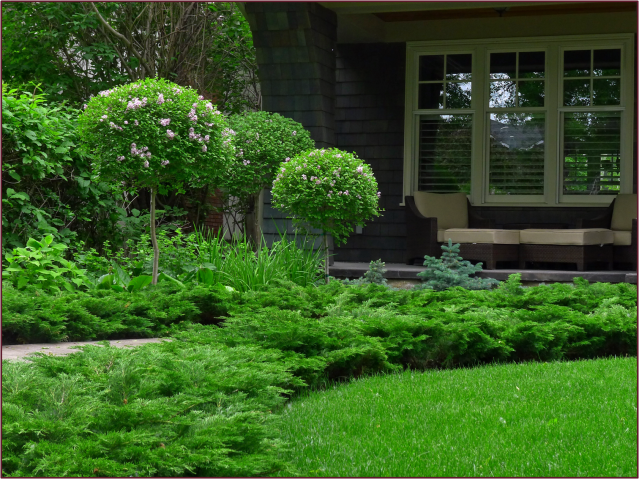
3 Syringa meyeri

Planting standards in a triad isn’t usually recommended, but in this scenario they are all different heights and widths – the end result is therefore quite pleasing. I suspect this was purposeful – very clever in fact.
Photo: Pat Gaviller 

Topiary

Topiary is the practice of shearing woody plant material into… well, just about any shape you can imagine. My intention here isn’t to instruct you in the art of plant sculpture (my attempt at topiary would likely result in something akin to Richard Dreyfuss’s infamous mashed potato mountain), but rather to instruct you in their appropriate use. Of course a shrub can be sculpted into a mouse, a monkey, or a monster but the most common forms you’ll find at a nursery are standards, pompoms, poodle tiers and spirals.

Standards

These are created by pruning a large shrub, which is naturally multi-stemmed, into a single-stem, tree-like form with a ball-shaped top.  They look pretty much the same as a grafted standard – in fact now that I think of it, a couple of the photos in this post were of standards I just assumed were grafted, but they could well have been shrubs that had been pruned to a single trunk, rather than grafted. No matter, their application is exactly the same.

Pom-poms

Pom-pom topiary is formed from a shrub that is pruned into several main stems with a “ball” of foliage at the end of each. This is a very unique form and  should be used as a lone specimen – this means only one in your entire composition. No grouping, repeating, planting in a row, or framing – they’re the wrong shape for any of these applications.
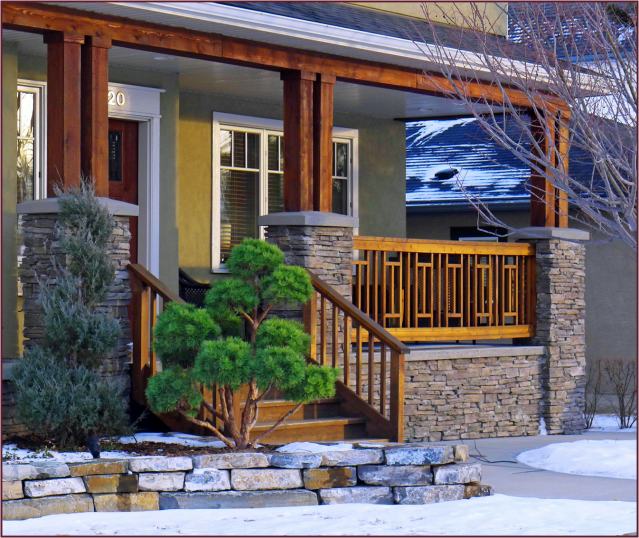
Topiary Pine

Pom-pom topiary has such distinctive form that it must stand alone, like this lovely pine, which has been situated beautifully. Photo: Pat Gaviller

Topiary pine and Syringa standards

This landscape is one I’ve featured before – I love its clean lines and minimalistic style. While I don’t as a rule choose to critique another’s work on this blog, for the sake of a teaching moment, I will suggest that the pom-pom pine might have greater effect without the Syringa meyeri standards to compete with.
Photo: Sue Gaviller

Pom-poms, especially pines, can lend an Asian feel to a garden composition because they, like bonsai, are part of the Japanese aesthetic. Topiary and bonsai are used to create Reduced Scale, an important Japanese design principle which refers to the reproduction in miniature, of scenes in nature – bonsai and topiary are used to fashion “trees”, but in much-reduced scale. For this reason, it is acceptable to use more than one of these forms in a Japanese garden composition.

Japanese Topiary

A modified form of pom-pom topiary, cloud pruning is used to create the impression of aged and weathered trees. Photo: Pat Gaviller, Butchart Gardens Victoria, B.C.

Poodle Tiers
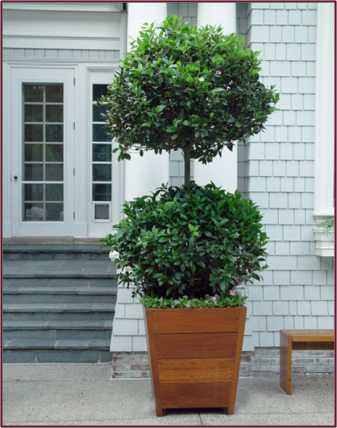
Bay Laurel Topiary

A potted two-tier poodle topiary makes a pretty statement. Photo: Deborah Silver, Dirt Simple

This form is a single trunk with two or more individual balls of foliage along its length. Poodle tiers are fairly upright specimens, which makes them an appropriate choice for framing views and entryways. They also make excellent single features. Like topiary standards and grafted standards, poodle tiers are especially suited to Mediterranean style gardens, formal Colonial style gardens and English Landscape gardens.

tiered topiary 2

Left: This Spanish Mediterranean-style home is suitably landscaped, except for the two pom-pom topiaries. While the goal may have been to frame the entrance, their form doesn’t effectively serve this purpose.
Photo: Patti Cartier
Right: A graphic depiction of the more appropriate 3-tiered poodle topiary providing the desired frame.

Spirals

Spiral topiary is an upright form that has been pruned into a spiral or corkscrew shape. These forms have the same application as poodle tiers and standards – they’re elegant as single specimens, or repeated sequentially along a design line, are suitable for framing, and are fine additions to theme gardens like Colonial, Mediterranean or English Landscape.

Two spiral junipers frame the entrance to a lavish outdoor ‘sitting room’.
Photo: Deborah Silver, Dirt Simple

In our climate most garden topiary is Juniperus chinensis, Juniperus scopulorum or Juniperus virginiana, as well as several Pinus species. In warmer climes, Boxwood, Yew, False Cypress, Rosemary and Bay Laurel are used. These are often available as potted annuals for us Northern gardeners, and given a sunny window, they might overwinter indoors.

Topiary and grafted standards present very strong form in the landscape – suitably sited, they will bring style and sophistication to your garden.

Happy St. Pat’s Day – just think green.
Sue

The Form of Things to Come, Part 3 – Weeping Form

Until a day or two ago, it was feeling quite springy around here – longer days, mild daytime temperatures, and I’d begun the flurry of client interviews and site assessments that typify my spring schedule. Then BAM – old man winter returns with a big dump of the white stuff.  Lucky for you, this means a short reprieve from aforementioned activities, and I can work on this post. Next in the plant form series is weeping form.

Weeping Form

Weeping plants can be huge trees like Betula pendula ‘Laciniata’, or small grafted specimens like Betula pendula ‘Youngii’. The large weeping trees have less distinct form because there are countless branches, each with delicate drape – the resultant outline of form is therefore somewhat amorphous, though still quite elegant.

Weeping Birch

Large weeping trees like this weeping birch don’t exhibit a distinct outline – the weeping habit of their branches creates more textural interest, than well-defined form. Photo: Pat Gaviller

To me, they bring a sense of quiet luxuriance to a landscape, perhaps because I associate this form with the giant weeping willows that reside near still waters – the picture of both opulence and serenity.

Although these big weepers lack definitive form, their lacy texture makes them lovely feature trees – if scale and proportion allow. They are especially lovely as waterside accents and make elegant shade trees – again if the size of your house and/or property allows.

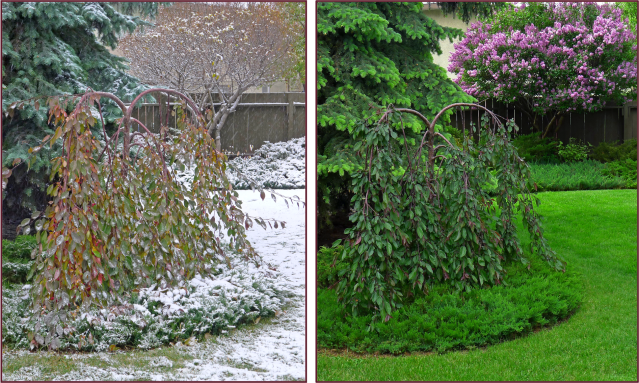
Small weeping trees offer much stronger architectural form than their larger counterparts– their arched weeping branches create an umbrella-like form. Many of the weeping specimens available at nurseries are actually low-growing creeping shrubs that have been grafted onto a standard, for example Young’s weeping birch, Walker’s weeping Caragana or Rosy Glo weeping crabapple.

This form draws the eye up … and back down again. It is strongly dominant so should always be used as a single specimen – I can’t stress this enough. Don’t try to group them in threes, or use two to frame an entry, or plant several in linear fashion – it just doesn’t work. I made the mistake of planting two in my front yard several years ago – you can read about it in my post from last year around this time: Form, Colour and Texture in the Winter Garden. The bottom line is, any more than one and they’ll just compete for dominance and create visual unrest. So one is enough – got it?

Malus Rosy Glo 3

Malus ‘Rosy Glo’ makes a beautiful specimen tree as it looks spectacular any time of year – here I’ve underplanted with Juniperus sabina ‘Moor Dense’ which stages her nicely. Photos: Sue Gaviller

C. arborescens ‘Walker’s Weeping’

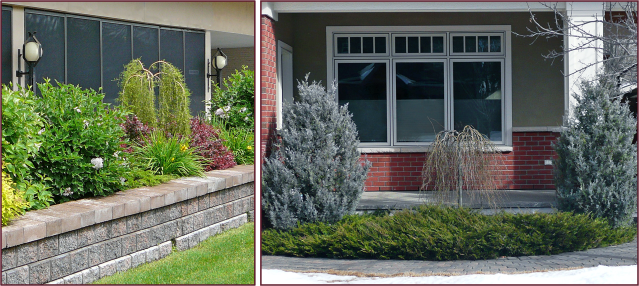
A weeping form makes a nice centrepiece for a symmetrical composition. Left – Caragana arborescens ‘Walker’s Weeping’ in a client’s raised planter. Right – another of those pretty scenes I periodically drive by, C. arborescens ‘Walker’s Weeping’ in winter still has strong form. Photos: Sue Gaviller

Weeping Caragana

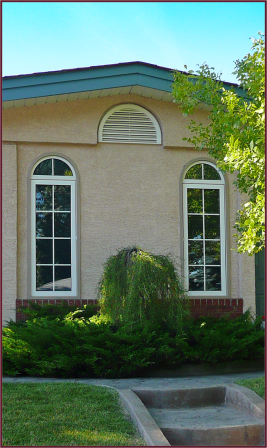
Walker’s weeping Caragana: simple repetition of line makes this tidy scene one I often stop to admire. Photo: Sue Gaviller

These small weeping trees are useful for highlighting architectural details, like arched doorways or windows – the arching form of the branches mimic the architectural line, thus bringing attention to it, and creating unity (by repetition).

Fountains too, can be ‘echoed’ in this way with the placement of a weeping tree nearby.

As well, a weeping form looks very appealing at the top of, or near a slope – the weeping branches reiterate the sloping line of the hillside.

And don’t plant one of these feature trees in the middle of an expanse of lawn where it will appear lonely and insignificant – it’s much more effective when staged and supported by the presence of other plant material.

Weeping Norway Spruce

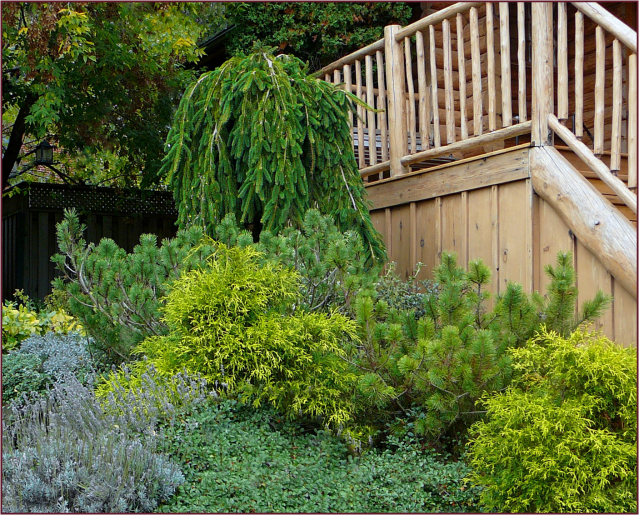
A fine-looking specimen, Picea abies ‘Pendula’ looks splendid in this sloped front yard garden in charming Elora, Ontario. Photo: Sue Gaviller

I’ve had several clients tell me they don’t like the shape of weeping trees because it makes them feel sad (maybe it’s the name – y’know power of suggestion and all). I don’t get this. To me weeping forms are graceful and very pleasing to the eye. Indeed their appropriate use demonstrates a mature design sensibility. I guess it’s a humble reminder for me, and all you aspiring designers, that there is a degree of subjectivity in design that must be acknowledged and respected. And with that little piece of wisdom my friends, I shall bid you adieu.

More “Fun with Forms” in my next post – see ya then.

Humbly yours,
Sue

© Sue Gaviller and Not Another Gardening Blog 2012.

Unauthorized use and/or duplication of this material without express and written permission from this blog’s author and/or owner is strictly prohibited. Excerpts and links may be used, provided that full and clear credit is given to Sue Gaviller and Not Another Gardening Blog with appropriate and specific direction to the original content.

The Form of Things to Come – Part 2

In my last post, I opened a discussion on plant form with a look at columnar or fastigiate forms and their use in the landscape. Today I continue this discussion with two additional forms – Pyramids and Vases.

Pyramidal/Conical

Pyramids or cones are wider at the bottom, becoming narrower and tapering to a point at the top. Their geometric form gives a garden solidity, structure and definition. In our climate, it is during the long winter months that pyramids carry the most visual weight – most of the pyramids we see are evergreens, which are dense, stiff needled and weighty in appearance. As well, pyramidal forms carry their weight close to the ground – this wide-bottomed shape means that visually they are very grounding (anyone else start silently singing the refrain from a certain song?)
Pine

A solid green pyramid, which I suspect is Pinus mugo ‘Tannenbaum’, stands out in this winter landscape, firmly anchoring the more yielding forms of leafless woodies and dried grasses. Photo: Sue Gaviller

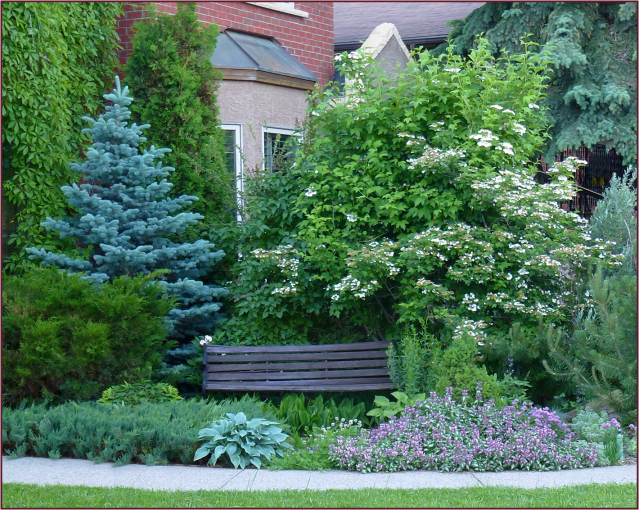
Blue spruce and bench

The pyramidal form of blue spruce provides definition and structure to this pretty vignette.
Photo: Sue Gaviller

Pyramids can be quite variable in size and proportion – some are short and squat, some tall and narrow and some in between. This means their use in the landscape is also variable. A tall narrow pyramid will behave more like a columnar form, making a striking vertical accent or effectively framing a view or entrance, whereas the more wide-bottomed specimens won’t have this effect and better serve as anchors with their bottom heavy appearance (there’s that song again).

Pyramidal Spruces

Left – A tall narrow pyramid like Picea pungens ‘Fastigiata’ makes a dramatic vertical feature.
Photo: Pat Gaviller.
Right – Short and squat, dwarf cone-shaped Picea pungens (likely cv. ‘Montgomery’) steadies this pretty composition. Photo: Sue Gaviller

Picea pungens var. Glauca

Two Picea pungens var. glauca create a nice frame – their size, form and texture provide solid structure, matching that of the large brick building. Photo: Pat Gaviller.

Pyramids are also useful for repeating the shape of roof peaks or mountains in the background. As well, their natural geometry lends itself to use in formal landscapes, where parterres and hedges are clipped into strong geometric forms.

Spruce and cedars

The narrow pyramidal forms of two cedars effectively repeat the shape of the church steeple (and frame its entrance), while the broader spruce repeats the form of the roof peak. Photo: Pat Gaviller

Geometric shapes

Pyramidal forms fit well into formal designs. Photo: Evelyn Steinberg

Keep in mind that the more narrow the pyramid, the more it will perform like a columnar form, so the same guidelines will apply regarding its overuse. Otherwise this form can be used fairly freely in the landscape, remembering that evergreen material shouldn’t comprise more than about half of your plant material due to its weight. And of course scale, proportion and all the other design principles still apply.

Vase shaped

Vases are inverted pyramids – narrow at the bottom and flaring out towards the top.  They are graceful and elegant, making them excellent feature trees/shrubs. Like pyramids they vary somewhat in proportion, with some being quite slender and others much broader. A very narrow specimen can make an elegant vertical accent, frame an entrance or view, or be planted in groups. Just like columns or narrow pyramids, narrow vases shouldn’t be overused – because they stop the eye and draw it up, the same guidelines will apply as for columnar forms, though a narrow vase is less dramatic.

Sutherland Caragana

Left – Slender vase-shaped Caragana arborescens ‘Sutherland’, together with a bird bath and Hemerocallis ‘Stella d’Oro’, make a lovely focal vignette in a client’s sunny backyard. Photo: Sue Gaviller.
Right – A trio of Sutherland Caragana also works well. Photo: Jane Reksten.

Broader vases are still graceful but don’t behave as verticals. They can therefore be used liberally throughout a landscape composition – a single specimen though, makes an outstanding feature on its own.

Broad Vase

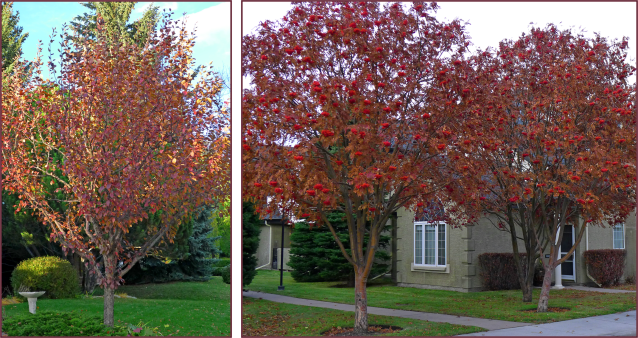
Plants with broad vase form are a beautiful addition to the landscape, whether used singly or grouped.
Left – Malus
‘Thunderchild’. Right – Sorbus decora. Photos: Sue Gaviller

Vase shaped trees planted on either side of a street or walkway create a lovely arching canopy as they meet at the top. If you’ve ever peered down one of Calgary’s elm-lined streets you’ll know what a spectacular sight this is, especially with a dusting of hoar-frost coating the lacy branches of the stately elms.

Vase shaped trees

Ornamental crabapple trees have a beautiful vase shape – some very broad and some more narrow. I love how the designer has utilized the form in this landscape, both framing the walkway and creating the arched canopy over it. Photo: Gabe Girimonte.

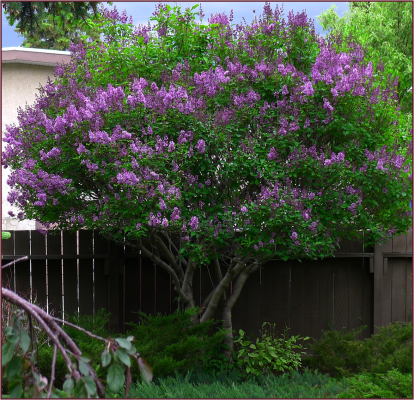
Pruned Syringa prestoniae

Syringa prestoniae grows naturally in a globe shape, but looks lovely pruned into a broad vase. Photo: Sue Gaviller

Vase shapes are a favourite with many gardeners – in fact so enamoured are we of this form that we’ll often prune a shrub into a vase shape, and labour to maintain it, despite the fact that its natural growth habit is otherwise.

I’ve seen various shrub species, including Syringa, Prunus, Lonicera and Viburnum, pruned in this manner.

Note too that during the growing season, the leafy canopy of a vase-shaped tree or shrub may affect its form, appearing somewhat like a ball on top of a vase. Whether you then choose to use this plant as a round form or a vase, will depend on how much of its woody skeleton is visible when clothed in foliage. It will also depend on how much of the year it actually has leaves.

Vases and pyramids are important inclusions in your landscape or garden composition. Indeed they work in beautiful concert with each other, fitting together like puzzle pieces.

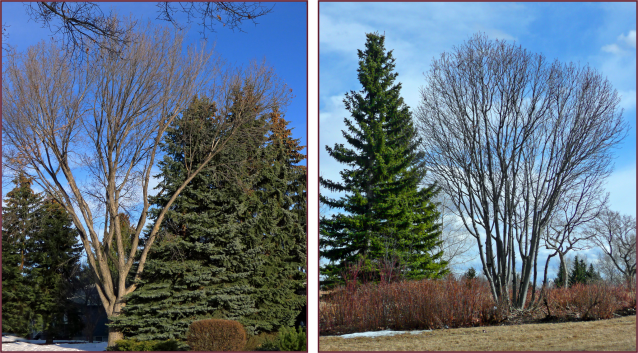
Pyramids and Vases

Left – Ulmus americana and Picea pungens var. glauca. Photo: Sue Gaviller
Right – Picea and Prunus sp. Photo: Sue Gaviller

Next post we’ll continue to build our garden sight-line with more plant forms, so y’all come back now, hear?

Sue

The Form of Things to Come

My first thought the morning of February 2nd is hooray! Balzac Billy didn’t see his shadow! According to groundhog legend, this means spring is just around the corner. Again I say hooray! A sense of disquiet ensues though, as I remember the client designs I’ve been putting off because hey, there’s lots of time, it’s still the middle of winter. While I don’t really subscribe to the belief that a rodent can predict the weather, I suddenly feel called out of hibernation. I’m not sure I’m ready.

I dust off the old creativity cap and reluctantly put it on. I’m just not feelin’ it though. I guess I could work on my next blog post – yikes not feelin’ that either. I believe I have the dreaded writer’s block, and designer’s block too! This is weird – my brain is usually so full of thoughts and words and ideas that stuff just tumbles out onto my drawing page or laptop screen.

A memory of some words my husband once spoke to me finds its way through the fog, “Sue, just put your pencil on the paper and start to draw”. Yes, yes of course – start the process and inspiration will follow. I know this to be true.

Fortunately I’m able to come up with some concepts for last night’s client meeting – I’m actually pretty happy with the drawings, and the clients are ecstatic. Now if I can just get this blog post underway. So where were we anyways? Oh yeah, in my last post I left off with the promise of discussion on the significance of plant form, texture and colour.

Plant Form

We choose plants for any or all of these characteristics (form, texture and/or colour), but in order to arrange them appropriately we need to understand how specific traits will play out in the garden scenario, in relation to other plants. To me, plant form is the most important quality a plant brings to a garden composition, so I’ll begin there. It is the various plant forms working in concert that creates a sight-line. Much like a city skyline, the landscape sight-line is what we experience when viewing the garden from more distant vantage points – across the street or down the road. It allows us to see the garden in its larger essence.

Calgary Skyline

An attractive city Skyline has high points and low points, as well as variety in the shape of its buildings. Photo: Pat Gaviller

Sight-line

A landscape too should have variety in height and form – note the different tree and shrub forms that contribute to this attractive sight-line. Photo: Sue Gaviller

Sight-line 2

Designers of English Landscape Style gardens pay particular attention to the creation of an undulating sight-line. Photo: Marny Estep

As well, the form of the garden’s woody denizens (trees and shrubs) makes a significant contribution to the creation of a true four-season garden. It is this that provides a sense of permanence in the garden – to see its beauty season after season, year after year.

FOUR SEASONS

This view from my diningroom window is always serene and elegant – due in part to the variety and balance of form. Photos: Sue Gaviller

Plants come in many shapes. Classifying these shapes, simplistic though it is, can help us to understand their visual impact in the landscape and utilize them accordingly. For the sake of simplicity then, let’s say plant forms fit into one of the following categories:

  • Columnar/Fastigiate
  • Pyramidal/Conical
  • Vase shaped
  • Weeping
  • Topiary/Grafted standards
  • Fountain/Arching
  • Round/Mound
  • Mat/Flat

Today I will discuss the first.

Columnar/ Fastigiate

Columnar and Fastigiate forms are tall and narrow with very little taper. These strong vertical accents draw the eye, stop it, and send it skyward, thus momentarily arresting the flow of movement. Stately and spire-like, they have many applications in the urban landscape.

When used as a single specimen, a columnar form appears somewhat like an exclamation point. They are also lovely as a trio, and placing one on either side of an entrance or view will provide a visual frame, inviting the eye (or the viewer) through.

columnar forms

Left – A single columnar form can make quite a statement. Photo: Cathy Gaviller.
Right – A group of three is also stunning. Photo: Sue Gaviller

Skyrocket juniper

Two narrow Juniperus scopulorum ‘Skyrocket’ nicely frame an entryway. Photo: Marg Gaviller.

Columnar forms are useful where taller scale is required but space is tight. As well, adding a few of these tall narrow trees to Mediterranean theme gardens can help to set the mood as they mimic the tall Italian cypress.

Italian Cypress

Nothing says Mediterranean quite like Italian cypress – it is seen in abundance throughout the region. In colder climates, like ours, other columnar trees can do the trick quite nicely. Photo: Cathy Gaviller

Overuse of this form can result in very choppy movement as the eye stops and starts, darting up and down. This ‘jumpy’ feel will be most evident if these forms are dotted randomly around the landscape. If you want to use numerous columnar forms, they are best grouped together, used sequentially to reinforce a design line, or in a pattern of alternating elements.

columnar aspens

Alternating Populus tremula ‘Erecta’ and Picea pungens, effectively reinforce the straight design line, as well as providing some privacy for the homeowners. Photo: Sue Gaviller

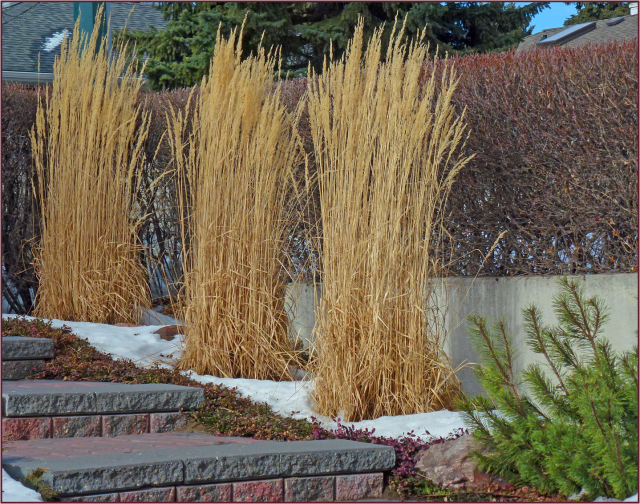
On a smaller scale, columnar form is seen in these Calamagrostis acutiflora 'Avalanche'. They provide winter interest in both form and colour. Photo: Sue Gaviller

On a smaller scale, columnar form is seen in these Calamagrostis acutiflora ‘Avalanche’. They provide winter interest in both form and colour and reinforce directional movement along the path.
Photo: Sue Gaviller

The columnar plant form is an outstanding addition to the landscape – why not give one or two a home in your garden.

Join me next time as I look at another of the plant forms for your garden.

Til then,
Sue
© Sue Gaviller and Not Another Gardening Blog 2012. Unauthorized use and/or duplication of this material without express and written permission from this blog’s author and/or owner is strictly prohibited. Excerpts and links may be used, provided that full and clear credit is given to Sue Gaviller and Not Another Gardening Blog with appropriate and specific direction to the original content.

Where Do We Go From Here – Part 2

Last week I discussed the various functional roles plants may serve in the landscape – with these practical considerations out of the way now, we can finally go about utilizing plants purely for their aesthetic appeal. However, we can’t just go plopping plants into our designs haphazardly. There is still a process – indeed this is inherent in the very definition of design. According to Wikipedia, design is defined as:

  • the creation of a plan or convention for the construction of an object or a system
  • a roadmap or a strategic approach for someone to achieve a unique expectation

Note the words ‘plan’ and ‘strategic approach’ – this suggests we must arrange our plants in a mindful, purposeful fashion. Nuff said? Okay I won’t belabour the point. Alrighty then let’s get going….

Um – where exactly do we go from here? There’s so much to choose from. Well let’s see if we can’t narrow down our choices by looking at what, where, when and why.

What Plants Should I Choose First?

Trees should always be your first consideration – they are the backbone of a well designed garden. Trees provide scale and structure, and since they take the longest to reach maturity, dedicating the largest portion of your plant budget to a few of these horticultural giants, means you’ll have good scale and structure from the get-go.

Once you’ve chosen your trees you can consider shrubs – if trees are the backbone of good garden design, shrubs are the rest of its skeletal structure. Perennials then, are the garden’s attire, and bulbs and annuals, the accessories.

The irony is, most of us have proceeded in exactly the opposite direction. Our first tentative foray into gardening often begins with brightly coloured annuals (I wince at the memory of marigolds and geraniums that were my first garden) or bulbs like tulips and daffodils. Soon we discover perennials, and sometime later (often much later) we start to think about shrubs and trees. I can tell you from experience that it is difficult to go backwards – save ripping it all up and starting over again, this backwards progression will always look like a retrofit.

So what kind of trees should you choose? It goes without saying that they should be of appropriate scale for your house, and of course you’ll choose what you personally find appealing, but there’s more yet to consider. Keep reading.

Where Should I Plant What?

This really is the million dollar question isn’t it? To begin with you’ll need to take into account details like site exposure and available space, to ensure your plant choices will thrive where you place them.  Next, consider plants which will present high visual impact and position them accordingly. For example a specimen tree or other dominant feature should be situated where it can take center stage. Use your design lines, and the shape of the spaces they create, to guide you – a swell in a garden bed or an area that is enclosed on three sides can provide a visual ‘frame’ for a feature tree or focal point.

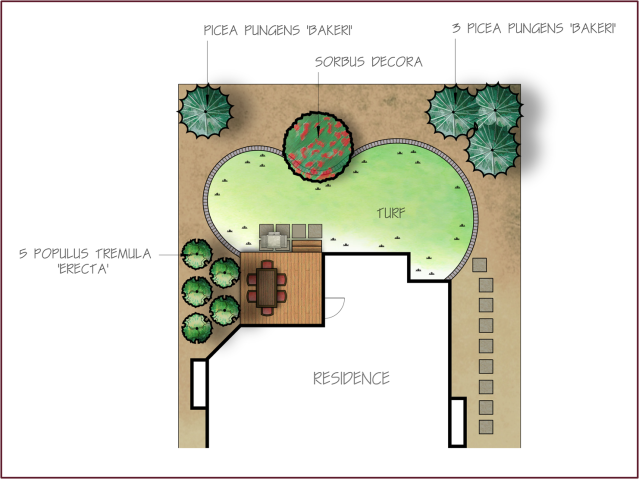
Revisiting last week’s example – with the shade trees already in place, we can now add a specimen tree, say Sorbus decora. The outward curve of the back bed is just the kind of space that invites a special feature like this showy mountain ash, with its four-season appeal. We could also add some evergreens to anchor the corners – evergreens, because of their stiff needles and their density, provide visual weight.

TREE PLACEMENT

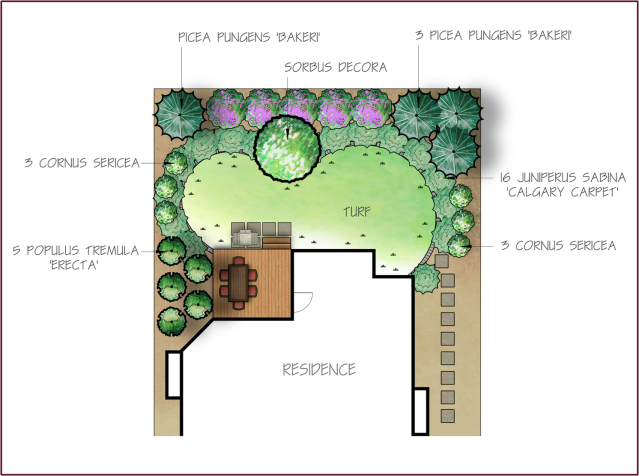
Your design lines and resulting spaces can also help you organize and configure plant groupings. Looking again at the previous example, we see that the space beside the deck is somewhat wedge-shaped – note that the aspens are arranged to precisely fill that space. And the trio of spruces fit nicely into the triangular corner space. We can utilize the spaces between the various plantings in a similar fashion. Or we can emphasize a design line by bordering its entire length, or a portion thereof, with a single type of plant. And don’t forget to utilize Design Principles where applicable.

TREE & SHRUB PLACEMENT

Juniperus sabina planted all along the edges of the curvilinear design lines, creates gentle movement and helps to emphasize the curves. The trio of Cornus sericea on either side also follows the curves, thereby reinforcing them.

Reinforcement Planting

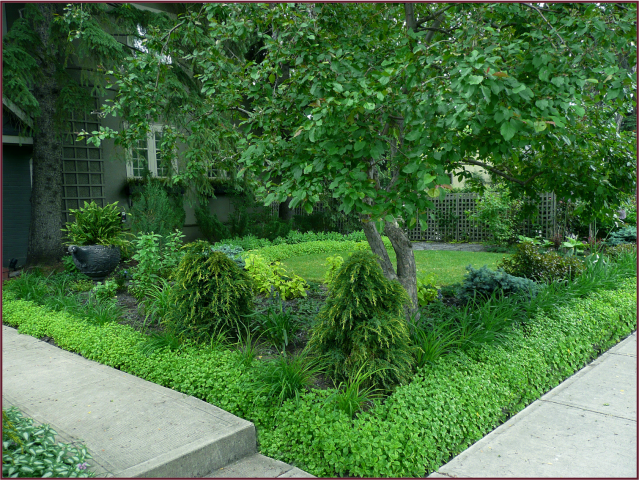
Planting a single type of perennial along the entire span of a design line, as this homeowner has done,  serves to reinforce the line. In this charming garden, low-growing Sedum edges the lovely arc of lawn space in the centre, as well as the straight lines abutting the sidewalks. Photo: Sue Gaviller

Thymus citriodorus 'Doone Valley'

A generous swath of Thymus citriodorus ‘Doone Valley’ borders this softly curving bed.
Photo: Marg Gaviller

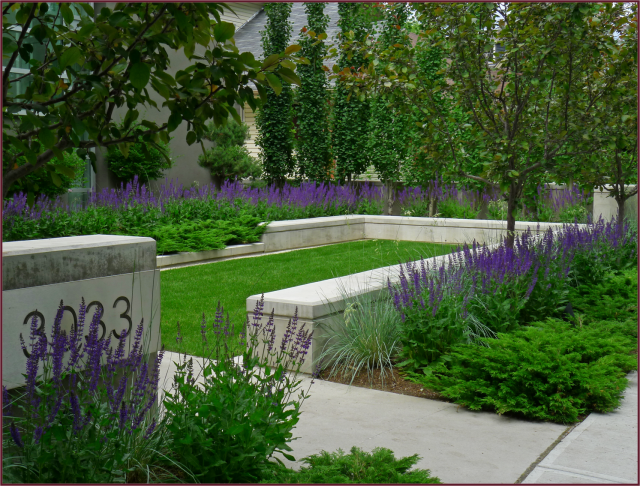
Straight lines are strong design lines. This impressive rectilinear design is well emphasized by the linear plantings of Salvia and Juniperus. Photo: Pat Gaviller

Straight lines are strong design lines. This impressive rectilinear design is well emphasized by the linear plantings of Salvia and Juniperus. Photo: Pat Gaviller

When (What Season) Should I Consider First?

This will depend on where you live and to some degree, your lifestyle. Where I live it can be winter for as much as 6 months of the year, so I usually start with winter interest – evergreens, woody plants with interesting form, and plants with colourful bark, berries or seedheads.  For those who travel during part of the year, the season(s) to concentrate on would be when you are actually home to enjoy your garden or landscape. For example I have clients that spend winter in the South and summer at their cottage, so spring and fall are the seasons I considered first when choosing plant material. You’ll also want to make sure you choose plants that require very little maintenance during the growing season so you don’t come home from your cottage to a mess of deadheads and straggly foliage.

Rectilinear Concept with feature trees

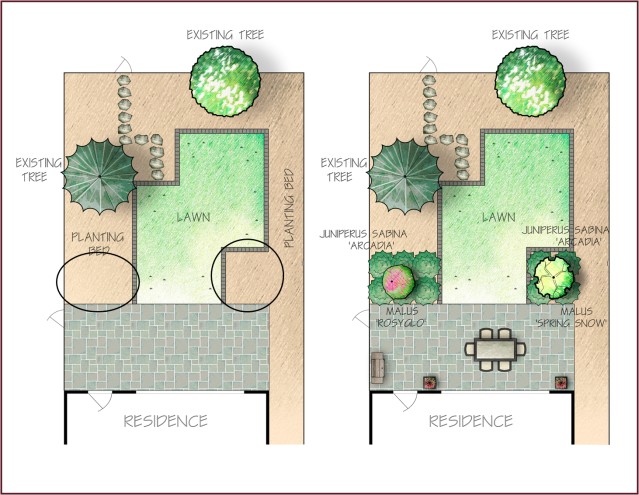
Planting for aesthetics in this client’s yard began with the two spaces circled on the left. Both are bordered on 3 sides with design lines – an ideal frame for a feature tree. The underplanting of spreading junipers creates a neutral, year-round prop for these four-season trees. See the ‘real life’ view below.

Rectilinear Design lines

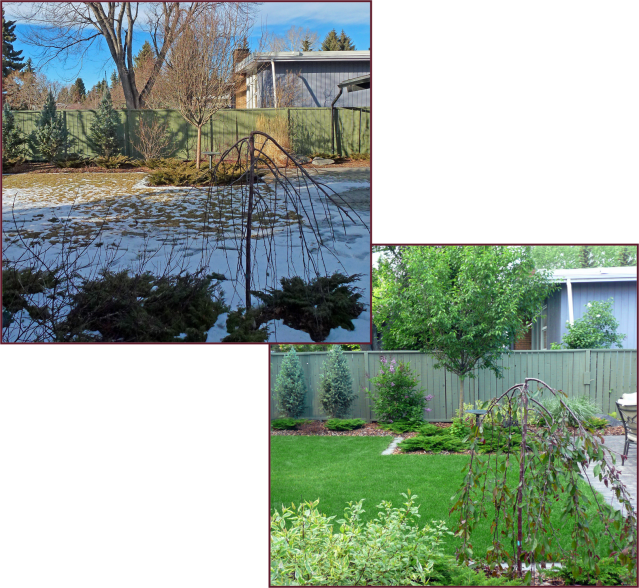
View from the side gate in late winter (top) and early summer (bottom). Photos: Sue Gaviller

Why Choose a Particular Plant?

Up to this point we’ve discussed plant choices mostly in general terms – size (i.e. trees first), visual impact (feature trees and anchors), cultural and maintenance requirements, and season of interest. Also worth considering are such things as tactile impression and fragrance – especially next to a patio, or in a garden designed for the visually impaired (the subject of another post). But the real reason most of us choose a particular plant is because we like how it looks – its form, its texture and/or its colour. Indeed these traits are the manner in which plants relate visually to each other, and to choose appropriately is to choose in the context of these relationships.

Last March I wrote about form, colour and texture in the winter garden – during the growing season however, these plant characteristics are that much more significant as there’s so much more plant material present. In the coming weeks I’ll be examining the visual impact of plant form, textural differences and colour relationships in order to help you arrange plants in the most effective and pleasing way.

Hope you can join me!

Til then,
Sue

© Sue Gaviller and Not Another Gardening Blog 2012. Unauthorized use and/or duplication of this material without express and written permission from this blog’s author and/or owner is strictly prohibited. Excerpts and links may be used, provided that full and clear credit is given to Sue Gaviller and Not Another Gardening Blog with appropriate and specific direction to the original content.

Where Do We Go From Here?

After 8 months exploring Design Principles we’re finally ready to tackle the third and final phase of the Landscape Design Process – The Planting Plan. We began way back in April with functional diagrams, which map out a landscape based on the function of each space, and Concept Plans, which give form to those functional spaces (these are outlined in GOOD LINES MEAN GOOD DESIGNS and CURVES WONDERFUL CURVES).

Now at long last it’s time to introduce plant material into our design. Off you go then – pop those plants into your drawing. You know you wanna. You’ve been waiting for this….

Ha! Are you still staring at your page? Not so easy is it – where does one begin? Indeed where do we go from here?

Well, I have bad news for you. We must begin where we always begin – with function. Ah dear fellow gardeners I can hear you protest, “Oh no, not the f-word again.” Yes I’m afraid so. Plants serve many functions in the landscape and we must first determine what role we need them to play before choosing and arranging plant material.

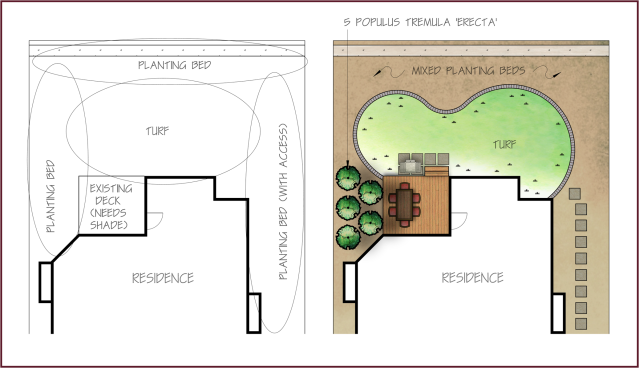
Revisiting your functional diagram may be of help here – for example perhaps you made note that some means of providing shade on your sunny deck or patio will be required. If so, an appropriately sized shade tree might do the trick – placed strategically of course, so it can in fact serve that purpose.

A group of 5 columnar aspens provide shade for a sunny deck. While there may be room for a single larger canopy tree, these tall narrow aspens grow faster and will fulfill their intended function sooner.

A group of 5 columnar aspens provide shade for a sunny deck. While there may be room for a single larger canopy tree, these tall narrow aspens grow faster and will fulfill their intended function sooner.

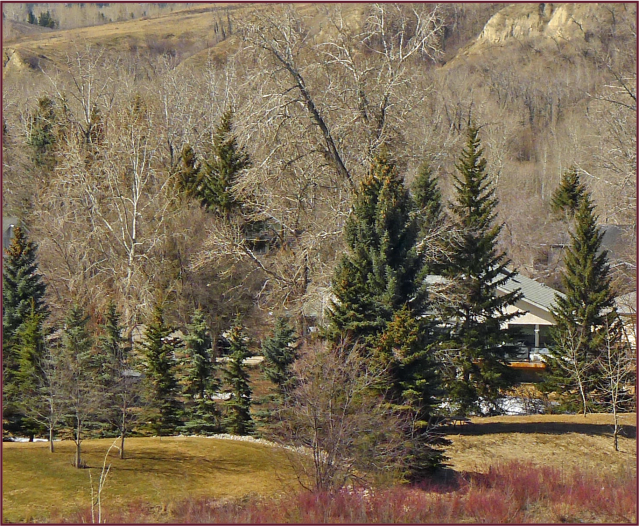
How about privacy? A tree or two may be the answer – again suitably sized for the scale of your house and property. And if you require this privacy year round, you may want to consider evergreens.

Large evergreen trees provide privacy for homes abutting a year-round public park space. Photo: Pat Gaviller

Large evergreen trees provide privacy for homes abutting a year-round public park space.
Photo: Pat Gaviller

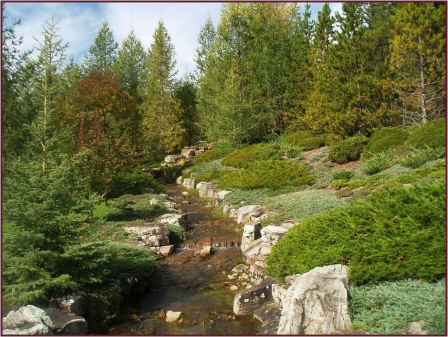
Spreading junipers make good slope stabilizers, creating a tidy uniform look. Photo: Ann Van de Reep

Spreading junipers make good slope stabilizers, creating a tidy uniform look. Photo: Ann Van de Reep

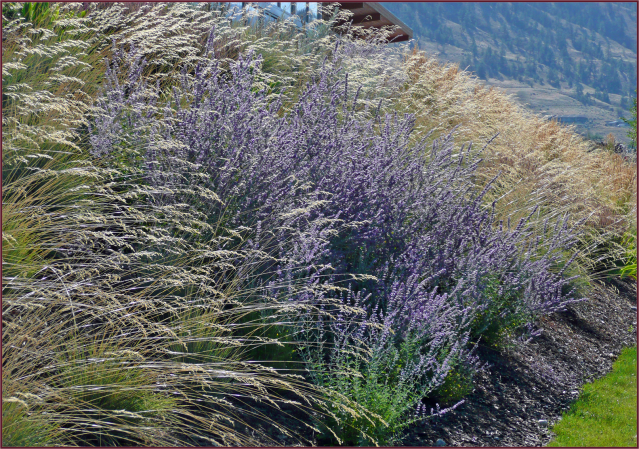
Shrubs and perennials can also serve a purely practical purpose. For example, if you have a slope to contend with, shrubs and/or perennials with dense root systems can stabilize an embankment quite effectively.

Slope stabilization

Festuca, Helictotrichon, and Perovskia make a casual, but effective hillside planting at Poplar Grove Winery, Naramata Bench, B.C. Photo: Len Steinberg

Or perhaps you want to limit foot traffic in an area – using shrubs that are thorny or abrasive can provide an efficient barrier.

Are you starting to get the picture?

As you can see, plants are great problem solvers. The size of the plant or plants you choose will be relative to the size of the problem you’re trying to solve. If you want to screen your air conditioning unit from view, a medium-sized shrub planted in front of it may be all you need, whereas if you want to screen your view of an entire street or roadway, a hedge of tall shrubs may be in order. And a windbreak or shelterbelt will require very large trees.

Keep in mind that the ability of your plant selections to produce favourable results is dependent on choosing plant material of a suitable size. For example, a shrub or planting that is too small to obscure an unsightly view may end up drawing attention to it instead.

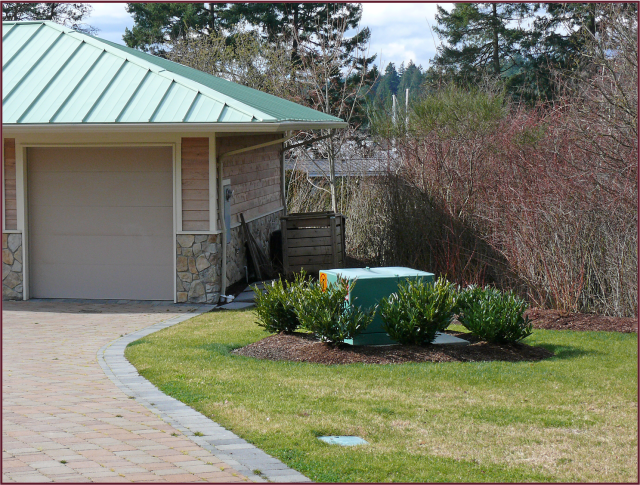
Ineffective screening

These shrubs are too small to effectively screen the unattractive green utility box. Unfortunately the result is to draw attention, not only to the box, but the unsightly utility area behind. Photo: Pat Gaviller

So when do we get to the part where we plant things just because they look pretty? Don’t worry we’ll get there. Once you’ve dealt with all of the practical considerations you can start to think about aesthetics. But you’ll have to wait til my next post.

Stay Tuned,
Sue
© Sue Gaviller and Not Another Gardening Blog 2012. Unauthorized use and/or duplication of this material without express and written permission from this blog’s author and/or owner is strictly prohibited. Excerpts and links may be used, provided that full and clear credit is given to Sue Gaviller and Not Another Gardening Blog with appropriate and specific direction to the original content.

Gardening is a Sport Right?

To all you Hockey Fans out there – Happy Hockey Season!

No this post isn’t about the NHL and NHLPA deal that was reached earlier today, but it is about sports…….sort of.

Over the years my boys and I have had numerous animated discussions regarding what does, and does not, constitute a sport. Both my sons speak from a position of expertise on this, since one is a sports broadcaster and the other played every possible team sport in junior high and high school.

The repartee might go something like this:

Round One

Me: “Boxing shouldn’t be a legal sport.”

Them: “What? Muhammad Ali was one of the greatest athletes ever! And pugilism is the oldest sport in the world.”

Me: “Yeah I know, but there’s something wrong with a sport that requires contenders to knock their opponent out. Doesn’t that mean render him unconscious?”

Youngest Son: “Mom remember my best friend used to be an amateur boxer – he won most of his matches y’know. He wants me to start boxing too and I’m considering it. It’s an awesome fitness regime.” (Okay he probably didn’t use words like ‘fitness regime’)

Me: “Yes I know your friend was a fine young boxer, but please don’t you start boxing – you’ve already had one too many concussions.”

Oldest Son: “Mom’s right about that Bro.”

My youngest son’s friend no longer boxes because he doesn’t want to take any more blows to the head. My son quit playing football and rugby because he didn’t want to sustain any more head injuries. Thank you Lord.

Round Two

Them: “Horse racing and show jumping aren’t real sports.”

Me: “Say what? They most certainly are. Ever watched the Kentucky Derby or Grand Prix show jumping?”

Them: “Yeah but Mom the horse does all the work and the rider just sits there.”

Me: “As one who did plenty of show jumping when I was younger, I can assure you the rider is half the talent on the horse/rider team. I’ll admit the horse is the superior athlete of the two, but riders are still athletes. Riding takes real core strength. Riders have – and there’s no delicate way to put this – really tight toned buttocks, as well as strong quads and inner thighs, firm calves, strong abs………”

Them (grimacing): “Okay enough – don’t need to hear my Mom talk about buttocks.”

I suspect since seeing the movie ‘Secretariat’, they might admit that riding is indeed a sport.

Round Three

This one just the other day with my husband:

Me: “Do you think I could sell the idea of a Gardening Talk Show to our local Sports Radio station. I could call it Not Another Gardening Show”

Him: “No I don’t think so.”

Me: “Why not? If they have poker tournaments on Sports TV, why not a gardening show on Sports Radio.”

Him: “Poker is a sport.”

Me: “No it’s not. And if it is, then gardening should be considered a sport too – it requires way more physical exertion.” (We can both attest to this – so can our backs, knees, hands and wrists. And I bet if you talked to an ER doctor they’d tell you they’ve seen some nasty gardening wounds.)

Him: “I know but it’s still not a sport.”

Me: “Why not?”

Him: “Because it’s not competitive.”

Me: “Oh but it is – there are major gardening competitions all over the world.”

The conversation ends here – he’s still not buying it.

My husband isn’t particularly competitive, at least not when it comes to gardening. He’s in charge of the vegetable garden and the lawn, but he’s not one of those ‘Lawn Ranger’ guys riding around on his John Deere mower (though I bet he would if he had one). And while he grows a mean tomato, he isn’t into growing ridiculously large squash or pumpkin, just so he can say ‘mine’s bigger’. I guess it’s understandable then, that he doesn’t think of gardening as a sport.

According to Wikipedia: ‘Sport is all forms of competitive physical activity which,[1] through casual or organized participation, aim to use, maintain or improve physical ability and provide entertainment to participants.’

Sounds like gardening to me.

The SportAccord, International Sports Federations Council recognizes 5 categories of sport

  • Primarily physical – football, hockey, lacrosse, bodybuilding, etc.
  • Primarily mind – chess, bridge
  • Primarily motorised – motorcycling, powerboating
  • Primarily coordination – archery, billiards, darts
  • Primarily animal-supported – equestrian sports, sled-dog sports

I like to divide the sport of Gardening into 5 categories too:

  • Primarily physical – digging, raking, pruning, planting
  • Primarily mind – remembering botanical names and where you planted those bulbs last fall
  • Primarily motorised – riding mowers, electric hedge trimmers
  • Primarily coordination – gardening and chewing gum simultaneously
  • Primarily animal-supported – birdwatching, chasing Mr. Rabbit (if you have a dog he might do this for you), running from wasps (this can look like a weird spastic dance), swatting mosquitoes

So folks if gardening isn’t a sport I don’t know what is.

Play safe,
Sue
 
© Sue Gaviller and Not Another Gardening Blog 2012. Unauthorized use and/or duplication of this material without express and written permission from this blog’s author and/or owner is strictly prohibited. Excerpts and links may be used, provided that full and clear credit is given to Sue Gaviller and Not Another Gardening Blog with appropriate and specific direction to the original content.
 

Principled Gardening – The Final Chapter: Proportion

Today is the last Monday of the month, the last day of the year, and the last installment in our Principled Gardener series – we have one last design principle to look at and that is Proportion.

Proportion is related to Scale – in fact the terms are often used interchangeably, but I consider them to be different enough to present separately. You may recall from Part 7 of this series that Scale refers to the size of landscape elements in relation to their existing surroundings, i.e adjacent buildings, neighbouring buildings/trees etc. Proportion on the other hand, is the size of landscape elements in relation to each other and to the design as a whole. It can also refer to the ratio of one dimension to another, such as width to length.

So how do we know if the various elements and dimensions in our design are proportionate to one another? To some degree this must be intuited, but there are a few guidelines that may be helpful.

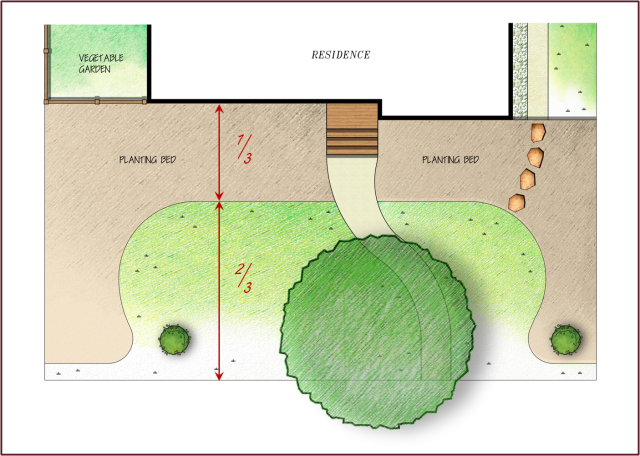
For relatively simple designs, the rule of thirds, or an adaptation thereof, can be used. As it pertains to landscape design, this means elements or dimensions that relate to each other in a 1:3 or 2:3 ratio.

This is most effective when applied to linear dimensions. For example, in my own front yard the linear distance from the street to the house is roughly divided into thirds, one-third being garden space and two-thirds lawn space. (Please ignore the goofy little strips of lawn at the bottom on both sides – bad design.)

PROPORTION - front yard

If however, we look at the horizontal dimension of this same yard, the rule of thirds isn’t adhered to. The existing walkway is too far to the right, and more significantly, the overall or cumulative width of the side beds is only 14 feet – less than the 20 feet needed to satisfy the rule of thirds.

PROPORTION - front yard 2

Both beds would have to be wider to make up one-third of the total horizontal space, but the current position of the walkway and the two Cotoneaster shrubs preclude this option.

While these horizontal proportions may be less than optimal, the overall proportions are still quite favourable – at least on paper. However, because the yard slopes somewhat, the garden area in front of the house appears much shallower from the street. This makes the lawn look disproportionately large in both directions – a real source of frustration for me. It could of course be remedied, but not using the present design lines. I get tired just thinking about the work required to execute effective change, not to mention the expense. You can see why good design requires some forethought, preferably expressed first on paper. I suspect if I’d known what I was doing decades ago when I began this whole thing, I would have designed something very different. Sigh.

For now I’ll just have to resort to that hypocritical mantra of many a parent, teacher or boss: ‘Do as I say, not as I do’.

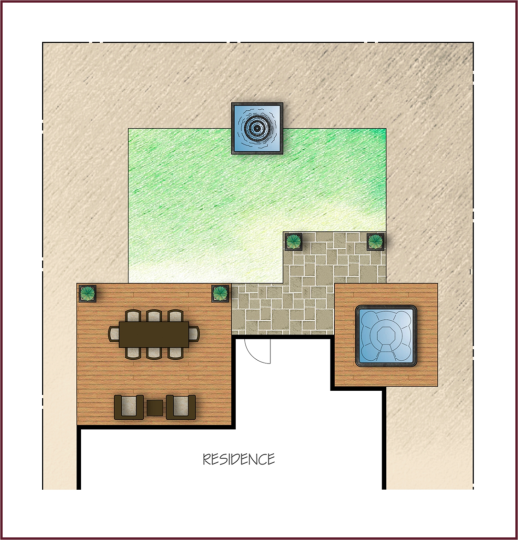
But enough about me.  Let’s look at a simple design that puts the rule of thirds to work. The example below illustrates a symmetrical design using the rule of thirds to achieve good proportion. You can see that all of the rectangular spaces relate to one another in a 1:3 or 2:3 ratio – the lawn area is 2/3 the width of the property, the dining area is 2/3 the width of the lawn and the seating area is 2/3 the width of the dining area.

Rule of ThirdsIn addition each rectangle is in itself proportioned such that the shorter dimension is two-thirds the length of the longer one. The result is a design with very pleasing proportions.
PROPORTION - plant material

The rule of thirds can also be applied to plant selection, albeit loosely as plants don’t reach an exact height, but rather a range – keeping this range in mind can help you achieve well proportioned planting arrangements.

In the photo on the right, two Syringa sp. together with Picea pungens, illustrate one such plant grouping.

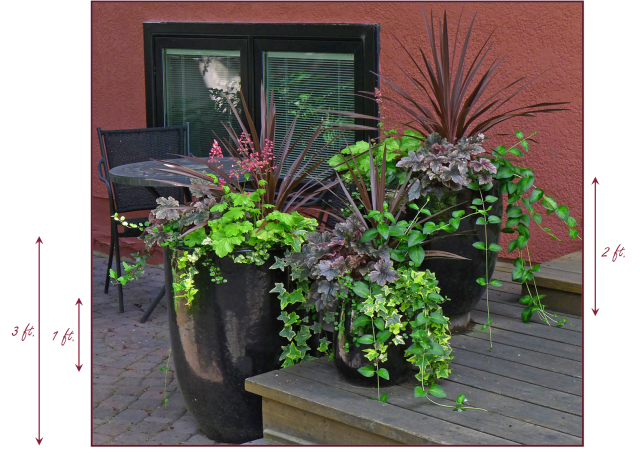
Containers too can be arranged this way – many ‘nesting pots’ are trios that bear a 1/3, 2/3 relationship to each other. Planting them in a similar or identical manner is very effective.

These 3 containers on my client's front deck display good proportion based roughly on the rule of thirds. Photo: Pat Gaviller

These 3 containers on my client’s front deck display good proportion based roughly on the rule of thirds. Photo: Pat Gaviller

The rule of thirds is not always easily or realistically applicable – existing hardscapes, the shape of adjacent buildings, positioning of property lines, or even the design itself, can make this tool ineffectual. Many of the elements we add to our gardens – be they plants, focal points or furniture – don’t really lend themselves to the use of this ratio either. This is when we just have to rely on our intuition and common sense.

Consider a tiny bird bath or piece of statuary – it might appear lost in an expanse of trees and large shrubs, but be right at home amongst smaller perennials. Likewise, that gargantuan classical fountain may look ridiculous adorning a small urban patio, but fit perfectly into a more grandiose courtyard or terrace, as illustrated in the photos below.

Court of the Lions, Alhambra, Granada, Andalusia

Court of the Lions, Alhambra, Granada, Andalusia. Photo Credit: Wikipedia

Gardens at the Livadiya Palace, Crimea, Ukraine.

Gardens at the Livadiya Palace, Crimea, Ukraine. Photo Credit: Andrew Butko, Wikipedia

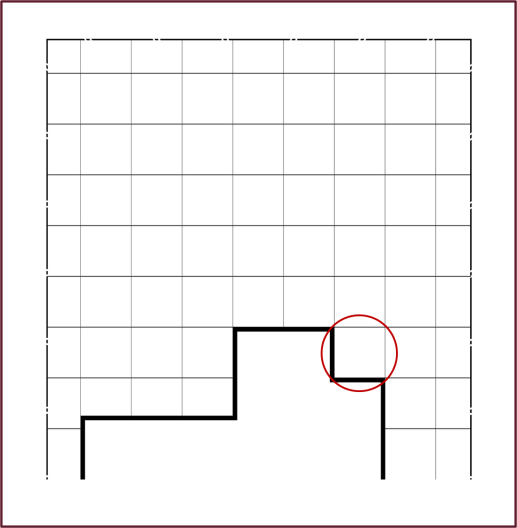
Another way we can ensure good proportion in our landscapes is with the use of a grid. To do this, draw a series of vertical and horizontal lines on some trace paper and place over a plan view of your property. It’s most effective if you can make the size of the grid square relate to the house in some way, but be careful not to make the square too small or the whole purpose will be defeated. In the example below, I’ve chosen a grid square that is the same size as the house indentation in the right corner.

GRID

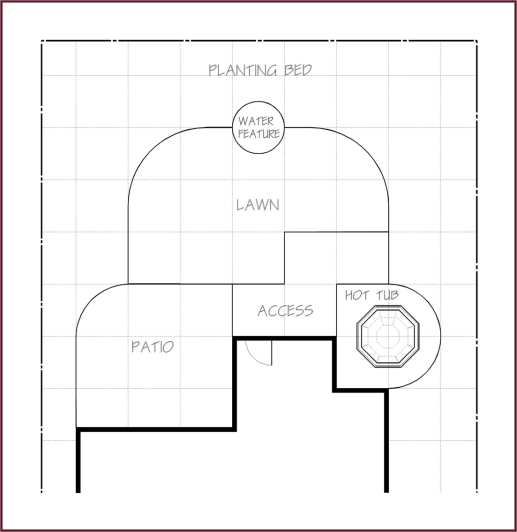
The grid lines are then used as an outline for the design.

PROPORTION - RECTILINEAR

Your choice of design concept isn’t limited to straight lines as the grid is just a template – arcs could be inserted into some of the corners to create an Arc & Tangent design. Each arc would necessarily segment or bisect a grid square.

PROPORTION - ARC & TANGENT

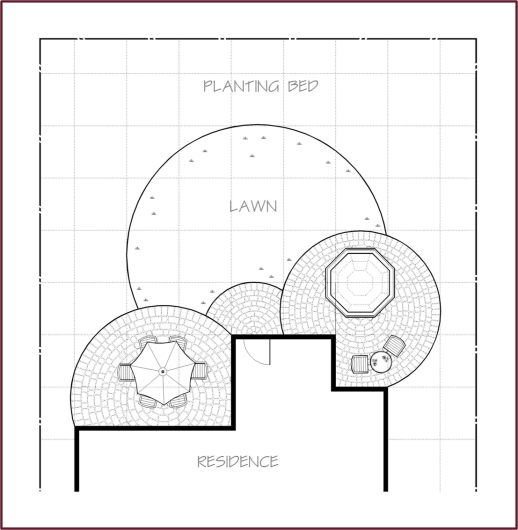
For circular or curvilinear designs a grid can still be used, but because there are no straight lines it must be more loosely interpreted. Ideally the outermost point of an arc or circle should extend to a grid line – since this isn’t always possible using up a half grid square is acceptable.

GRID - circular

Regardless of the concept, the spatial relationship that now exists between all design elements, is one of good proportion.

GRID - RECTILINEAR Colour

GRID - CIRCULAR Colour

So ladies and gentlemen, there you have it – design principles in a nutshell. It’s been a long process – thanks for your patient reading.

Happy New Year to Y’all
Sue
 
 
© Sue Gaviller and Not Another Gardening Blog 2012. Unauthorized use and/or duplication of this material without express and written permission from this blog’s author and/or owner is strictly prohibited. Excerpts and links may be used, provided that full and clear credit is given to Sue Gaviller and Not Another Gardening Blog with appropriate and specific direction to the original content.

Are You Done Yet?

I’m not.

Getting there though – just a few gifts left to take care of, mostly stocking stuffers really. How about you – still looking for some last-minute Christmas gift ideas? Well maybe we can help.

Is there a gardener on your list? Good – we gardeners are easy to buy for. Gardening can be hard work, so anything that makes it a little easier on us is always appreciated. Ergonomic secateurs, long-handled shears, a really good pair of buttery-soft leather gardening gloves, gardener’s soap and hand balm – all make very thoughtful gifts. Or how about a beautiful gardening book?  A gardener can never have too many of those – we especially like books with big glossy pictures (my husband calls this plant porn).

Not a gardener? Sorry I can’t be of much help then – our Sommelier extraordinaire has some ideas though…….

The Spirits of Giving

by Len Steinberg

It’s that time of year. We’re preparing for the season of giving and not everyone on our list is easy to buy for. Some already have everything they need, some are just picky and some we just don’t know very well.  I have some solutions for you.

Rich foods, baking and sweets are a big part of the Christmas Season. There a number of wines that will work very well with those sweet indulgences and make excellent gifts.

Port

This is a fortified wine which finds its origin in the Douro Valley of Portugal. Port is produced by arresting the fermentation process with neutral spirits – this preserves the natural sweetness of the grapes while boosting the alcohol level to 17 to 22%. It comes in a number of styles:

  • Ruby, a young fresher style.
  • Tawny, a barrel aged oxidized style which is classified by age.        
  • LBV or Late Bottled Vintage, which fits in the middle of the two styles. I feel LBV port is one of the best values on the market.
  • Vintage port, declared in only the best years, has great longevity in bottle and is of course pricey.
Tawny Port

Tawny Port. Photo credit: Wikipedia

Port is usually served after a meal and pairs well with baking, chocolate and nuts.

The classic cheese pairing would be Stilton, and Christmas cake or Christmas pudding also work splendidly.

Dessert Wines

Dessert wines come in a number of styles:

Late Harvest Wine

Late Harvest wines are produced from grapes left on the vines for an extended period of time, which allows for a concentration of flavour and sugars. This style of wine is produced around the globe, Canada being a premier producer, along with Alsace, Germany and Australia. Look for grape varieties of Riesling, Vidal, Semillon and Sauvignon Blanc. They pair well with fruit flans, caramel tarts and strong cheeses, even blue cheese.

Ice Wine

Ice Wine is a unique production process that can only take place in colder climates. Grapes are left on the vine to freeze to temperatures of -8 to -10 Celsius. The grapes are then picked and fermented into beautifully structured dessert wines. Canada produces some of the world’s greatest examples of Ice Wine, from both Ontario and British Columbia. In Quebec they are producing Ice Apple Ciders that are delicious. These wines are concentrated and as a result the prices tend to be a little higher.

Ice wine grapes frozen on the vine. Photo credit: Wikipedia

Ice wine grapes frozen on the vine. Photo credit: Wikipedia

Ice Wine is produced mostly from white grapes like Riesling or Vidal but some producers are making wines from red varieties like Cabernet Franc. These wines present rich fruit on the nose and due to the high acidity, are much crisper and more structured than you might expect. They pair well with a full range of desserts – be sure to take into account the grape variety when pairing.

Sauterne

Sauternes and other Botrytis Affected wines are quite extraordinary. The grapes used to produce these wines are infected with the benevolent form of Botrytis cinerea or Noble Rot. This fungus breaks down the cellular walls of the grape which causes the fruit to lose moisture, concentrating the sugars and flavours, and developing bold structure.

Botrytis cinerea on Semillon grapes. Photo credit: Wikipedia

Botrytis cinerea on Semillon grapes. Photo credit: Wikipedia

In the Sauterne region of France the classic grapes used are Semillon and Sauvignon Blanc, in a blend.

In Alsace, Gewürztraminer, Pinot Gris, Riesling and Muscat grapes are used. You can find BA wines from many wine-producing countries, including Canada and the US.

Sauternes are the standard for this style of wine. They have great cellaring potential, improving with age. They are complex enough to be paired with savoury dishes, classically Fois Gras and Roquefort. For dessert pairings, accent flavours of apple, pear, cinnamon or exotic fruits. Ginger Bread is always a favorite too.  These wines come in many price ranges, with the quality being directly linked to price.

Champagne and Sparkling Wines

These are the sought-after wines of celebration.

Champagne uncorking. Photo credit: Wikipedia

Champagne uncorking. Photo credit: Wikipedia

Sparkling wines are made around the world, but the classic bubbles – true Champagne – comes from Champagne, France. Here the wines are produced in various styles, from 3 grapes: Chardonnay, Pinot Noir and Pinot Meunier.

Champagne is produced by secondary fermentation in bottle, producing the mousse or bubbles we love so much. You can find less expensive sparkling wines that use the Charmat or tank method of production, like Prosecco or Asti.

All sparkling wines are very versatile and make excellent aperitifs, on their own or with the addition of a flavoured liqueur. As well, they can be paired with almost any course with an affinity to seafood, shellfish and fresh fruit.

The gift of wine is always a treat, but there are also alternatives for those that prefer stronger beverages.  Choose someone’s favorite Whisky, Brandy, Tequila, or Rum. For those who don’t imbibe there are Sparkling Ciders, and Alcohol-free wines and sparkling wines.

Essentially there is something for everyone in the world of wine. Let’s raise a glass to the season.

“To Life”
Len
© Sue Gaviller and Not Another Gardening Blog 2012. Unauthorized use and/or duplication of this material without express and written permission from this blog’s author and/or owner is strictly prohibited. Excerpts and links may be used, provided that full and clear credit is given to Sue Gaviller and Not Another Gardening Blog with appropriate and specific direction to the original content.

A Nice Pair Part 2 – What Should I Have to Drink With This?

‘Tis the season.

Depending on your cultural or religious background you might be participating in the frenzy of shopping, cooking, eating and drinking that is the Christmas Season. So many decisions still to make – like what to buy for Mom or Dad, son, daughter, boss or in-laws. Or what delectable delights we’re going to dish up for our guests. And what kind of wine should we serve with that?

Resident Sommelier, Len Steinberg, offers some helpful hints…………..

Let it Snow, Let it Snow, Let it Snow

by Len Steinberg
 

Winter has arrived with a vengeance. I know weather varies by locale but when you live anywhere in Canada you just can’t escape the cold. The seasons change, as do our appetites and menu choices. Fall and winter fare tends to be on the heartier side. We move away from the lighter meals of summer to the rich flavours of comfort food, like braised and roasted meats, stews, and soups. These, along with the texture and flavours of root vegetables and hearty grains, will be on the menu for the duration.

The switch to winter fare also brings the change on our palates for wine. Not to suggest that there isn’t a place for fresh whites and lighter reds, but the seasonal changes in cooking styles call for heavier wines to match the weight of our dishes. The whites tend to be fuller and richer in texture while the reds are deeper and more structured.

Here is a quick look at a few seasonal dishes and some possible pairings.

Roast chicken is one of our favorites. We still like a dry Riesling for this one, but an oaked Chardonnay or a Bordeaux White is also a great match. If the sauce is rich, a chipotle rub for example, a medium bodied red like a Cotes du Rhone or Pinot Noir is a good fit.

Baked ham or roast pork is a fine choice for a hearty meal. Once again a white may be on the menu, possibly Viognier or an Arneis from Piedmont. Reds work too – maybe a Spanish Grenache, a medium bodied Zinfandel from California, or a Barbera.

Pasta in our house calls for red wine. A Chianti, Valpolicella or Chilean Carmenere is always nice.

Cabernet Sauvignon from Sonoma region in California

Cabernet Sauvignon from Sonoma region in California.
Photo Credit: Wikipedia

Stews of any sort call for bold reds. Whether lamb or beef, braised meats have that concentrated richness from the slow cook. I like to use a similar wine in the sauce while it simmers. Merlot, Malbec or Cabernet Sauvignon will enhance the flavours of the dish.

Roasted beef or lamb is rich protein and the flavours demand the structure of big Reds. I reach for Bordeaux Reds or Meritage Blends, Cabernet Sauvignon, Shiraz or Nebbiolo to round out the meal.

This is a great time of year to explore the world of wine. Try a new producer, country or grape variety. Wine can be a fun and inexpensive way to ‘travel’ to warmer climes as we endure the storms of winter.

Malbec vineyard in Cahors, Southwest France

Vineyard in Cahors, Southwest France. Photo Credit: Wikipedia

Take a beautiful Malbec from Southwest France.

As you inhale the complexity of the aromas, close your eyes and imagine standing in the vineyards on a warm summer afternoon.

Works for me.

Cheers,
Len
 
© Sue Gaviller and Not Another Gardening Blog 2012. Unauthorized use and/or duplication of this material without express and written permission from this blog’s author and/or owner is strictly prohibited. Excerpts and links may be used, provided that full and clear credit is given to Sue Gaviller and Not Another Gardening Blog with appropriate and specific direction to the original content.