Pretty in Pink

Everything’s popping up pink along city boulevards, in parks and front yards – the first of the spring-flowering shrubs are strutting their stuff.  These pretty ladies are various species of the Prunus genus, a large genus that includes peaches, plums, cherries, apricots and almonds. In Calgary, the current explosion of pink blossoms comes from 3 different species.

Prunus tomentosa is first on the scene, with pale pink flowers that present before the leaves.  Commonly known as Nanking Cherry, this medium to large shrub is native to China, Korea and the Himalayas. It has been cultivated in North America since early last century, providing a drought tolerant, cold hardy (Zone 2) shrub that grows to a height and spread of 2–3 metres. It produces small tart cherries that are excellent for jams and jellies.

Prunus tomentosa

Pale pink Prunus tomentosa is a common sight on city boulevards. Photo: Sue Gaviller

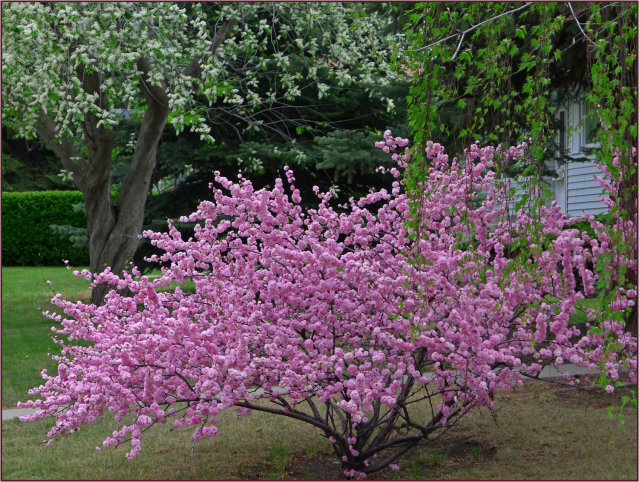
Prunus triloba multiplex, the double-flowering plum, is by far the showiest of the three, its large double pastel-pink blossoms like cotton-balls along the many arching stems. A very vigorous grower, reaching 2–3 metres tall and wide, it will benefit from periodic pruning to remove any crossed or rubbing branches. This variety is sterile and doesn’t produce fruit.

Prunus triloba multiplex. Photo: Sue Gaviller

Prunus triloba multiplex. Photo: Sue Gaviller

Prunus tenella (Russian almond) is a smallish shrub with an upright vase shape and narrow green leaves that appear at the same time as the medium pink flowers. It’s compact and tidy, reaching only about 1 metre in height and spread. Very fragrant too, it is much underutilized in the urban landscape.

Prunus tinella. Photo: Sue Gaviller

Prunus tenella. Photo: Sue Gaviller

Despite their similar appearance when seen from a distance, these three shrubs have very different blossoms. Left – Prunus tomentosa. Middle – Prunus tenella. Right – Prunus triloba multiplex.  Photos: Sue Gaviller

Despite their similar appearance when seen from a distance, these three shrubs have very different blossoms. Left – Prunus tomentosa. Middle – Prunus tenella. Right – Prunus triloba multiplex.
Photos: Sue Gaviller

Design Value

Many designers eschew the use of these shrubs because they’re “old fashioned”. It’s true they are, but they still have design value. They’re right at home in a Naturalistic garden and are especially useful in Asian-inspired or Colonial style gardens – and they’re reliably floriferous too.

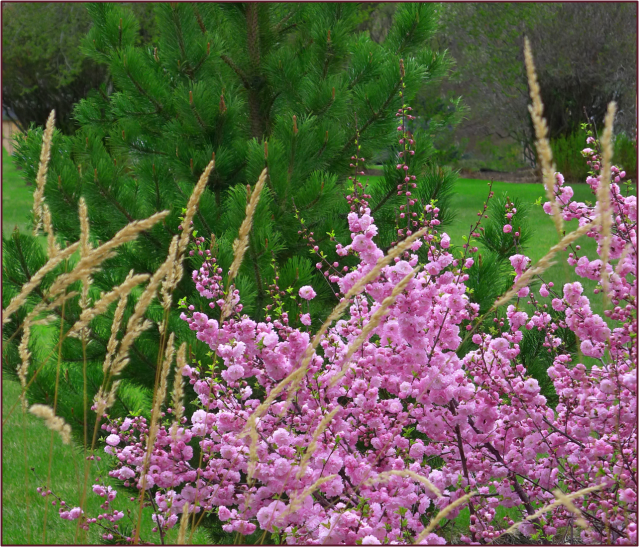
A naturalistic planting of grasses, pine and double flowering plum in a local park.  Photo:Sue Gaviller

A naturalistic planting of grasses, pine and double flowering plum in a local park.
Photo: Sue Gaviller

Prunus tomentosa is lovely in front of the Asian inspired fence I designed for a client. Photo: Sue Gaviller

Prunus tomentosa is lovely in front of an Asian-inspired fence I designed for a client. Photo: Sue Gaviller

When finished blooming, their design worth is more as a backdrop than a showpiece. Nanking cherry and flowering plum both have a lovely natural vase shape, as well as dark green, medium-coarse leaves which provide nice contrast to other brighter plants. Russian almond is much finer textured with lighter green leaves – together with its very upright branches, also provides good contrast in the landscape. And as woodies, they all offer much-desired structure to our gardens.

Perhaps it’s time to rethink these old-fashioned beauties – charm and grace come with age you know.

Til next time,
Sue

The Form of Things to Come – Part 6

I promised myself I wouldn’t begin today’s post with comments or complaints about our wintry weather as I did in three of my last four posts. I don’t want readers to get the erroneous impression that Canada is the land of perpetual ice and snow. Nor do I want readers to think all Calgarians are a bunch of weather-whiners. And I certainly don’t want you to think that whining about the weather is my shtick – the hippy dippy weather girl, or that it’s the only intro I can come up with. Because it’s not. I have plenty of clever intros up my sleeve – clever is my middle name. So how about this… nah, okay then how about…. dagnabbit, folks that’s all I got today. I just wanna whine about the weather okay?

Correct me if I’m wrong fellow Calgarians, but has it not been an extraordinarily long winter? I know it’s only the middle of April but Spring isn’t even trying anymore. She just teased us and left us high and dry – well more like cold and wet. Even my stoic husband, who chides weather-whiners for bemoaning that which they can’t control, has on two recent occasions grumbled about the weather. “This weather is sucking the life out of me,” he lamented last night.

Today I look out my window at snow-covered branches, knowing there’s more snow in the forecast – I don’t even think it makes for a pretty picture anymore. I feel like I’m in Narnia under the white witch’s rule – where “it’s always winter, but never Christmas” (uttered with the most refined of British accents). Enough already old man winter – go away.

Okay I’m done complaining now. I’m not even going to attempt a smart segue into today’s topic, I’m just going to start right in on rounds and mounds and flats and mats. If you’re joining me for the first time, you may wonder what on earth I’m talking about – if you’ve been following my latest series of posts, you’ll know of course that I’m referring to plant form.

Round/Mound

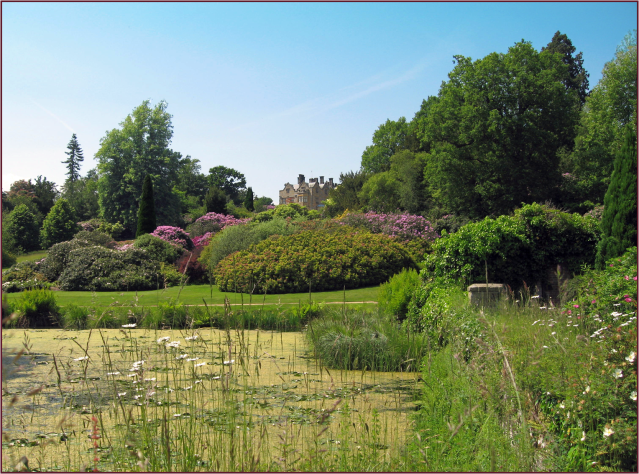
Rounded plant forms grow in a roughly spherical shape. Mounds are somewhat flattened rounds.  These “roundy-moundys”, as my design instructor called them, are the most common form. They are non-directional, meaning they don’t send the eye up or down – rather the eye just glides over them and moves through the landscape in an undulating kind of progression.

Round and mound forms

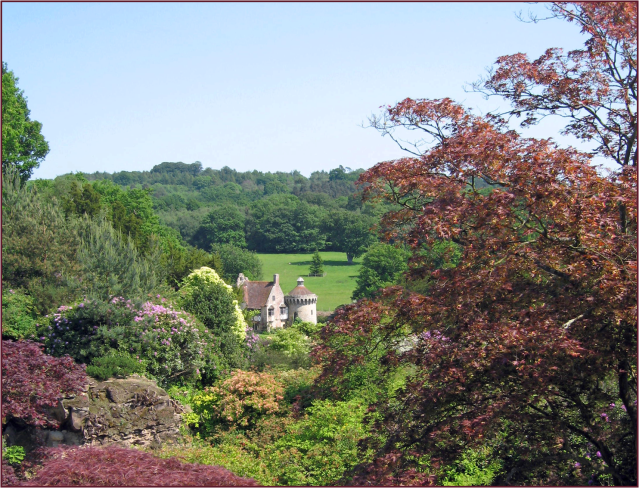
This rolling English landscape consists mostly of rounded/mounding trees and shrubs. Photo: Marny Estep

Rounds and mounds are relatively neutral and soft, thus aren’t particularly dominant forms. They can be massed, work well grouped in threes, and a single round form, if large, can make an effective anchor. As well these forms can “echo” other curvy forms.

A trio of Cherry Bomb Barberry orbs visually supports the more dominant weeoing caragana. Photo: Sue Gaviller

A trio of globe-shaped Cherry Bomb barberry visually supports the more dominant weeping form of Walker’s caragana in a client’s gardenThey also nicely echo the orbicular shape of the wall-mounted light fixture. Photo: Sue Gaviller

Globe cedar

A large globe cedar provides a visual corner anchor. Photo: Sue Gaviller

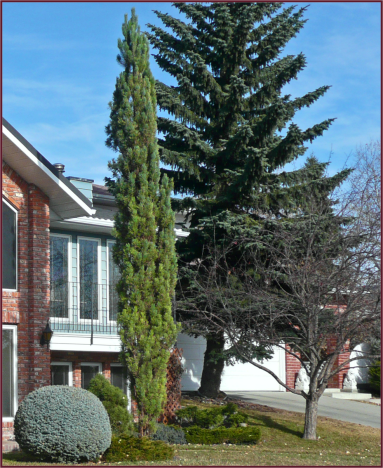
Round forms are excellent foils for colmnar forms like this Pinus sylvestris 'Fastigiata', but the effect would have more credibility if the heavily pruned round evergreen had more natural form. Photo: Sue Gaviller

Round forms are excellent foils for columnar forms like this Pinus sylvestris ‘Fastigiata’, but the effect would have more credibility if the heavily pruned globe-shaped evergreen had more natural form. Photo: Sue Gaviller

Despite the ubiquity of the round/mound form, gardeners and landscapers seem to want more of it, often pruning shrubs unnaturally into this shape. It may be that the form’s common presence leads to the mistaken notion that all shrubs are round; hence they all get pruned that way. Or it may be that gardeners intuit the gentle movement that results from the use of rounded or mounding forms in the landscape.

Regardless, this pruning style can sometimes produce attractive results and sometimes not.

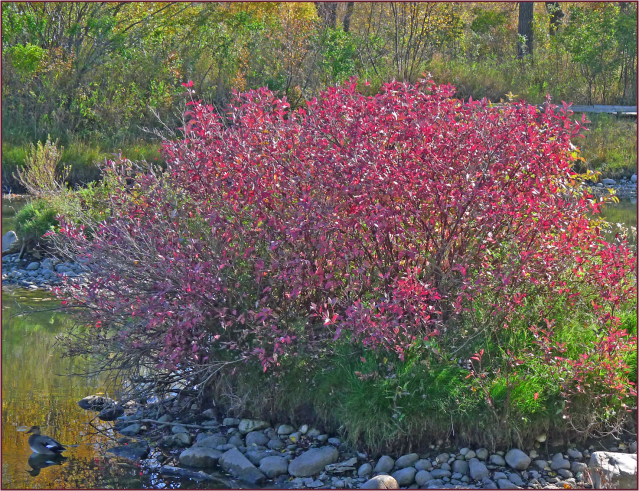
Cornus sericea natural form

Cornus sericea has a naturally round form. Photo: Sue Gaviller

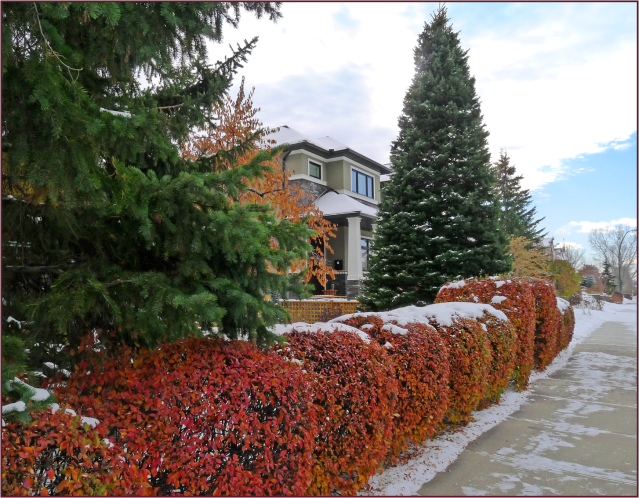
Cotoneaster

While Cotoneaster lucidus grows naturally as a very large loosely shaped ball, this homeowner has pruned them into an attractive rhythmic sequence of perfect spheres. Photo: Pat Gaviller

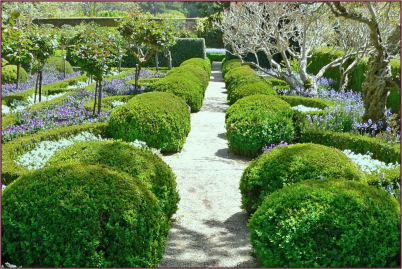
Round forms

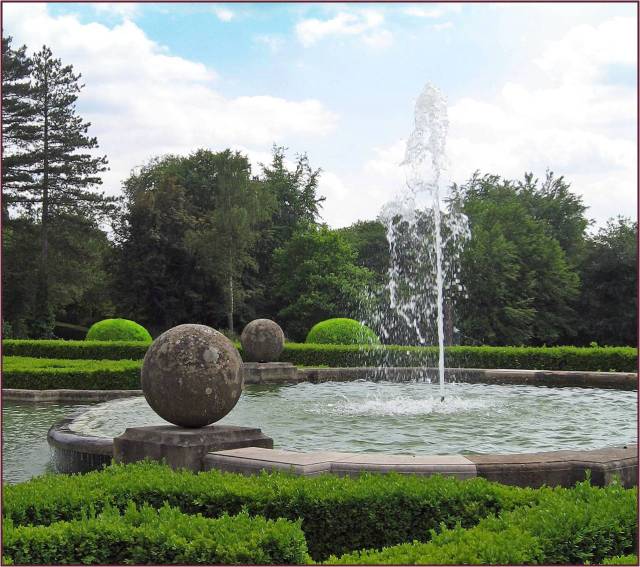
Geometric forms like these roundly sheared boxwood, abound in formal landscapes. Note the very rolling movement that results, especially when planted sequentially. Photo: Jane Reksten

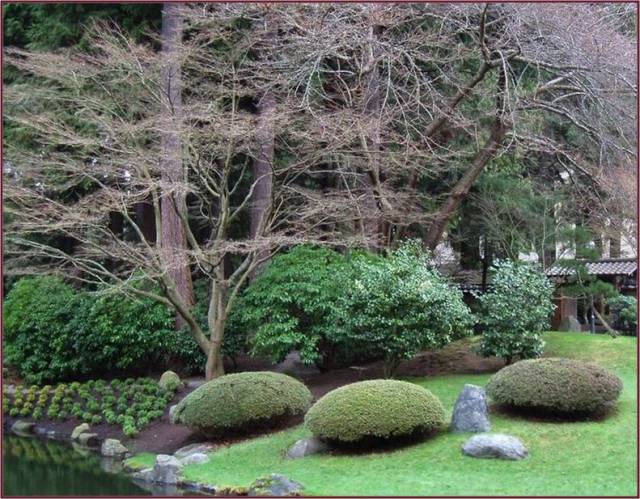
This form is common in certain theme gardens – for example, in the Japanese garden, shrubs are pruned into globose forms to mimic rocks, an important component in their garden compositions.

Formal gardens too, utilize very round shapes as well as other strong geometric forms.

Round forms in Formal Garden

In this formal landscape, shrubs have been pruned to repeat the shape of the stone spheres .
Photo: Marny Estep.

pruned mounds in Japanese Garden

Three mounded shrubs pruned to symbolize rocks. Japanese Garden, UBC. Photo: Ann Van de Reep

Keep in mind that despite their relative neutrality, round forms can be overused – so use them freely but make sure you punctuate periodically with other forms.

Flat/Mat

Flat forms are much wider than they are tall, and of course flat. If they have any appreciable curve to their upper surface then they are actually mounds – due to the undulating movement the curved surface creates. Flat forms that hug the ground and create spreading groundcovers are mats.

Mat form - underplanting

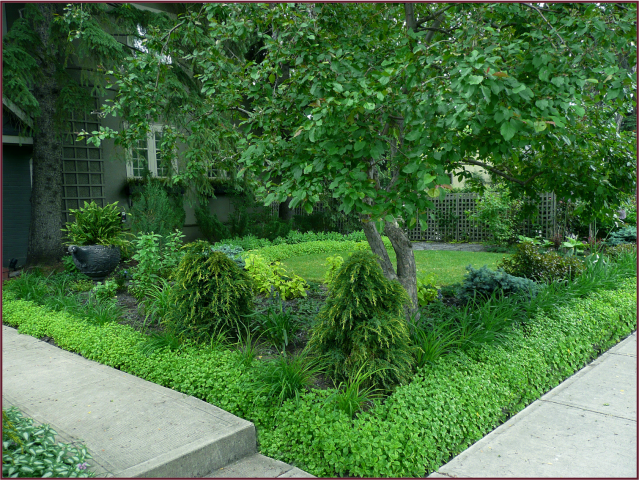
Spreading Juniperus sabina ‘Calgary Carpet’ underplants Syringa reticulata ‘Golden Eclipse’ in a client’s front yard.
Photo: Sue Gaviller

Like rounded and mounding forms, flat and mat forms are very common.

They are the most neutral of all the plant forms, making them excellent backdrops or underplantings for other more significant elements, like a focal point or specimen tree.

Their shorter stature and flattened surface, relate the scale of the garden to the horizontal plane of the ground.

mat form - junipers

Various Juniperus sabina and horizontalis cultivars underplant other trees and shrubs and effectively delineate the planting space and the lawn. Photo: Sue Gaviller

In addition, flat and mat forms transition the landscape from pathways or lawn into the garden, thereby connecting them.

Mat forms - transition

Numerous flat and mat forms in my front garden provide a transition zone, connecting the lawn to the garden. Photo: Sue Gaviller

Thymus pseudolanuginosis

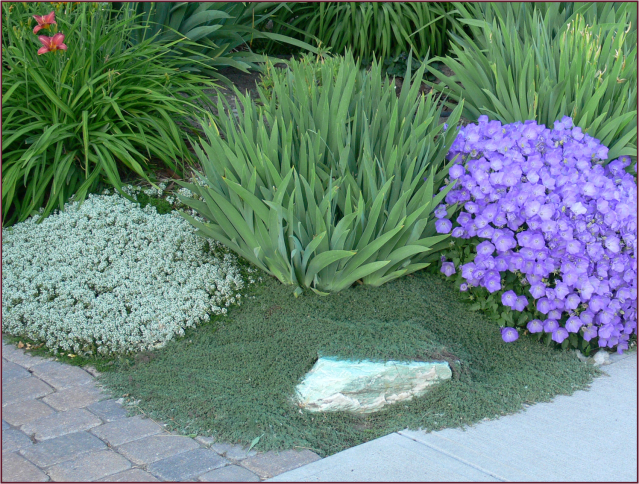
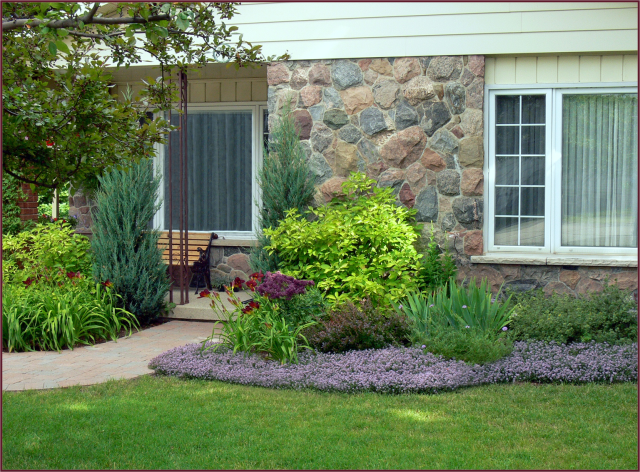
The mat form of Thymus pseudolanuginosis provides transition from sidewalk to garden and softens the straight lines of the pathways. Photo: Cathy Gaviller

Well my friends I’ve reached the end of my discussion on plant form. Texture and colour are next, but I think I’ll postpone those until our gardens wake up a bit and allow for some new ‘photo pursuits’. I’ll come up with some other topics to write about in the interim, so do stay tuned.

As I’m preparing to publish this post, I’ve become aware of the scary events that occurred in Boston earlier today – our weather woes seem suddenly pretty trivial. I won’t complain again anytime soon.

Be sure to hug your loved ones tonight.

Til next time,
Sue
 

© Sue Gaviller and Not Another Gardening Blog 2012.

Unauthorized use and/or duplication of this material without express and written permission from this blog’s author and/or owner is strictly prohibited. Excerpts and links may be used, provided that full and clear credit is given to Sue Gaviller and Not Another Gardening Blog with appropriate and specific direction to the original content.

The Form of Things to Come – Part Five

They say gardeners and golfers are the most impatient people on the planet. While I can’t speak for golfers as I don’t golf, I can certainly attest to the impatience of gardeners. Whether it’s for a prized plant to bloom or for the arrival of gardening season, we have difficulty waiting.

It’s tempting to let the warmer days and chirping robins declare the beginning of the season, but the snow has barely melted and the ground is still soggy. Patience gardeners – old man winter has at least one more kick left in him. So to keep y’all busy while patiently waiting for another gardening season to begin, let’s have some more ‘Fun with Forms’. Today I look at….

Fountain Forms

Fountain-shaped plants grow upward, then arch out and curve downward, often to the ground. They are graceful and soft, so most of the plants that exhibit this form are herbaceous perennials – daylilies, grasses/sedges, and ferns for example. There are also some woody shrubs that grow in this manner – bridal wreath spirea and Rose Glow barberry to name a couple.

Rose Glow Barberry and Ornamental Grasses

The fountain forms of Berberis thunbergii ‘Rose Glow’ and ornamental grasses create an elegant picture in this Victoria, B.C. garden. Photo: Pat Gaviller

Like weeping forms, fountains draw the eye up and back down again, but their form is much less rigid, so has a different landscape application.

While its exquisite form can make a fountain-shaped plant an appropriate accent or feature, the emphasis it provides is quite subtle because of the soft drape of its foliage. Larger size then, must also be a factor if this form is to truly stand out.

Ornamental grass and statue

A large fountain form like this striking Miscanthus can provide emphasis on its own, but the effect is that much more pronounced when paired with a non-living focal point. The two together make a stunning feature. Photo: Pat Gaviller

Fountain forms can be used fairly freely in the landscape but they do require some woody neighbours with stiffer structure to visually support their more yielding form. They’re neutral enough to be massed, the resulting effect a bit like waves in the ocean. Smaller selections planted en masse are great for underplanting a specimen tree and look especially lovely in front of a taller vertical accent to ‘stage it’.

Daylily underplanting

Left – A mass of fountain-shaped Hemerocallis provides a neutral underplanting for Syringa reticulata. Photo: Sue Gaviller.
Right – Hemerocallis ‘Stella d’Oro’ effectively stages the very vertical Caragana arborescens ‘Sutherland’ and bird bath, creating a lovely focal vignette. Photo: Sue Gaviller

This form is particularly effective when planted along the length of a design line, serving to accentuate it. When planted along both sides of a walk, fountain shapes define the passageway while still maintaining an open, welcome space.

Helictotrichon and Hemerocallis

Fountain shapes look lovely as spatial definers. Here a swath of Helictotrichon sempervirens lines the sidewalk and Hemerocallis delineates the property line. Photo: Sue Gaviller

Fountain forms can also be useful for repeating the cascading branches of weeping trees, or mimicking the spray pattern of a water fountain. This repetition of line and form brings unity to a garden composition.

Carex

Repeating clumps of ornamental grasses echo the form of both the weeping Norway spruce (right) and the droopy foliage of the pom-pom cypress (left). Photo: Pat Gaviller

Helictotrichon

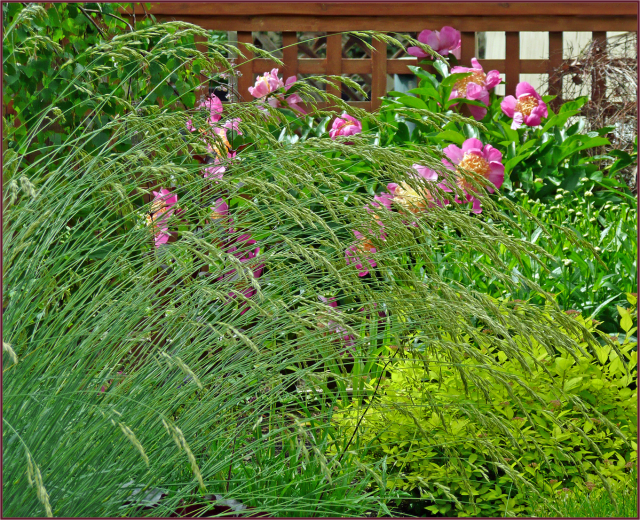
The beautiful inflorescence of Helictotrichon sempervirens appear like sprays of water in this scene from my front garden. The effect is especially marked when backlit by late-day sun. Photo: Sue Gaviller

Keep in mind that some perennials have foliage that grows in an arching fountain shape, but the flowers have a more upright growth habit. For example, Calamagrostis foliage is fountain-like but the inflorescence is upright, so when in bloom the overall effect is that of an upright column. Or the reverse may be the case where only the flowers exhibit a fountain form and the foliage presents as some other form. Determining whether a plant should be utilized as one form or the other will depend on when it blooms. In the case of Calamagrostis, the inflorescence appears fairly early, so the whole plant presents as an upright form for most of the season and should thus be used accordingly.

Well fellow gardeners, we have only a couple more plant forms to look at – I’ll cover those in the next and final post in this series on Plant Form in the landscape. Do come back!

Until then,
Sue

© Sue Gaviller and Not Another Gardening Blog 2012.

Unauthorized use and/or duplication of this material without express and written permission from this blog’s author and/or owner is strictly prohibited. Excerpts and links may be used, provided that full and clear credit is given to Sue Gaviller and Not Another Gardening Blog with appropriate and specific direction to the original content.

The Form of Things to Come – Part Four

Top o’ the mornin’ to all ye lads and lasses. Today is St. Patrick’s Day – a good day to celebrate all things green don’t ya think?  Not so green ’round here though is it?

Well soon enough my friends, soon enough. Spring will come – in the meantime we still have a ways to go in our study of plant form, texture and colour. I’ll try to have you ready in time for the frenetic plant-shopping sprees that will begin in the next month or so.

Continuing our exploration of plant form then…. next up are grafted standards and topiary forms.

Grafted Standards

A grafted standard is essentially a shrub grafted onto a stem or “standard” – also called a top-graft, the overall effect is that of a stick with a ball on top. If that sounds disparaging, it isn’t intended to – they’re actually very attractive additions to the landscape. Many different shrubs can be grafted this way, but the ones that work best are those that are smallish with a naturally round(ish) growth habit – this means minimal pruning will be required. Dwarf Korean lilac, globe spruce and globe Caragana are all commonly used and available in grafted form at most nurseries.

Depending on the particular shrub used, the height of the standard, and how it is pruned, this form can have several landscape or garden applications. They work well as linear plantings to emphasize a design line – both curving and straight design lines can be planted this way.

I designed this fence/wall combo to prevent weed encroachment from a neighbouring property onto my client’s property. It nicely showcases these three top-graft globe spruce. Photo: Sue Gaviller
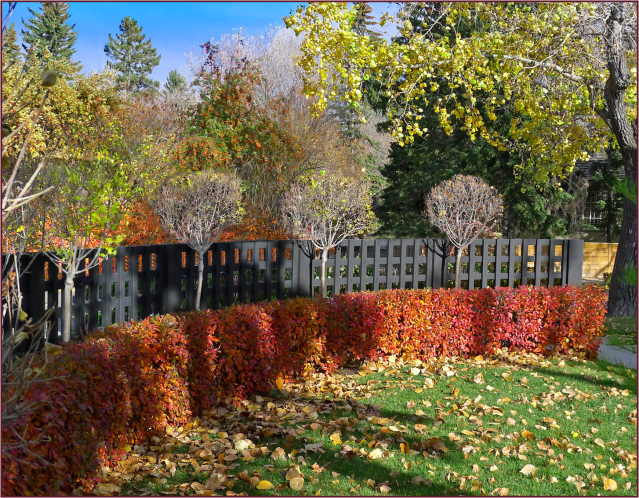
Rhythmic repetition of grafted Syringa meyeri standards reinforce movement along this uniquely curving fence. Photo: Sue Gaviller

A row of grafted Syringa meyeri standards accentuates a curving fence line. Photo: Sue Gaviller

Euonymus fortunei standard

This oddly shaped Euonymus fortunei standard makes a unique feature tree. Photo: Pat Gaviller

If they’re tallish and not too wide, two top-grafted standards on either side of an entryway, can make an attractive frame – not so much, if they’re short and stout though; these are best used as single specimens.

I find this form to be especially useful when designing certain theme gardens, most notably Mediterranean, Colonial and English Landscape Style.
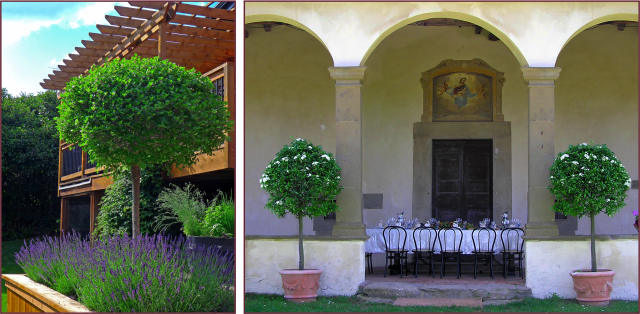
Mediterranean Theme

Left – Top-graft Syringa meyeri is underplanted with Lavandula angustifolia ‘Hidcote’ in a client’s Mediterranean-inspired back yard. Photo: Pat Gaviller
Right – Two potted standards gracefully frame an arched entryway for a Tuscan wedding reception. Photo: Cathy Gaviller

As a general rule grafted standards don’t work in groups (unless planted in a row along a design line), but there are of course exceptions to every rule – see below.
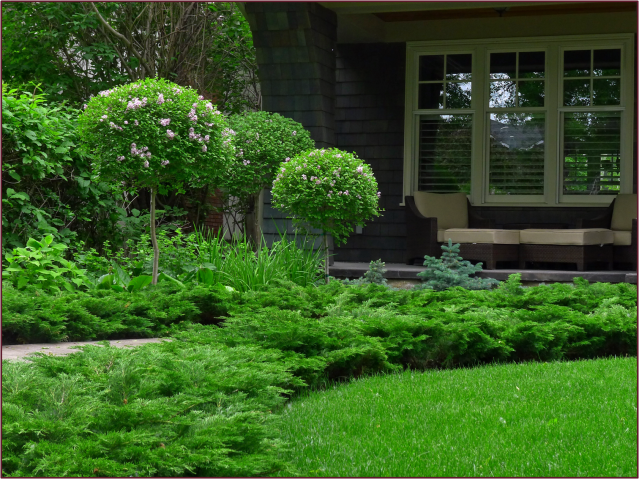
3 Syringa meyeri

Planting standards in a triad isn’t usually recommended, but in this scenario they are all different heights and widths – the end result is therefore quite pleasing. I suspect this was purposeful – very clever in fact.
Photo: Pat Gaviller 

Topiary

Topiary is the practice of shearing woody plant material into… well, just about any shape you can imagine. My intention here isn’t to instruct you in the art of plant sculpture (my attempt at topiary would likely result in something akin to Richard Dreyfuss’s infamous mashed potato mountain), but rather to instruct you in their appropriate use. Of course a shrub can be sculpted into a mouse, a monkey, or a monster but the most common forms you’ll find at a nursery are standards, pompoms, poodle tiers and spirals.

Standards

These are created by pruning a large shrub, which is naturally multi-stemmed, into a single-stem, tree-like form with a ball-shaped top.  They look pretty much the same as a grafted standard – in fact now that I think of it, a couple of the photos in this post were of standards I just assumed were grafted, but they could well have been shrubs that had been pruned to a single trunk, rather than grafted. No matter, their application is exactly the same.

Pom-poms

Pom-pom topiary is formed from a shrub that is pruned into several main stems with a “ball” of foliage at the end of each. This is a very unique form and  should be used as a lone specimen – this means only one in your entire composition. No grouping, repeating, planting in a row, or framing – they’re the wrong shape for any of these applications.
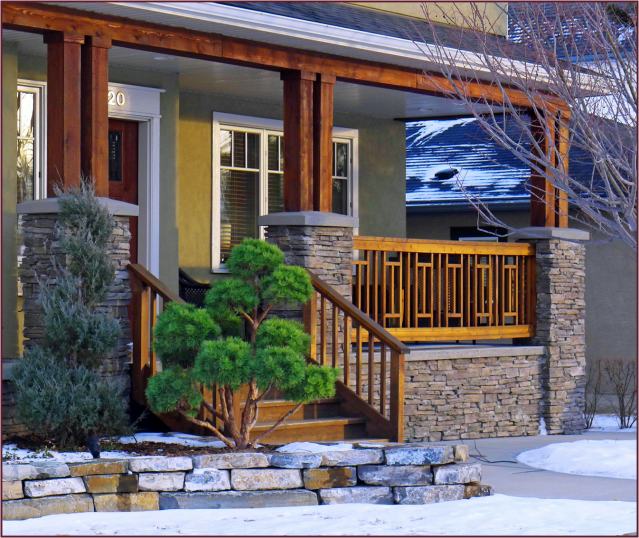
Topiary Pine

Pom-pom topiary has such distinctive form that it must stand alone, like this lovely pine, which has been situated beautifully. Photo: Pat Gaviller

Topiary pine and Syringa standards

This landscape is one I’ve featured before – I love its clean lines and minimalistic style. While I don’t as a rule choose to critique another’s work on this blog, for the sake of a teaching moment, I will suggest that the pom-pom pine might have greater effect without the Syringa meyeri standards to compete with.
Photo: Sue Gaviller

Pom-poms, especially pines, can lend an Asian feel to a garden composition because they, like bonsai, are part of the Japanese aesthetic. Topiary and bonsai are used to create Reduced Scale, an important Japanese design principle which refers to the reproduction in miniature, of scenes in nature – bonsai and topiary are used to fashion “trees”, but in much-reduced scale. For this reason, it is acceptable to use more than one of these forms in a Japanese garden composition.

Japanese Topiary

A modified form of pom-pom topiary, cloud pruning is used to create the impression of aged and weathered trees. Photo: Pat Gaviller, Butchart Gardens Victoria, B.C.

Poodle Tiers

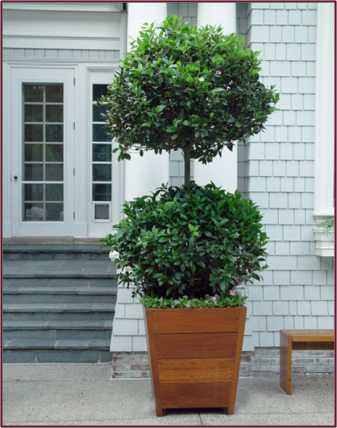
Bay Laurel Topiary

A potted two-tier poodle topiary makes a pretty statement. Photo: Deborah Silver, Dirt Simple

This form is a single trunk with two or more individual balls of foliage along its length. Poodle tiers are fairly upright specimens, which makes them an appropriate choice for framing views and entryways. They also make excellent single features. Like topiary standards and grafted standards, poodle tiers are especially suited to Mediterranean style gardens, formal Colonial style gardens and English Landscape gardens.

tiered topiary 2

Left: This Spanish Mediterranean-style home is suitably landscaped, except for the two pom-pom topiaries. While the goal may have been to frame the entrance, their form doesn’t effectively serve this purpose.
Photo: Patti Cartier
Right: A graphic depiction of the more appropriate 3-tiered poodle topiary providing the desired frame.

Spirals

Spiral topiary is an upright form that has been pruned into a spiral or corkscrew shape. These forms have the same application as poodle tiers and standards – they’re elegant as single specimens, or repeated sequentially along a design line, are suitable for framing, and are fine additions to theme gardens like Colonial, Mediterranean or English Landscape.

Two spiral junipers frame the entrance to a lavish outdoor ‘sitting room’.
Photo: Deborah Silver, Dirt Simple

In our climate most garden topiary is Juniperus chinensis, Juniperus scopulorum or Juniperus virginiana, as well as several Pinus species. In warmer climes, Boxwood, Yew, False Cypress, Rosemary and Bay Laurel are used. These are often available as potted annuals for us Northern gardeners, and given a sunny window, they might overwinter indoors.

Topiary and grafted standards present very strong form in the landscape – suitably sited, they will bring style and sophistication to your garden.

Happy St. Pat’s Day – just think green.
Sue

The Form of Things to Come, Part 3 – Weeping Form

Until a day or two ago, it was feeling quite springy around here – longer days, mild daytime temperatures, and I’d begun the flurry of client interviews and site assessments that typify my spring schedule. Then BAM – old man winter returns with a big dump of the white stuff.  Lucky for you, this means a short reprieve from aforementioned activities, and I can work on this post. Next in the plant form series is weeping form.

Weeping Form

Weeping plants can be huge trees like Betula pendula ‘Laciniata’, or small grafted specimens like Betula pendula ‘Youngii’. The large weeping trees have less distinct form because there are countless branches, each with delicate drape – the resultant outline of form is therefore somewhat amorphous, though still quite elegant.

Weeping Birch

Large weeping trees like this weeping birch don’t exhibit a distinct outline – the weeping habit of their branches creates more textural interest, than well-defined form. Photo: Pat Gaviller

To me, they bring a sense of quiet luxuriance to a landscape, perhaps because I associate this form with the giant weeping willows that reside near still waters – the picture of both opulence and serenity.

Although these big weepers lack definitive form, their lacy texture makes them lovely feature trees – if scale and proportion allow. They are especially lovely as waterside accents and make elegant shade trees – again if the size of your house and/or property allows.

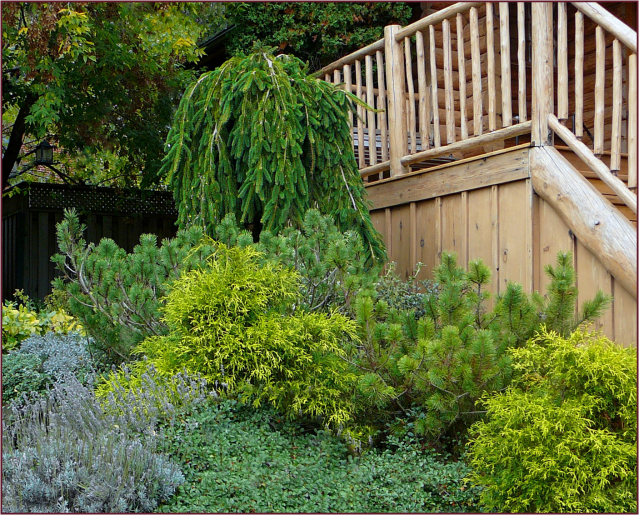
Small weeping trees offer much stronger architectural form than their larger counterparts– their arched weeping branches create an umbrella-like form. Many of the weeping specimens available at nurseries are actually low-growing creeping shrubs that have been grafted onto a standard, for example Young’s weeping birch, Walker’s weeping Caragana or Rosy Glo weeping crabapple.

This form draws the eye up … and back down again. It is strongly dominant so should always be used as a single specimen – I can’t stress this enough. Don’t try to group them in threes, or use two to frame an entry, or plant several in linear fashion – it just doesn’t work. I made the mistake of planting two in my front yard several years ago – you can read about it in my post from last year around this time: Form, Colour and Texture in the Winter Garden. The bottom line is, any more than one and they’ll just compete for dominance and create visual unrest. So one is enough – got it?

Malus Rosy Glo 3

Malus ‘Rosy Glo’ makes a beautiful specimen tree as it looks spectacular any time of year – here I’ve underplanted with Juniperus sabina ‘Moor Dense’ which stages her nicely. Photos: Sue Gaviller

C. arborescens ‘Walker’s Weeping’

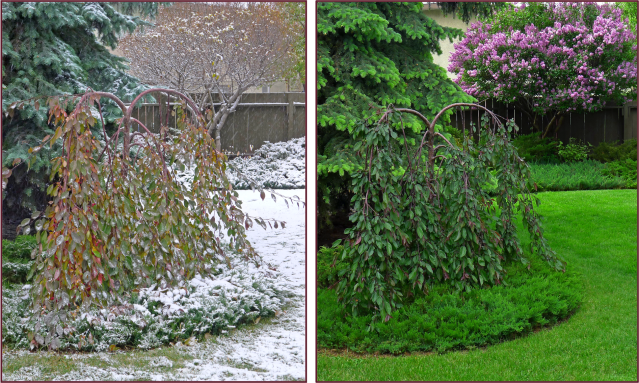
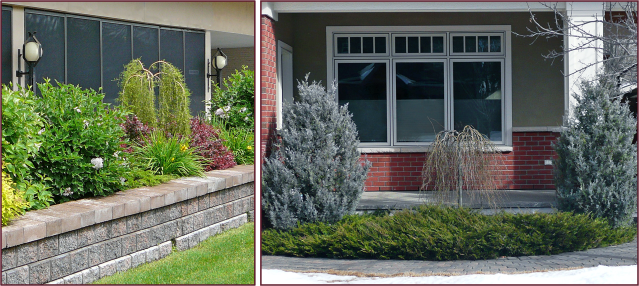
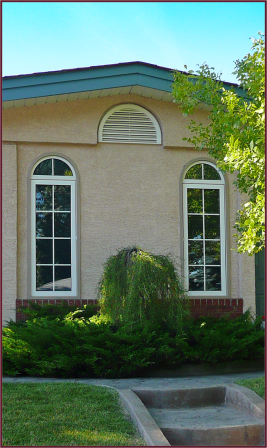
A weeping form makes a nice centrepiece for a symmetrical composition. Left – Caragana arborescens ‘Walker’s Weeping’ in a client’s raised planter. Right – another of those pretty scenes I periodically drive by, C. arborescens ‘Walker’s Weeping’ in winter still has strong form. Photos: Sue Gaviller

Weeping Caragana

Walker’s weeping Caragana: simple repetition of line makes this tidy scene one I often stop to admire. Photo: Sue Gaviller

These small weeping trees are useful for highlighting architectural details, like arched doorways or windows – the arching form of the branches mimic the architectural line, thus bringing attention to it, and creating unity (by repetition).

Fountains too, can be ‘echoed’ in this way with the placement of a weeping tree nearby.

As well, a weeping form looks very appealing at the top of, or near a slope – the weeping branches reiterate the sloping line of the hillside.

And don’t plant one of these feature trees in the middle of an expanse of lawn where it will appear lonely and insignificant – it’s much more effective when staged and supported by the presence of other plant material.

Weeping Norway Spruce

A fine-looking specimen, Picea abies ‘Pendula’ looks splendid in this sloped front yard garden in charming Elora, Ontario. Photo: Sue Gaviller

I’ve had several clients tell me they don’t like the shape of weeping trees because it makes them feel sad (maybe it’s the name – y’know power of suggestion and all). I don’t get this. To me weeping forms are graceful and very pleasing to the eye. Indeed their appropriate use demonstrates a mature design sensibility. I guess it’s a humble reminder for me, and all you aspiring designers, that there is a degree of subjectivity in design that must be acknowledged and respected. And with that little piece of wisdom my friends, I shall bid you adieu.

More “Fun with Forms” in my next post – see ya then.

Humbly yours,
Sue

© Sue Gaviller and Not Another Gardening Blog 2012.

Unauthorized use and/or duplication of this material without express and written permission from this blog’s author and/or owner is strictly prohibited. Excerpts and links may be used, provided that full and clear credit is given to Sue Gaviller and Not Another Gardening Blog with appropriate and specific direction to the original content.

The Form of Things to Come – Part 2

In my last post, I opened a discussion on plant form with a look at columnar or fastigiate forms and their use in the landscape. Today I continue this discussion with two additional forms – Pyramids and Vases.

Pyramidal/Conical

Pyramids or cones are wider at the bottom, becoming narrower and tapering to a point at the top. Their geometric form gives a garden solidity, structure and definition. In our climate, it is during the long winter months that pyramids carry the most visual weight – most of the pyramids we see are evergreens, which are dense, stiff needled and weighty in appearance. As well, pyramidal forms carry their weight close to the ground – this wide-bottomed shape means that visually they are very grounding (anyone else start silently singing the refrain from a certain song?)

Pine

A solid green pyramid, which I suspect is Pinus mugo ‘Tannenbaum’, stands out in this winter landscape, firmly anchoring the more yielding forms of leafless woodies and dried grasses. Photo: Sue Gaviller

Blue spruce and bench

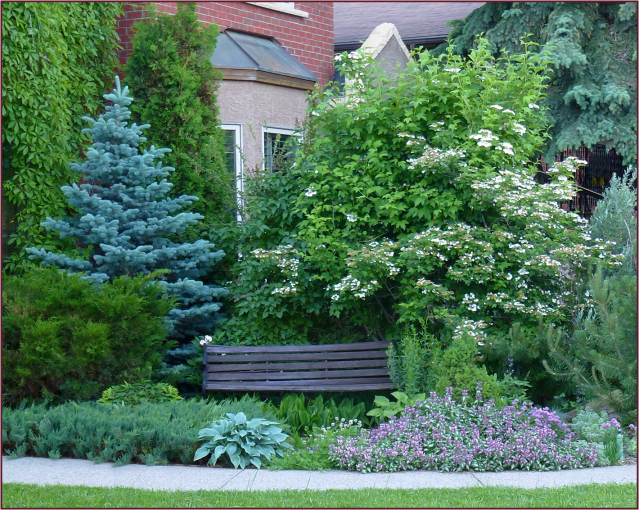
The pyramidal form of blue spruce provides definition and structure to this pretty vignette.
Photo: Sue Gaviller

Pyramids can be quite variable in size and proportion – some are short and squat, some tall and narrow and some in between. This means their use in the landscape is also variable. A tall narrow pyramid will behave more like a columnar form, making a striking vertical accent or effectively framing a view or entrance, whereas the more wide-bottomed specimens won’t have this effect and better serve as anchors with their bottom heavy appearance (there’s that song again).

Pyramidal Spruces

Left – A tall narrow pyramid like Picea pungens ‘Fastigiata’ makes a dramatic vertical feature.
Photo: Pat Gaviller.
Right – Short and squat, dwarf cone-shaped Picea pungens (likely cv. ‘Montgomery’) steadies this pretty composition. Photo: Sue Gaviller

Picea pungens var. Glauca

Two Picea pungens var. glauca create a nice frame – their size, form and texture provide solid structure, matching that of the large brick building. Photo: Pat Gaviller.

Pyramids are also useful for repeating the shape of roof peaks or mountains in the background. As well, their natural geometry lends itself to use in formal landscapes, where parterres and hedges are clipped into strong geometric forms.

Spruce and cedars

The narrow pyramidal forms of two cedars effectively repeat the shape of the church steeple (and frame its entrance), while the broader spruce repeats the form of the roof peak. Photo: Pat Gaviller

Geometric shapes

Pyramidal forms fit well into formal designs. Photo: Evelyn Steinberg

Keep in mind that the more narrow the pyramid, the more it will perform like a columnar form, so the same guidelines will apply regarding its overuse. Otherwise this form can be used fairly freely in the landscape, remembering that evergreen material shouldn’t comprise more than about half of your plant material due to its weight. And of course scale, proportion and all the other design principles still apply.

Vase shaped

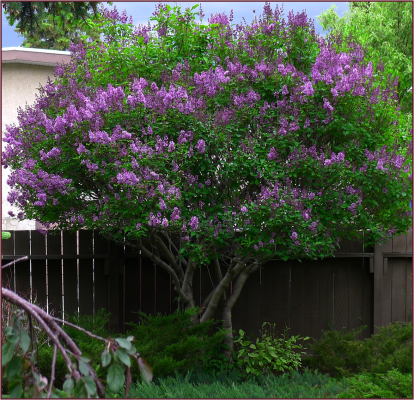
Vases are inverted pyramids – narrow at the bottom and flaring out towards the top.  They are graceful and elegant, making them excellent feature trees/shrubs. Like pyramids they vary somewhat in proportion, with some being quite slender and others much broader. A very narrow specimen can make an elegant vertical accent, frame an entrance or view, or be planted in groups. Just like columns or narrow pyramids, narrow vases shouldn’t be overused – because they stop the eye and draw it up, the same guidelines will apply as for columnar forms, though a narrow vase is less dramatic.

Sutherland Caragana

Left – Slender vase-shaped Caragana arborescens ‘Sutherland’, together with a bird bath and Hemerocallis ‘Stella d’Oro’, make a lovely focal vignette in a client’s sunny backyard. Photo: Sue Gaviller.
Right – A trio of Sutherland Caragana also works well. Photo: Jane Reksten.

Broader vases are still graceful but don’t behave as verticals. They can therefore be used liberally throughout a landscape composition – a single specimen though, makes an outstanding feature on its own.

Broad Vase

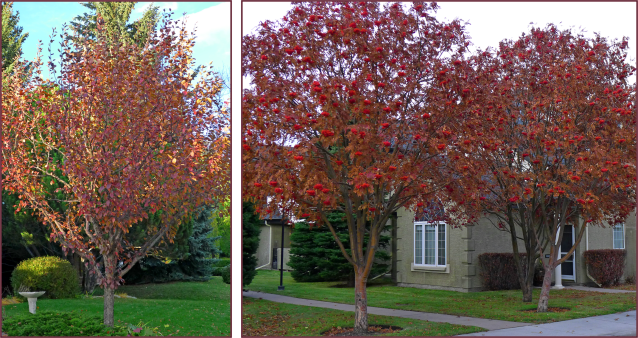
Plants with broad vase form are a beautiful addition to the landscape, whether used singly or grouped.
Left – Malus
‘Thunderchild’. Right – Sorbus decora. Photos: Sue Gaviller

Vase shaped trees planted on either side of a street or walkway create a lovely arching canopy as they meet at the top. If you’ve ever peered down one of Calgary’s elm-lined streets you’ll know what a spectacular sight this is, especially with a dusting of hoar-frost coating the lacy branches of the stately elms.

Vase shaped trees

Ornamental crabapple trees have a beautiful vase shape – some very broad and some more narrow. I love how the designer has utilized the form in this landscape, both framing the walkway and creating the arched canopy over it. Photo: Gabe Girimonte.

Pruned Syringa prestoniae

Syringa prestoniae grows naturally in a globe shape, but looks lovely pruned into a broad vase. Photo: Sue Gaviller

Vase shapes are a favourite with many gardeners – in fact so enamoured are we of this form that we’ll often prune a shrub into a vase shape, and labour to maintain it, despite the fact that its natural growth habit is otherwise.

I’ve seen various shrub species, including Syringa, Prunus, Lonicera and Viburnum, pruned in this manner.

Note too that during the growing season, the leafy canopy of a vase-shaped tree or shrub may affect its form, appearing somewhat like a ball on top of a vase. Whether you then choose to use this plant as a round form or a vase, will depend on how much of its woody skeleton is visible when clothed in foliage. It will also depend on how much of the year it actually has leaves.

Vases and pyramids are important inclusions in your landscape or garden composition. Indeed they work in beautiful concert with each other, fitting together like puzzle pieces.

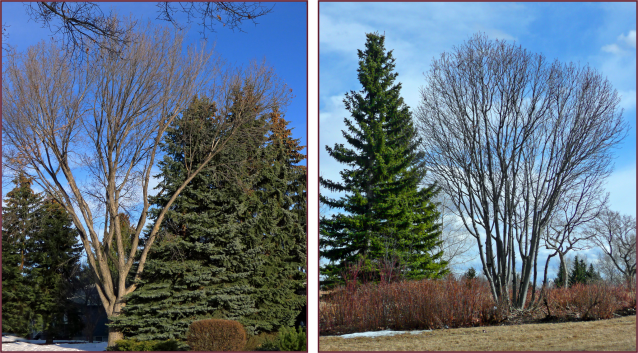
Pyramids and Vases

Left – Ulmus americana and Picea pungens var. glauca. Photo: Sue Gaviller
Right – Picea and Prunus sp. Photo: Sue Gaviller

Next post we’ll continue to build our garden sight-line with more plant forms, so y’all come back now, hear?

Sue

The Form of Things to Come

My first thought the morning of February 2nd is hooray! Balzac Billy didn’t see his shadow! According to groundhog legend, this means spring is just around the corner. Again I say hooray! A sense of disquiet ensues though, as I remember the client designs I’ve been putting off because hey, there’s lots of time, it’s still the middle of winter. While I don’t really subscribe to the belief that a rodent can predict the weather, I suddenly feel called out of hibernation. I’m not sure I’m ready.

I dust off the old creativity cap and reluctantly put it on. I’m just not feelin’ it though. I guess I could work on my next blog post – yikes not feelin’ that either. I believe I have the dreaded writer’s block, and designer’s block too! This is weird – my brain is usually so full of thoughts and words and ideas that stuff just tumbles out onto my drawing page or laptop screen.

A memory of some words my husband once spoke to me finds its way through the fog, “Sue, just put your pencil on the paper and start to draw”. Yes, yes of course – start the process and inspiration will follow. I know this to be true.

Fortunately I’m able to come up with some concepts for last night’s client meeting – I’m actually pretty happy with the drawings, and the clients are ecstatic. Now if I can just get this blog post underway. So where were we anyways? Oh yeah, in my last post I left off with the promise of discussion on the significance of plant form, texture and colour.

Plant Form

We choose plants for any or all of these characteristics (form, texture and/or colour), but in order to arrange them appropriately we need to understand how specific traits will play out in the garden scenario, in relation to other plants. To me, plant form is the most important quality a plant brings to a garden composition, so I’ll begin there. It is the various plant forms working in concert that creates a sight-line. Much like a city skyline, the landscape sight-line is what we experience when viewing the garden from more distant vantage points – across the street or down the road. It allows us to see the garden in its larger essence.

Calgary Skyline

An attractive city Skyline has high points and low points, as well as variety in the shape of its buildings. Photo: Pat Gaviller

Sight-line

A landscape too should have variety in height and form – note the different tree and shrub forms that contribute to this attractive sight-line. Photo: Sue Gaviller

Sight-line 2

Designers of English Landscape Style gardens pay particular attention to the creation of an undulating sight-line. Photo: Marny Estep

As well, the form of the garden’s woody denizens (trees and shrubs) makes a significant contribution to the creation of a true four-season garden. It is this that provides a sense of permanence in the garden – to see its beauty season after season, year after year.

FOUR SEASONS

This view from my diningroom window is always serene and elegant – due in part to the variety and balance of form. Photos: Sue Gaviller

Plants come in many shapes. Classifying these shapes, simplistic though it is, can help us to understand their visual impact in the landscape and utilize them accordingly. For the sake of simplicity then, let’s say plant forms fit into one of the following categories:

  • Columnar/Fastigiate
  • Pyramidal/Conical
  • Vase shaped
  • Weeping
  • Topiary/Grafted standards
  • Fountain/Arching
  • Round/Mound
  • Mat/Flat

Today I will discuss the first.

Columnar/ Fastigiate

Columnar and Fastigiate forms are tall and narrow with very little taper. These strong vertical accents draw the eye, stop it, and send it skyward, thus momentarily arresting the flow of movement. Stately and spire-like, they have many applications in the urban landscape.

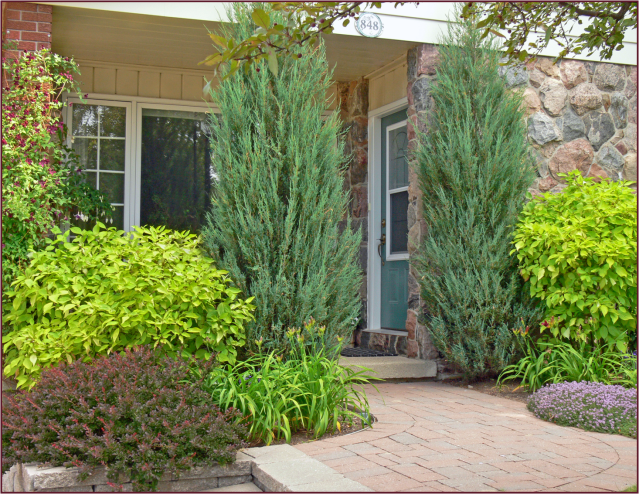
When used as a single specimen, a columnar form appears somewhat like an exclamation point. They are also lovely as a trio, and placing one on either side of an entrance or view will provide a visual frame, inviting the eye (or the viewer) through.

columnar forms

Left – A single columnar form can make quite a statement. Photo: Cathy Gaviller.
Right – A group of three is also stunning. Photo: Sue Gaviller

Skyrocket juniper

Two narrow Juniperus scopulorum ‘Skyrocket’ nicely frame an entryway. Photo: Marg Gaviller.

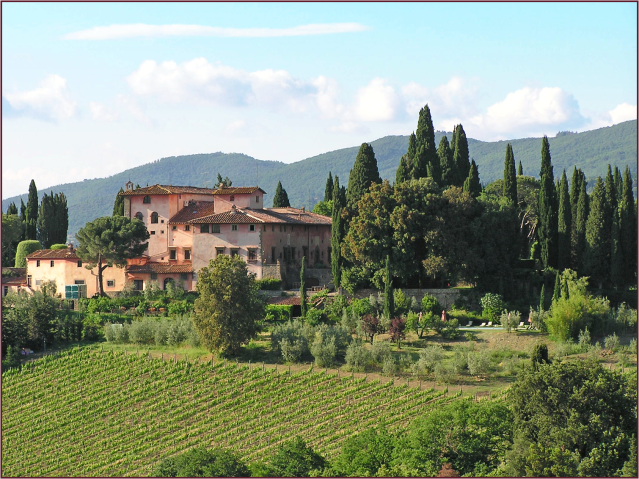
Columnar forms are useful where taller scale is required but space is tight. As well, adding a few of these tall narrow trees to Mediterranean theme gardens can help to set the mood as they mimic the tall Italian cypress.

Italian Cypress

Nothing says Mediterranean quite like Italian cypress – it is seen in abundance throughout the region. In colder climates, like ours, other columnar trees can do the trick quite nicely. Photo: Cathy Gaviller

Overuse of this form can result in very choppy movement as the eye stops and starts, darting up and down. This ‘jumpy’ feel will be most evident if these forms are dotted randomly around the landscape. If you want to use numerous columnar forms, they are best grouped together, used sequentially to reinforce a design line, or in a pattern of alternating elements.

columnar aspens

Alternating Populus tremula ‘Erecta’ and Picea pungens, effectively reinforce the straight design line, as well as providing some privacy for the homeowners. Photo: Sue Gaviller

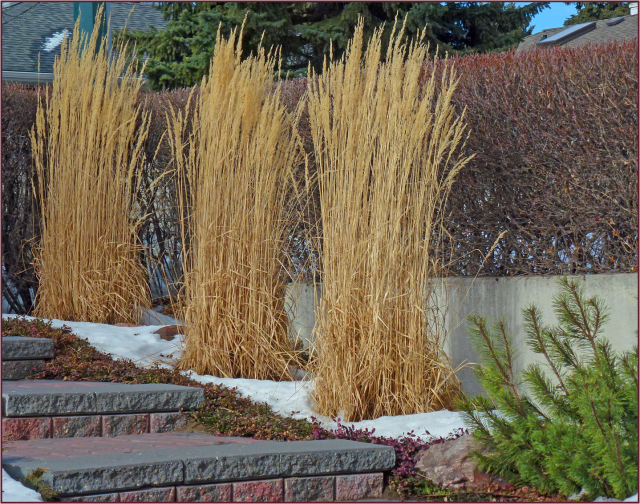
On a smaller scale, columnar form is seen in these Calamagrostis acutiflora 'Avalanche'. They provide winter interest in both form and colour. Photo: Sue Gaviller

On a smaller scale, columnar form is seen in these Calamagrostis acutiflora ‘Avalanche’. They provide winter interest in both form and colour and reinforce directional movement along the path.
Photo: Sue Gaviller

The columnar plant form is an outstanding addition to the landscape – why not give one or two a home in your garden.

Join me next time as I look at another of the plant forms for your garden.

Til then,
Sue
© Sue Gaviller and Not Another Gardening Blog 2012. Unauthorized use and/or duplication of this material without express and written permission from this blog’s author and/or owner is strictly prohibited. Excerpts and links may be used, provided that full and clear credit is given to Sue Gaviller and Not Another Gardening Blog with appropriate and specific direction to the original content.

Where Do We Go From Here – Part 2

Last week I discussed the various functional roles plants may serve in the landscape – with these practical considerations out of the way now, we can finally go about utilizing plants purely for their aesthetic appeal. However, we can’t just go plopping plants into our designs haphazardly. There is still a process – indeed this is inherent in the very definition of design. According to Wikipedia, design is defined as:

  • the creation of a plan or convention for the construction of an object or a system
  • a roadmap or a strategic approach for someone to achieve a unique expectation

Note the words ‘plan’ and ‘strategic approach’ – this suggests we must arrange our plants in a mindful, purposeful fashion. Nuff said? Okay I won’t belabour the point. Alrighty then let’s get going….

Um – where exactly do we go from here? There’s so much to choose from. Well let’s see if we can’t narrow down our choices by looking at what, where, when and why.

What Plants Should I Choose First?

Trees should always be your first consideration – they are the backbone of a well designed garden. Trees provide scale and structure, and since they take the longest to reach maturity, dedicating the largest portion of your plant budget to a few of these horticultural giants, means you’ll have good scale and structure from the get-go.

Once you’ve chosen your trees you can consider shrubs – if trees are the backbone of good garden design, shrubs are the rest of its skeletal structure. Perennials then, are the garden’s attire, and bulbs and annuals, the accessories.

The irony is, most of us have proceeded in exactly the opposite direction. Our first tentative foray into gardening often begins with brightly coloured annuals (I wince at the memory of marigolds and geraniums that were my first garden) or bulbs like tulips and daffodils. Soon we discover perennials, and sometime later (often much later) we start to think about shrubs and trees. I can tell you from experience that it is difficult to go backwards – save ripping it all up and starting over again, this backwards progression will always look like a retrofit.

So what kind of trees should you choose? It goes without saying that they should be of appropriate scale for your house, and of course you’ll choose what you personally find appealing, but there’s more yet to consider. Keep reading.

Where Should I Plant What?

This really is the million dollar question isn’t it? To begin with you’ll need to take into account details like site exposure and available space, to ensure your plant choices will thrive where you place them.  Next, consider plants which will present high visual impact and position them accordingly. For example a specimen tree or other dominant feature should be situated where it can take center stage. Use your design lines, and the shape of the spaces they create, to guide you – a swell in a garden bed or an area that is enclosed on three sides can provide a visual ‘frame’ for a feature tree or focal point.

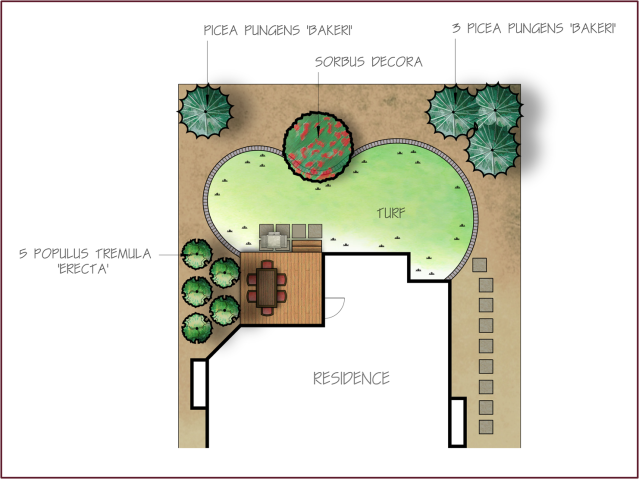
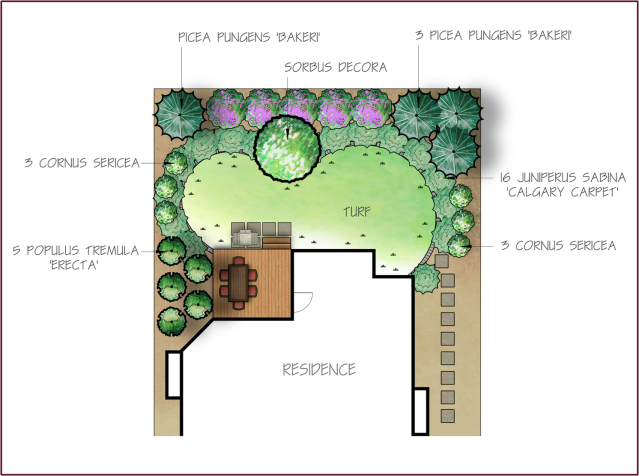
Revisiting last week’s example – with the shade trees already in place, we can now add a specimen tree, say Sorbus decora. The outward curve of the back bed is just the kind of space that invites a special feature like this showy mountain ash, with its four-season appeal. We could also add some evergreens to anchor the corners – evergreens, because of their stiff needles and their density, provide visual weight.

TREE PLACEMENT

Your design lines and resulting spaces can also help you organize and configure plant groupings. Looking again at the previous example, we see that the space beside the deck is somewhat wedge-shaped – note that the aspens are arranged to precisely fill that space. And the trio of spruces fit nicely into the triangular corner space. We can utilize the spaces between the various plantings in a similar fashion. Or we can emphasize a design line by bordering its entire length, or a portion thereof, with a single type of plant. And don’t forget to utilize Design Principles where applicable.

TREE & SHRUB PLACEMENT

Juniperus sabina planted all along the edges of the curvilinear design lines, creates gentle movement and helps to emphasize the curves. The trio of Cornus sericea on either side also follows the curves, thereby reinforcing them.

Reinforcement Planting

Planting a single type of perennial along the entire span of a design line, as this homeowner has done,  serves to reinforce the line. In this charming garden, low-growing Sedum edges the lovely arc of lawn space in the centre, as well as the straight lines abutting the sidewalks. Photo: Sue Gaviller

Thymus citriodorus 'Doone Valley'

A generous swath of Thymus citriodorus ‘Doone Valley’ borders this softly curving bed.
Photo: Marg Gaviller

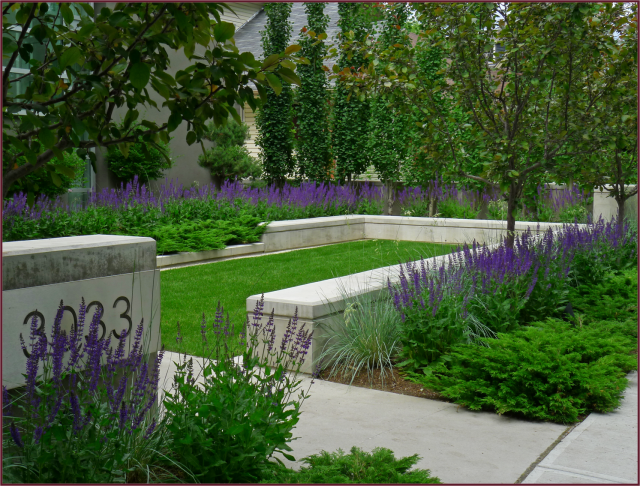
Straight lines are strong design lines. This impressive rectilinear design is well emphasized by the linear plantings of Salvia and Juniperus. Photo: Pat Gaviller

Straight lines are strong design lines. This impressive rectilinear design is well emphasized by the linear plantings of Salvia and Juniperus. Photo: Pat Gaviller

When (What Season) Should I Consider First?

This will depend on where you live and to some degree, your lifestyle. Where I live it can be winter for as much as 6 months of the year, so I usually start with winter interest – evergreens, woody plants with interesting form, and plants with colourful bark, berries or seedheads.  For those who travel during part of the year, the season(s) to concentrate on would be when you are actually home to enjoy your garden or landscape. For example I have clients that spend winter in the South and summer at their cottage, so spring and fall are the seasons I considered first when choosing plant material. You’ll also want to make sure you choose plants that require very little maintenance during the growing season so you don’t come home from your cottage to a mess of deadheads and straggly foliage.

Rectilinear Concept with feature trees

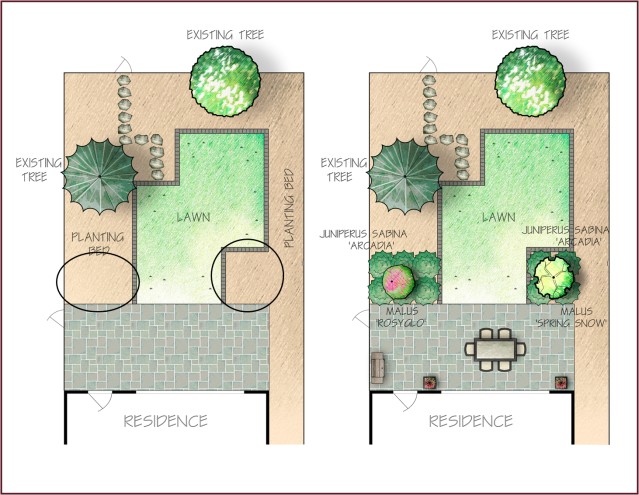
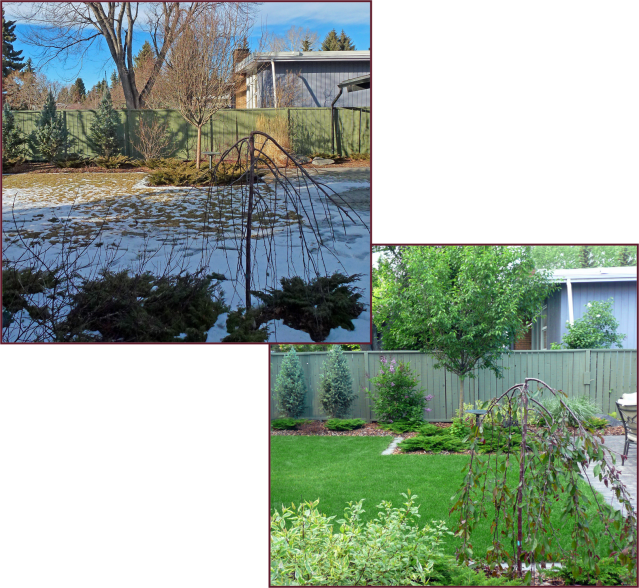
Planting for aesthetics in this client’s yard began with the two spaces circled on the left. Both are bordered on 3 sides with design lines – an ideal frame for a feature tree. The underplanting of spreading junipers creates a neutral, year-round prop for these four-season trees. See the ‘real life’ view below.

Rectilinear Design lines

View from the side gate in late winter (top) and early summer (bottom). Photos: Sue Gaviller

Why Choose a Particular Plant?

Up to this point we’ve discussed plant choices mostly in general terms – size (i.e. trees first), visual impact (feature trees and anchors), cultural and maintenance requirements, and season of interest. Also worth considering are such things as tactile impression and fragrance – especially next to a patio, or in a garden designed for the visually impaired (the subject of another post). But the real reason most of us choose a particular plant is because we like how it looks – its form, its texture and/or its colour. Indeed these traits are the manner in which plants relate visually to each other, and to choose appropriately is to choose in the context of these relationships.

Last March I wrote about form, colour and texture in the winter garden – during the growing season however, these plant characteristics are that much more significant as there’s so much more plant material present. In the coming weeks I’ll be examining the visual impact of plant form, textural differences and colour relationships in order to help you arrange plants in the most effective and pleasing way.

Hope you can join me!

Til then,
Sue

© Sue Gaviller and Not Another Gardening Blog 2012. Unauthorized use and/or duplication of this material without express and written permission from this blog’s author and/or owner is strictly prohibited. Excerpts and links may be used, provided that full and clear credit is given to Sue Gaviller and Not Another Gardening Blog with appropriate and specific direction to the original content.

Where Do We Go From Here?

After 8 months exploring Design Principles we’re finally ready to tackle the third and final phase of the Landscape Design Process – The Planting Plan. We began way back in April with functional diagrams, which map out a landscape based on the function of each space, and Concept Plans, which give form to those functional spaces (these are outlined in GOOD LINES MEAN GOOD DESIGNS and CURVES WONDERFUL CURVES).

Now at long last it’s time to introduce plant material into our design. Off you go then – pop those plants into your drawing. You know you wanna. You’ve been waiting for this….

Ha! Are you still staring at your page? Not so easy is it – where does one begin? Indeed where do we go from here?

Well, I have bad news for you. We must begin where we always begin – with function. Ah dear fellow gardeners I can hear you protest, “Oh no, not the f-word again.” Yes I’m afraid so. Plants serve many functions in the landscape and we must first determine what role we need them to play before choosing and arranging plant material.

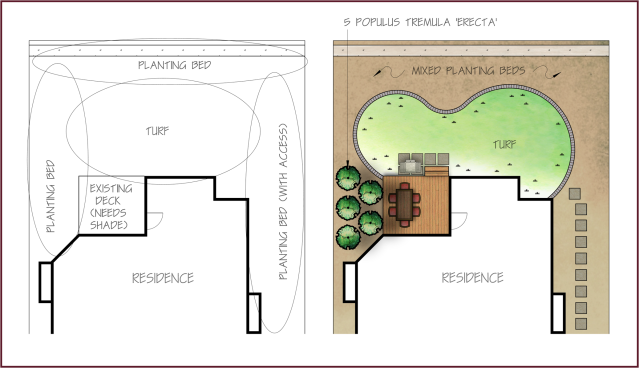
Revisiting your functional diagram may be of help here – for example perhaps you made note that some means of providing shade on your sunny deck or patio will be required. If so, an appropriately sized shade tree might do the trick – placed strategically of course, so it can in fact serve that purpose.

A group of 5 columnar aspens provide shade for a sunny deck. While there may be room for a single larger canopy tree, these tall narrow aspens grow faster and will fulfill their intended function sooner.

A group of 5 columnar aspens provide shade for a sunny deck. While there may be room for a single larger canopy tree, these tall narrow aspens grow faster and will fulfill their intended function sooner.

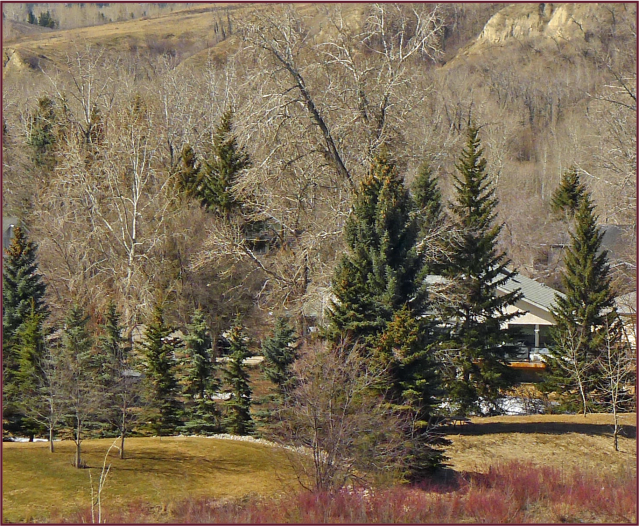
How about privacy? A tree or two may be the answer – again suitably sized for the scale of your house and property. And if you require this privacy year round, you may want to consider evergreens.

Large evergreen trees provide privacy for homes abutting a year-round public park space. Photo: Pat Gaviller

Large evergreen trees provide privacy for homes abutting a year-round public park space.
Photo: Pat Gaviller

Spreading junipers make good slope stabilizers, creating a tidy uniform look. Photo: Ann Van de Reep

Spreading junipers make good slope stabilizers, creating a tidy uniform look. Photo: Ann Van de Reep

Shrubs and perennials can also serve a purely practical purpose. For example, if you have a slope to contend with, shrubs and/or perennials with dense root systems can stabilize an embankment quite effectively.

Slope stabilization

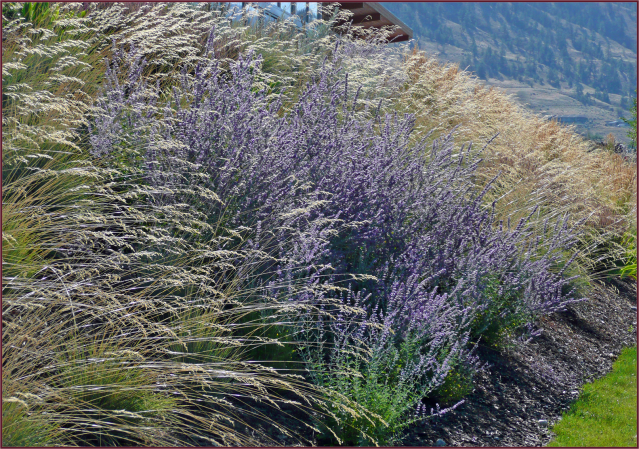
Festuca, Helictotrichon, and Perovskia make a casual, but effective hillside planting at Poplar Grove Winery, Naramata Bench, B.C. Photo: Len Steinberg

Or perhaps you want to limit foot traffic in an area – using shrubs that are thorny or abrasive can provide an efficient barrier.

Are you starting to get the picture?

As you can see, plants are great problem solvers. The size of the plant or plants you choose will be relative to the size of the problem you’re trying to solve. If you want to screen your air conditioning unit from view, a medium-sized shrub planted in front of it may be all you need, whereas if you want to screen your view of an entire street or roadway, a hedge of tall shrubs may be in order. And a windbreak or shelterbelt will require very large trees.

Keep in mind that the ability of your plant selections to produce favourable results is dependent on choosing plant material of a suitable size. For example, a shrub or planting that is too small to obscure an unsightly view may end up drawing attention to it instead.

Ineffective screening

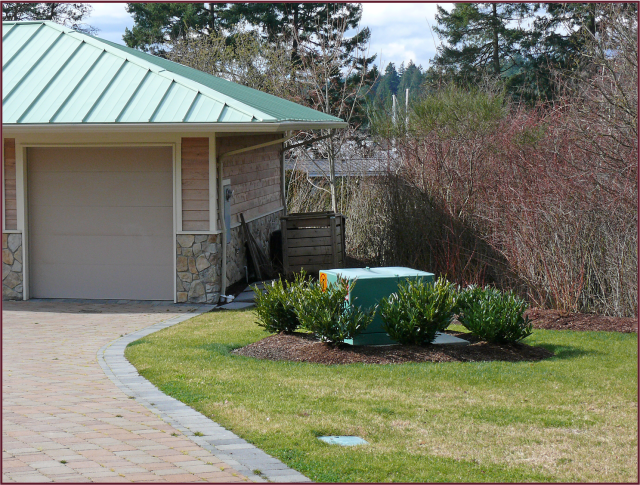
These shrubs are too small to effectively screen the unattractive green utility box. Unfortunately the result is to draw attention, not only to the box, but the unsightly utility area behind. Photo: Pat Gaviller

So when do we get to the part where we plant things just because they look pretty? Don’t worry we’ll get there. Once you’ve dealt with all of the practical considerations you can start to think about aesthetics. But you’ll have to wait til my next post.

Stay Tuned,
Sue
© Sue Gaviller and Not Another Gardening Blog 2012. Unauthorized use and/or duplication of this material without express and written permission from this blog’s author and/or owner is strictly prohibited. Excerpts and links may be used, provided that full and clear credit is given to Sue Gaviller and Not Another Gardening Blog with appropriate and specific direction to the original content.

Principled Gardening – The Final Chapter: Proportion

Today is the last Monday of the month, the last day of the year, and the last installment in our Principled Gardener series – we have one last design principle to look at and that is Proportion.

Proportion is related to Scale – in fact the terms are often used interchangeably, but I consider them to be different enough to present separately. You may recall from Part 7 of this series that Scale refers to the size of landscape elements in relation to their existing surroundings, i.e adjacent buildings, neighbouring buildings/trees etc. Proportion on the other hand, is the size of landscape elements in relation to each other and to the design as a whole. It can also refer to the ratio of one dimension to another, such as width to length.

So how do we know if the various elements and dimensions in our design are proportionate to one another? To some degree this must be intuited, but there are a few guidelines that may be helpful.

For relatively simple designs, the rule of thirds, or an adaptation thereof, can be used. As it pertains to landscape design, this means elements or dimensions that relate to each other in a 1:3 or 2:3 ratio.

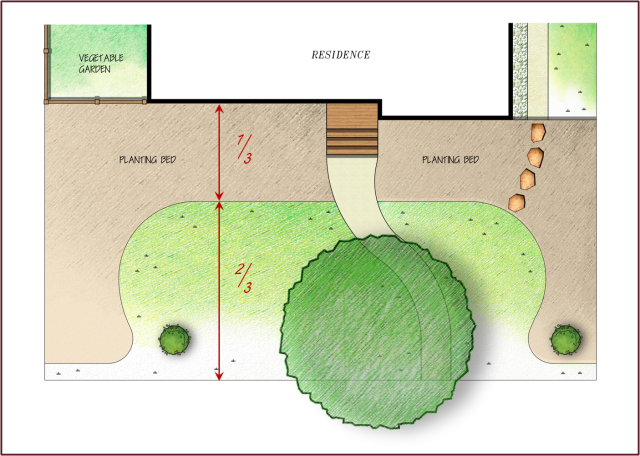
This is most effective when applied to linear dimensions. For example, in my own front yard the linear distance from the street to the house is roughly divided into thirds, one-third being garden space and two-thirds lawn space. (Please ignore the goofy little strips of lawn at the bottom on both sides – bad design.)

PROPORTION - front yard

If however, we look at the horizontal dimension of this same yard, the rule of thirds isn’t adhered to. The existing walkway is too far to the right, and more significantly, the overall or cumulative width of the side beds is only 14 feet – less than the 20 feet needed to satisfy the rule of thirds.

PROPORTION - front yard 2

Both beds would have to be wider to make up one-third of the total horizontal space, but the current position of the walkway and the two Cotoneaster shrubs preclude this option.

While these horizontal proportions may be less than optimal, the overall proportions are still quite favourable – at least on paper. However, because the yard slopes somewhat, the garden area in front of the house appears much shallower from the street. This makes the lawn look disproportionately large in both directions – a real source of frustration for me. It could of course be remedied, but not using the present design lines. I get tired just thinking about the work required to execute effective change, not to mention the expense. You can see why good design requires some forethought, preferably expressed first on paper. I suspect if I’d known what I was doing decades ago when I began this whole thing, I would have designed something very different. Sigh.

For now I’ll just have to resort to that hypocritical mantra of many a parent, teacher or boss: ‘Do as I say, not as I do’.

But enough about me.  Let’s look at a simple design that puts the rule of thirds to work. The example below illustrates a symmetrical design using the rule of thirds to achieve good proportion. You can see that all of the rectangular spaces relate to one another in a 1:3 or 2:3 ratio – the lawn area is 2/3 the width of the property, the dining area is 2/3 the width of the lawn and the seating area is 2/3 the width of the dining area.

Rule of ThirdsIn addition each rectangle is in itself proportioned such that the shorter dimension is two-thirds the length of the longer one. The result is a design with very pleasing proportions.
PROPORTION - plant material

The rule of thirds can also be applied to plant selection, albeit loosely as plants don’t reach an exact height, but rather a range – keeping this range in mind can help you achieve well proportioned planting arrangements.

In the photo on the right, two Syringa sp. together with Picea pungens, illustrate one such plant grouping.

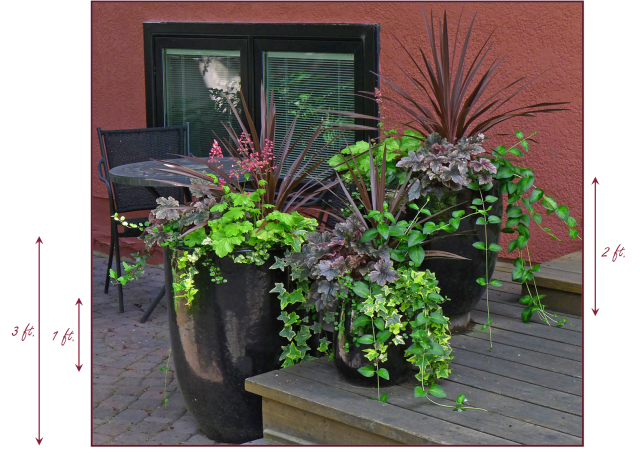
Containers too can be arranged this way – many ‘nesting pots’ are trios that bear a 1/3, 2/3 relationship to each other. Planting them in a similar or identical manner is very effective.

These 3 containers on my client's front deck display good proportion based roughly on the rule of thirds. Photo: Pat Gaviller

These 3 containers on my client’s front deck display good proportion based roughly on the rule of thirds. Photo: Pat Gaviller

The rule of thirds is not always easily or realistically applicable – existing hardscapes, the shape of adjacent buildings, positioning of property lines, or even the design itself, can make this tool ineffectual. Many of the elements we add to our gardens – be they plants, focal points or furniture – don’t really lend themselves to the use of this ratio either. This is when we just have to rely on our intuition and common sense.

Consider a tiny bird bath or piece of statuary – it might appear lost in an expanse of trees and large shrubs, but be right at home amongst smaller perennials. Likewise, that gargantuan classical fountain may look ridiculous adorning a small urban patio, but fit perfectly into a more grandiose courtyard or terrace, as illustrated in the photos below.

Court of the Lions, Alhambra, Granada, Andalusia

Court of the Lions, Alhambra, Granada, Andalusia. Photo Credit: Wikipedia

Gardens at the Livadiya Palace, Crimea, Ukraine.

Gardens at the Livadiya Palace, Crimea, Ukraine. Photo Credit: Andrew Butko, Wikipedia

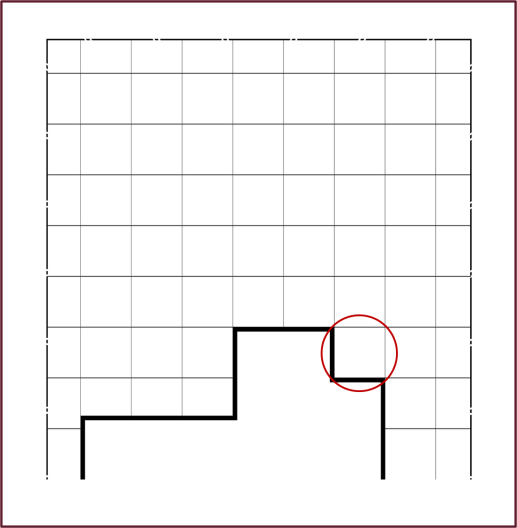
Another way we can ensure good proportion in our landscapes is with the use of a grid. To do this, draw a series of vertical and horizontal lines on some trace paper and place over a plan view of your property. It’s most effective if you can make the size of the grid square relate to the house in some way, but be careful not to make the square too small or the whole purpose will be defeated. In the example below, I’ve chosen a grid square that is the same size as the house indentation in the right corner.

GRID

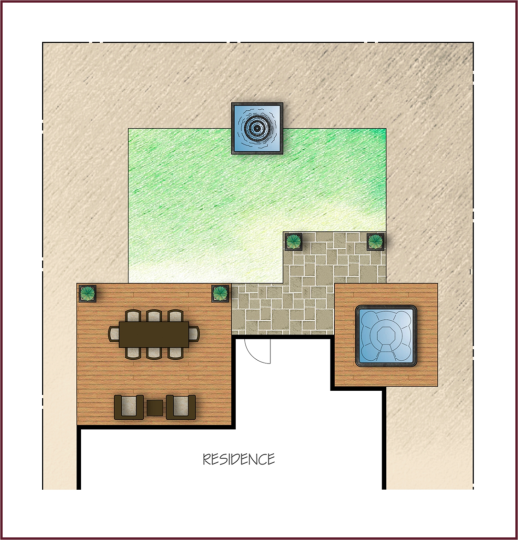
The grid lines are then used as an outline for the design.

PROPORTION - RECTILINEAR

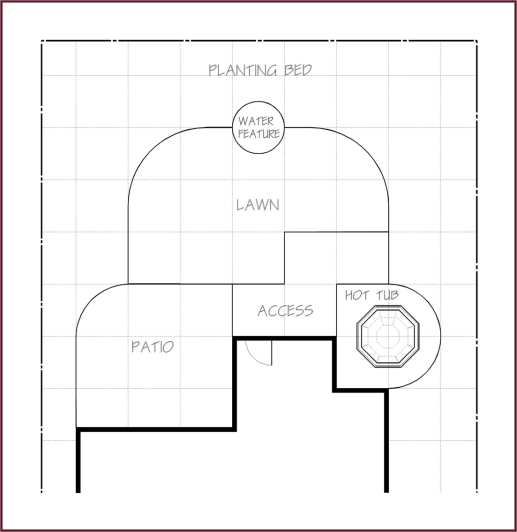
Your choice of design concept isn’t limited to straight lines as the grid is just a template – arcs could be inserted into some of the corners to create an Arc & Tangent design. Each arc would necessarily segment or bisect a grid square.

PROPORTION - ARC & TANGENT

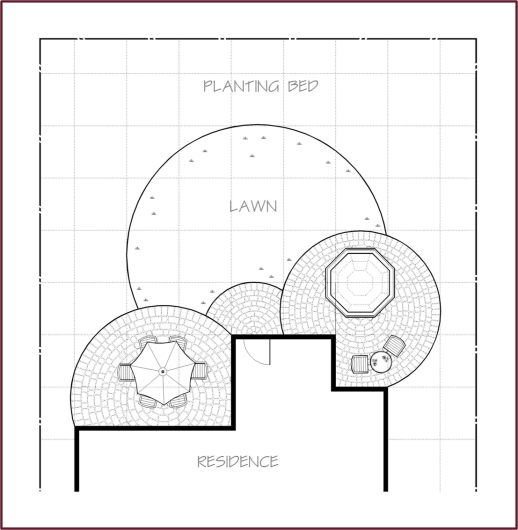
For circular or curvilinear designs a grid can still be used, but because there are no straight lines it must be more loosely interpreted. Ideally the outermost point of an arc or circle should extend to a grid line – since this isn’t always possible using up a half grid square is acceptable.

GRID - circular

Regardless of the concept, the spatial relationship that now exists between all design elements, is one of good proportion.

GRID - RECTILINEAR Colour

GRID - CIRCULAR Colour

So ladies and gentlemen, there you have it – design principles in a nutshell. It’s been a long process – thanks for your patient reading.

Happy New Year to Y’all
Sue
 
 
© Sue Gaviller and Not Another Gardening Blog 2012. Unauthorized use and/or duplication of this material without express and written permission from this blog’s author and/or owner is strictly prohibited. Excerpts and links may be used, provided that full and clear credit is given to Sue Gaviller and Not Another Gardening Blog with appropriate and specific direction to the original content.