All Creatures Great and Small

All things bright and beautiful,
All creatures great and small,
All things wise and wonderful:
The Lord God made them all.

I doubt that when Cecil Francis Alexander penned the chorus to this popular children’s hymn, she was staring down at a rabbit-chewed stump that was once a rose – or a tree trunk stripped almost bare of bark, or ornamental grasses mown down in the first flush of spring growth.

It can be immensely disappointing when our favourite trees, shrubs and perennials are razed by the likes of Peter Rabbit and Squirrel Nutkin. Unfortunately, solutions to this nuisance are less than perfect but there are a few.

The Design Solution

Designing a garden that is rabbit resistant entails housing vulnerable selections i.e. ‘rabbit candy’, in raised beds, containers or enclosures of some kind. Obviously rabbits do jump, but a 2 foot raised bed can act as a deterrent, and while a rabbit can squeeze through small openings, a fenced yard or courtyard does offer some protection.  In my own experience, my front yard is fair game for the rabbits but I’ve never seen them, or any evidence of their presence in my fenced back yard.

Unfortunately I can’t say the same for the squirrels – they are ubiquitous.

The smooth shiny bark of Caragana arborescens ‘Walker’s Weeping’ is a rabbit favourite. In this client’s raised planter it is somewhat protected. The underplanting of Berberis thunbergii ‘Cherry Bomb’ offers further protection since its thorny branches serve as a barrier. Photo: Sue Gaviller

And what about deer? Fences and raised beds aren’t going to keep Bambi out – unless they are 8 feet tall. A Shishi-odoshi (Japanese Deer Scarer) is one design solution that comes to mind. This can work for most nuisance wildlife but there are a couple of drawbacks. For one, the aesthetic is expressly Japanese so may not work thematically with all gardens. Second, it may discourage desirable wildlife from visiting. And third, the more brazen intruders like squirrels, could soon habituate to the sound.

Shishi odoshi 日本語: ししおどし

Shishi odoshi 日本語: ししおどし (Photo credit: Wikipedia)

For those living in the country, deer present a much bigger problem, due largely to habitat proximity – this may require a design approach calledDeeroscaping(awesome resource when deer pressure is extreme).

Underplanting susceptible trees with Lavandula or other aromatic, as I have with this client’s top-graft Syringa meyeri, may help deter pests. Photo: Pat Gaviller

Including some aromatic plants in your planting design can also be helpful. Salvia, Lavandula and Nepeta are all objectionable to deer and rabbits – they don’t like the smell. Happily these are pleasant smelling to us and very attractive additions to a garden. Keep in mind though that Nepeta will attract cats – in my neighbourhood we already have a cat problem (a topic for another post), so no Nepeta for me.
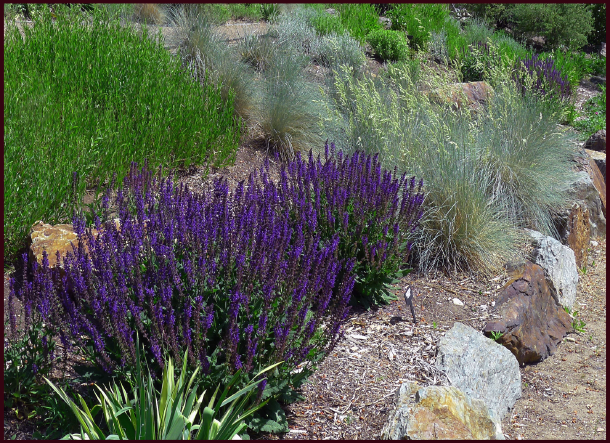
 

Salvia nemerosa ‘Maynight’ is a strongly aromatic ornamental sage which may discourage rabbits and deer. Photo: Sue Gaviller

Some gardeners will use wire baskets or chicken wire contraptions to cover anything that’s showing signs of pest activity. From a design perspective this is a poor solution – while it may indeed protect your plants, it is unsightly. I don’t think sacrificing the beauty of a garden for 6 months of the year is an acceptable price to pay, so unless these devices can be obscured from view, I personally don’t use them. The exception would be trees. Rabbits and deer love to nibble on the bark of certain trees; Malus, Populus, Salix and other trees with thin bark (also young trees). If the bark is damaged more than halfway around the trunk, the tree may not survive. Therefore I do recommend protecting trunks of susceptible trees, particularly in the winter – if you can do so inconspicuously, all the better. The trunk of my Malus ‘Pink Spires’ sustained extensive rabbit damage this past winter, until we wrapped it (loosely)with chicken wire. Because the tree is fronted by a bird bath and obscured from other vantage points by shrubbery, the chicken wire isn’t visible.

Most shrubs and perennials that have been chewed by rabbits will recover. Trees on the other hand may not – if more than half of the trunk circumference is damaged, the tree’s chances of survival are slim. The trunk of this Malus ‘Pink Spires’ is almost completely girdled in one spot, so it may well succumb to its injuries within the next year. I am keeping my fingers crossed though.

The Horticultural Solution

For most of us, by the time we discover we have a ‘critter’ problem, design solutions like raised beds or courtyards are no longer options, at least not without a costly and/or time-consuming redesign. So what can we do? Well we could remove altogether, anything that’s being eaten. However, what a particular animal finds tasty may not be consistent – in my own garden, the squirrels consistently bite the flower buds off one of my Scabiosa caucasica ‘Ultra Violet’, but leave the other two alone. Festuca glauca ‘Elijah Blue’ was sheared to the ground by rabbits every spring (and again as soon as it recovered from the first assault), until I moved it to the back yard. Spiraea bumalda ‘Goldmound’ is also ‘pruned’ to the ground every winter. It grows back though and stays quite compact thanks to the rabbits, so it’s not a problem. For many years these were the only plants bothered by nuisance wildlife.

Then last year I noticed elevated rabbit activity; all of my Heucheras were bitten off (silly rabbit didn’t eat the foliage, he just ate the tender juicy stems and left the beautifully coloured leaves scattered on the ground). Helictotrichon sempervirens – big bites out of it (weird because it has a very unpleasant tactile surface). Roses – gnawed to the ground (ouch, don’t they know roses have thorns). It seems a bunny is living somewhere very near my garden, though I’m not sure exactly where. I see him basking in the sun on my lawn or my neighbour’s lawn. And I do mean basking– splayed right out as if he was dead. And brash he is too. When I shoo him away he moves off slowly and nonchalantly – if he could speak I’m sure he’d be saying, ‘Yo, lady. What’s your problem?’

But I digress.

There are commercial rabbit, deer and squirrel repellents on the market, some of which are safe and environmentally friendly, others not. In addition, there are home remedies you can try – some target a specific pest, but since all are herbivores with similar fear responses, what works on one will often work on all.

  • In a comic strip a few years ago, one of the characters placed dog hair around plants to deter rabbits and squirrels. I tried this and it was actually working until the birds discovered the dog hair and decided it was excellent nesting material. My dog couldn’t shed fast enough to keep up with the demand for her hair so I gave up.
  • Blood meal is a strong disincentive for deer, rabbits and squirrels. A teaspoon or so sprinkled around the plant works very well, but it needs reapplication after it rains. Unfortunately blood meal can attract cats, though in my experience it doesn’t seem to draw them with any more frequency than usual. If you live in an area where bears and/or cougars are common, blood meal is not recommended as it may attract them. As well, because blood meal is a source of nitrogen, if frequent reapplication is required you run the risk of encouraging too much leafy growth. This can then create other issues; slugs and aphids to name a couple.
  • Crushed garlic in some water, steeped for a few days, then strained and sprayed on plants can be an effective repellent.
  • The presence of human urine, particularly male urine, is also purported to deter nuisance wildlife. Several years ago I advised an acreage client to, ahem, ‘mark his territory’, which he did and I believe it in fact reduced pest activity. Hard to say how it would have worked in the long-term though as I don’t think he was willing to continue this practice indefinitely. For city dwellers, you’ll have to be a little more creative in the method you ‘apply’ this if you don’t want to be noticed. And be sure to drink lots of water.
  • Other homemade concoctions may be also effective, but I urge you not to use any that have cayenne or Tabasco sauce as ingredients – I don’t think our aim should be to cause pain.

The Culprit – this fluffy fella camped out in my front yard all winter. I suspect it is the same rabbit who made my garden his favourite lunch spot last summer, as he has the same brazen attitude.
Photo: Pat Gaviller

So now that you have a few weapons in your arsenal let me offer…

Another Perspective

When we first embark on the journey that is gardening, it’s very much about ourselves – what we like, what we want. It’s not intentionally selfish, but we’re a bit like the youngster who is determined to ‘do it by myself ’. We’re content to putter and play in the dirt and we’re not much interested in what the experts, or the neighbors, have to say.

Once we’ve gardened for a few years, and after countless mistakes (sometimes expensive ones) we recognize that some advice from a garden designer or coach might be helpful. And we become all too interested in what the neighbors and passers-by have to say.

Eventually enlightenment comes, with the realization that our gardens are much more than just playgrounds for our green thumbs, or a source of affirmation for our needy egos. Our gardens are enormous ecosystems, home to millions of life forms, some we can’t see, some we can’t pronounce and some we’ve never even heard of. While not all of them can be deemed ‘beneficial’, they all have a role to play. Aphids for example are pests to be sure, but they are also a food source for an army of beneficial visitors – ladybugs, green lacewings, hoverflies, midges (and the larva of all), and many birds (especially the young). If there are no aphids these predator bugs lose a significant component of their diet. An enlightened gardener therefore, learns to leave well enough alone.

There is wisdom to be gained from Ms. Alexander’s refrain. When I find myself lamenting the loss or damage to a prized plant by some hungry critter, those words ‘all creatures great and small’ start playing in my head. Yes, all have a role to play.

I haven’t figured out yet what role that ‘Wascally Wabbit’ has to play (they do love to eat dandelions), nor the pesky squirrels (I guess they too are a food source, most notably for the magnificent birds of prey), but I can’t help feeling some compassion, even kinship, with these animals that make my yard and garden their home – in a way we’re all in this together. I have a particular soft spot for the young ones. A touching experience with a very young squirrel the other day underscored my feelings. I don’t know where he came from or where he disappeared to, but to me he appeared too young to be without his mama. He was quite enamoured of both me and my husband and stayed to ‘visit’ with us for a bit, then scampered off. He sure was a cute.

Some years ago my father and his wife sent me this lovely birthday card – don’t know if they chose it just for its garden theme or if they recognized the gem of wisdom it contained:

The garden is home to so many – kinda puts it all in perspective doesn’t it?

So fellow gardeners, take heart  –  ‘Lucky is the World……to have you in it.’

Happy Mother’s Day,

Sue

© Sue Gaviller and Not Another Gardening Blog 2012.

Unauthorized use and/or duplication of this material without express and written permission from this blog’s author and/or owner is strictly prohibited. Excerpts and links may be used, provided that full and clear credit is given to Sue Gaviller and Not Another Gardening Blog with appropriate and specific direction to the original content.
CURVES WONDERFUL CURVES: Good Lines Mean Good Designs – Part 2

At the end of March, I published a post on some of the early, though somewhat obscure, Harbingers of Spring – for me these offer hope after a long cold winter (my tolerance for winter must be decreasing as I get older, because this winter was neither long nor particularly cold).

The glimmer of colour I noticed radiating from tree branches last month is now a full-on flush of green as plumped-up buds become tiny unfurling leaves, especially after this week’s rain. The waiting game it seems is over. Hooray, gardening season is upon us! Perennials and annuals have been arriving at local greenhouses for a few weeks, trees and shrubs are here now too. Rakes, shovels, gloves and overalls are coming out of storage – it’s time to start ‘digging in the dirt’. Okay hold on there gardeners, slow down – remember you need to get those garden design lines right first. Guess I better finish Part 2 of GOOD LINES MEAN GOOD DESIGNS before your attention turns to the array of bright shiny things at your neighbourhood nursery.

Alrighty then … last post we looked at Landscape Design Concepts that contain straight lines – from that discussion you might conclude that a rectilinear design theme is my preferred concept form. Not so – in fact my back yard is curvilinear and my front yard, arc and tangent.  So you see I do like curves, but if I’d presented curving themes first, would you have read further?

CURVILINEAR FORM

Curves are the design line most favoured by gardeners, often to the exclusion of other design themes. Admittedly, there is something very captivating about voluptuous curves – the problem is curvilinear designs are the hardest to execute skillfully. The curves required to make this design theme work, are sweeping arcs as opposed to wiggly lines.

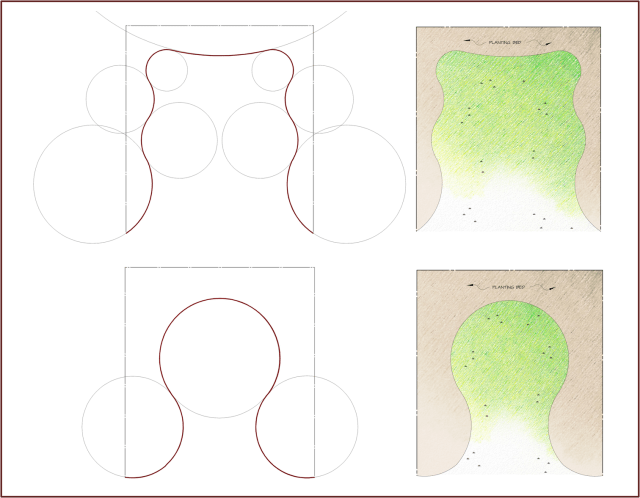
The curvilinear design theme is a design formed from continuous flowing lines using the circumferences of adjacent circles and/or ellipses. The fewer circles used and the more of each circle you can utilize, the more effective this theme will be.

Weak vs. Strong design lines. The top image illustrates weak design lines formed from many circles, utilizing a small portion of each circle. The bottom example illustrates strong design lines formed from fewer circles utilizing a greater portion of each circle.

Unfortunately the tendency is to use too many smaller arcs. As I’ve mentioned before, gardeners tend to subscribe to the adage that more is better – they equate simple with boring and mistakenly assume that adding a few more bows and bends will up the wow factor. It doesn’t. Instead it creates an awkward kind of visual movement as the eye wanders along a vague path.

The extra curves (top left) unnecessarily complicate this design line. The simplified curve shown in the second image (bottom right) would create a more effective curvilinear design.

Not all sites or space allotments are ideal for a curvilinear design theme. It’s really best suited for a site that is relatively large – large enough to accommodate some big bold arcs. Sometimes though, there may be a reasonable amount of space, but only in one direction, say a site that is either narrow and deep, or wide and shallow.  In this case, the solution might be to choose a different concept form altogether, or you may just have to be a little creative in your understanding of the curvilinear theme.

Side yards are typically long and narrow – gardeners often opt for a weak serpentine line like the one on the left, assuming there isn’t room for larger arcs. Instead, one could reinterpret the curvilinear theme to include a straight line, resulting in a bolder design line.

A back yard with very little depth can still be designed in a curvilinear fashion, but not with the use of weak wavy lines(left). Including one or two straight lines can allow for the use of longer deeper arcs even when space is tight(right).

But what if you have no appreciable distance in either direction – does this mean you are limited to straight lines?  Not necessarily. While a very small urban yard doesn’t lend itself to a curvilinear design theme, there are still ways you can incorporate curves into your garden beds. The Arc and Tangent Form I discussed in my last post can work nicely in a small yard, or you could try a circular design form, which is made up of circles and portions of circles. There are several circular design themes, but the simplest of them is overlapping circles.

CIRCULAR FORM – OVERLAPPING CIRCLES

An overlapping circular design is formed entirely from the arcs of overlapping circles. The key to making this design theme work is to use a variety of sizes, with one dominant circle. The circles should overlap enough that they can intersect at 90 degrees or more, thus avoiding acute angles.

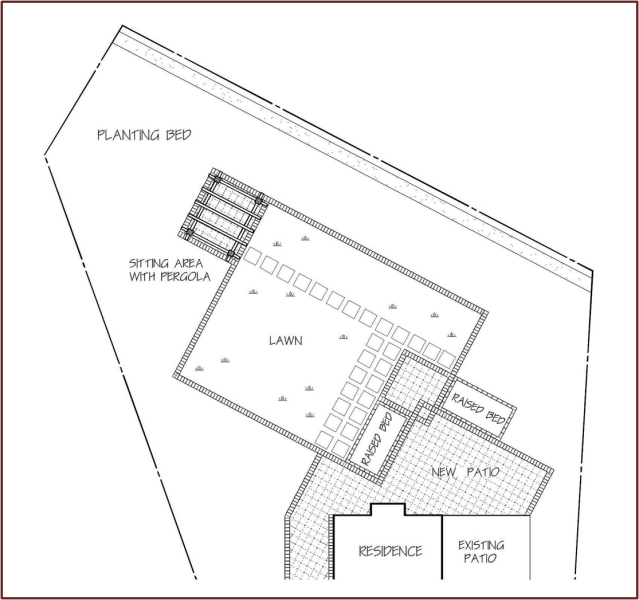
An Overlapping Circular design theme can work equally well on a small site or a large site, because the circles can be moved in any direction. Note that on the larger property space is taken up, not by increasing the number of circles, but rather the size of the circles. This ensures that they will be in scale with the site.

A lovely example of an overlapping circle design. Photo Credit: Merton Designs, Dublin


MAKING YOUR DESIGN LINES WORK

Regardless of whether you choose a curving or straight line design there a few things to keep in mind.

  • Maintain continuity – stick with one design theme, as mixing themes will result in disunity.  This doesn’t mean that you can’t include an arc or a circle in an angular design, but the dominant theme must still be angular. It’s also acceptable to use one form in the front yard and a different one in the back, assuming that they are visually separated hence wouldn’t be experienced together.

This angular design contains a single arc for the purpose of creating emphasis.

  • Avoid acute angles – when design lines meet at less than 90 degrees, acute angles are formed. These are best avoided if at all possible. Aesthetically, these sharp angles appear awkward – in fact as a design instructor, they are first thing my eye goes to when critiquing student’s work. Functionally, there are several reasons to avoid them – in concrete, the use of acute angles creates weak areas prone to cracking. In beds and borders it creates tiny unusable spaces, too small for plants to grow in, and in lawns creates tight spots that are difficult to mow.
The use of acute angles in garden design is not recommended, for both functional and aesthetic reasons.

The use of acute angles in garden design is not recommended, for both functional and aesthetic reasons.

  • Use design lines to guide planting – the outline of your garden beds can influence ‘where you plant what’. For example, the space that is created when a design line arcs or juts out, is a great place for a feature plant or Focal Point. As well, you can accentuate your design lines by planting a single type of plant along the entire length of that line. Or you can alternate two or three different plants in a rhythmic pattern along the line, which will also serve to emphasize it.
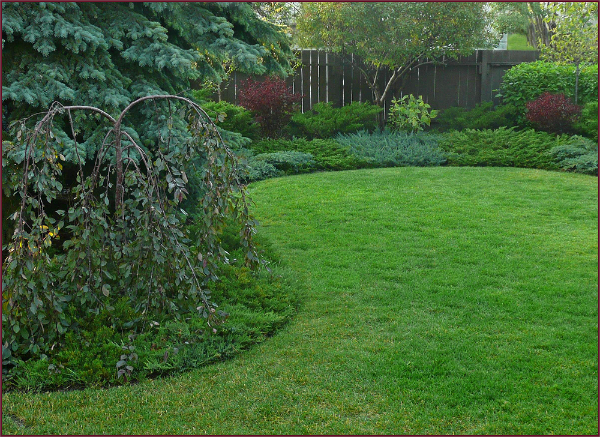
The generous curves in this simple curvilinear design are accentuated by the alternating blue and green Junipers. The Malus 'Rosyglo' in the foreground is nicely 'framed' by the arching design line around it. Photo: Sue Gaviller

The generous curves in this simple curvilinear design are accentuated by the alternating blue and green Junipers. The Malus ‘Rosyglo’ in the foreground is nicely ‘framed’ by the arching design line around it. Photo: Sue Gaviller

Okay gardeners, I’m finished talking about arcs & angles, form & function and other designerspeak. Now you can go plant shopping – if you’re like me you’ll be the proverbial ‘kid in a candy store’. They say you should never go grocery shopping when you’re hungry….

Happy Gardening (at last),
Sue

© Sue Gaviller and Not Another Gardening Blog 2012.

Unauthorized use and/or duplication of this material without express and written permission from this blog’s author and/or owner is strictly prohibited. Excerpts and links may be used, provided that full and clear credit is given to Sue Gaviller and Not Another Gardening Blog with appropriate and specific direction to the original content.

GOOD LINES MEAN GOOD DESIGNS

Now that spring is here we can … well we can wait. The ground is almost fully thawed (I know this because my Rhodos tell me so) but it’s still too early to start digging in the soil – to do so could harm its delicate structure.

So what then is a restless gardener to do? Some will busy themselves with tasks from spring ‘to do lists’ posted by local gardening sites/blogs. Others pore over mail order catalogues and websites looking for inspiration. And we all try to visualize the dozens of new plants we’ll surely add to our gardens this year – as if the addition of new plant material will magically solve any dissatisfaction we had with last year’s garden. Sometimes it does, but more often not – good designs don’t begin there.

Functional Drawings

Most gardeners fail to understand that good design isn’t about manipulating plants, it’s about manipulating space. And good use of space begins with … the ‘f-word’. That’s right – function.  As gardeners, we often arrive at function last – perhaps if we’d considered it first we’d be much happier with our gardens. So we need to ask ourselves, “What is it we want to achieve here?” How do we want to utilize our outdoor space? For example, do we want a place to sit and relax? If so, do we want sun or shade?  And since the sunny and shady spots in our yards will be determined by the direction of the sun at any given time of day, what time of day are we most likely to be sitting outside? Do we need some lawn for children to play on, a place for Fido to call his own, a dining space, an entertainment space, a space to grow vegetables, a utility space etc.?

It can be helpful to map this out on paper – in fact a ‘functional drawing’ is the first step in the design process. It’s the ‘where everything goes’ phase and the site’s individual attributes will often determine where a particular functional space will be best located. For instance, a vegetable garden needs a considerable amount of sun, and young children will need a shadier spot. A dining space we’ll probably want conveniently close to the house and out of the wind, and the garbage, compost, workspace etc. we may want further away and out of sight. And be sure to allow enough room for a given space to fulfill its intended function – without creating areas that will be awkward to maintain or difficult to access. For example, a patio should be large enough that chairs can be pushed out from the table after a meal, a front walkway wide enough for 2 people to walk on, and a mixed shrub bed large enough to accommodate average-size shrubs (with a mature spread of 4-6 feet).

Let’s look at a real life example – I’ve adapted this from a recent client scenario. These clients wanted to redo their front yard, specifically the entrance – new walkway, sitting area, new garden beds. A functional diagram therefore, might look something like this:

The site itself often determines where a particular landscape element is most appropriately situated. In this example, the house, the garage and the existing wall create a semi-enclosed space perfectly suited to a sitting area.

The site itself often determines where a particular landscape element is most appropriately situated. In this example, the house, the garage and the existing wall create a semi-enclosed space perfectly suited to a sitting area.

Note that each space is still formless and depicted only by a simple oval shape, a bubble if you will. Indeed a functional drawing is often referred to as a ‘bubble diagram’.

Concept Drawings

Once you have sketched your map of functional spaces you can begin to give each space form in a Concept Drawing. A concept drawing outlines the shape of patios, walkways, garden beds etc.. This is where the real creativity in garden design begins, and yet gardeners are often stumped at this point – where do we begin? Gardeners limit themselves unnecessarily by ruling out all but curving design lines – curves are indeed a sensuous type of line, but they aren’t the only design line to choose from. In fact curvilinear designs aren’t always the best choice and more often than not, they are executed poorly.

Let’s look again at the real life example – since the space articulated by the house, garage and wall is rectangular, the best place to start is with a design concept that includes some straight lines. Those who lack design training might advise you that straight lines aren’t good garden lines, claiming that ‘there are no straight lines in nature’, but just take a look at a blade of grass, a leaf vein, rock face, tree branch, a pine or spruce needle, a thorn, etc. –  of course they may not be truly straight, but  perceptually they are straight and quite likely as straight or straighter than any line we might carve out in our gardens. Okay point made.

There are a number of design themes that include straight lines, but the 3 basic ones are Rectilinear, Angular/Diagonal and Arc & Tangent. Using the abovementioned Functional Diagram, I presented three possible options to my clients.

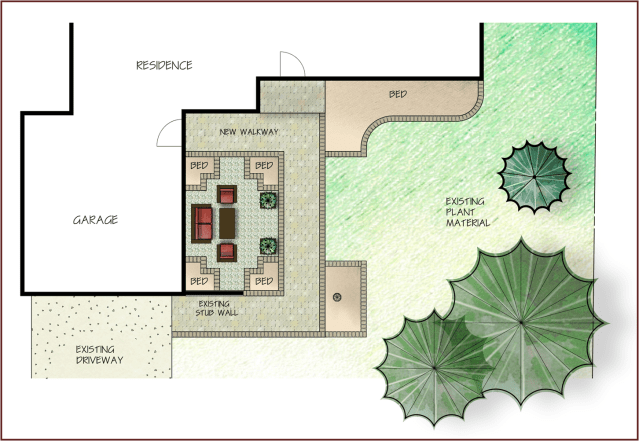
A Rectilinear design theme consists of shapes and lines that establish 90 degree relationships to each other and to the house or adjacent building. Here these lines are used to create a quadripartite courtyard design.

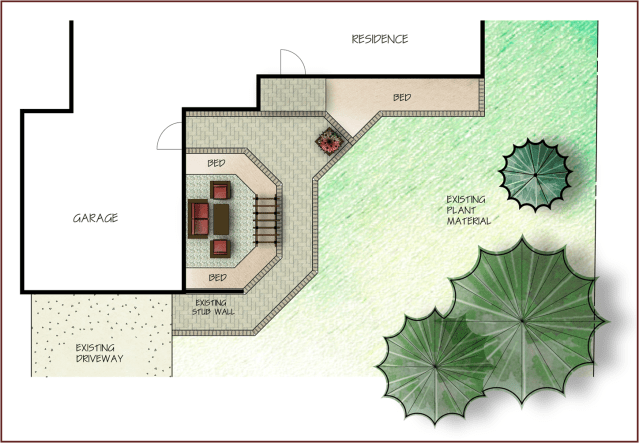
An Angular design theme consists of lines drawn at 45 or 60 degrees to the house, but 90 degrees or more to each other. To avoid the use of acute angles (less than 90 degrees), some lines will necessarily be perpendicular to the house.

The Arc & Tangent design theme is made up of arcs (¼ circle, ½ circle and/or ¾ circle) and straight lines that are tangent to those arcs.

The clients liked all three but were leaning towards the rectilinear design. However, they preferred the arc and tangent shape of the bed adjacent to the house – was it possible, they asked, to incorporate an arc into this bed and still choose the rectilinear design? The answer is of course yes – since an Arc & Tangent design is basically a Rectilinear design with arcs inserted into some of the corners, adding one or two arcs to this design still maintained a unified theme. So the resultant Concept looked something like this:

The Rectilinear theme and the Arc & Tangent theme relate well to each other so the client could, in this case, have the best of both. An additional rectangular bed was added to incorporate the existing gas lamp into the design.

Let’s look at the above three design themes in a little more detail.

RECTILINEAR FORM

Rectilinear form has received a bad rap – perhaps because its straight lines are associated with the straight narrow strips of soil against the house or fence that our mothers or grandmothers called their gardens. In reality this design form is made up of adjacent and/or overlapping squares and rectangles, which create much more interesting design lines.

The original owner of this house was an architect and had designed it in a ‘Frank Lloyd Wright-esque’ manner – my client wanted a design that would work with the style of the house, hence the rectilinear form. These photos were taken when this landscape was quite new – it has filled out considerably since then. Photos: Sue Gaviller

I drive by this landscape regularly and I’m always impressed with how great it looks, regardless of the season. This is partly owing to the strong design lines – the rectilinear design theme reflects the contemporary lines of the house. Photo: Sue Gaviller

The above two examples are small-scale urban applications of this design form, but it can be equally as applicable on a larger scale with a more ‘rural’ feel – check out this link for some lovely examples.

ANGULAR/DIAGONAL FORM

This design theme has a strong angular component, although all lines don’t need to be angled – sometimes a single purposeful angled line can achieve that angular component quite nicely. Ideally a diagonal design is just a rectilinear design, but rotated 45 or 60 degrees. There are a number of scenarios this form works well for, e.g. a property that is disproportionately longer than it is wide.  The long straight property lines draw our eye directly to the back of the property, but when angled design lines are used, the angled bearing encourages the eye to move along a less direct path, detracting from the site’s long narrow configuration. Another example where a diagonal or angular theme would be appropriate is a site with an angled property line.

A long narrow yard can feel a bit like a bowling alley – making use of an angular or diagonal concept can diminish this effect by drawing the eye away from the back of the yard.

The North property line angles at approximately 30/60 degrees to the house so an angular design theme using that same angle worked very well here.

For a couple of good photographic examples of angular designs, click here and here.

ARC AND TANGENT FORM

This design theme is made up of arcs and straight lines – an arc and tangent concept can be thought of as a rectilinear theme with arcs inserted into some of the corners. The arcs can be ¼ circles, ½ circles or ¾ circles and should be large enough that it actually looks like lines and arcs and not just right angles with slightly bevelled corners.

The easiest way to arrive at an arc & tangent concept is to begin with a rectilinear theme and insert arcs into some of the corners.

I find that photographing this design form is tricky because of the role perspective plays – the straight lines don’t always look truly tangent to the arcs. Below are a couple of photos from several years ago.

The Arc & Tangent design theme lends itself nicely to the architectural lines of the house. The landscape has matured some since this photo was taken. Photo: Sue Gaviller

A simple Arc and Tangent form effectively outlines this mixed shrub and perennial border. Photo: Sue Gaviller

So there you have it – a case for straight lines in the garden. Next post I’ll cover a couple of the curving design themes. In the meantime, try playing with new lines for your garden – on paper of course. And don’t be afraid to think outside the box – or maybe I should say ‘inside the box’.

Til then,
Sue

© Sue Gaviller and Not Another Gardening Blog 2012.

Unauthorized use and/or duplication of this material without express and written permission from this blog’s author and/or owner is strictly prohibited. Excerpts and links may be used, provided that full and clear credit is given to Sue Gaviller and Not Another Gardening Blog with appropriate and specific direction to the original content.

Harbingers of Spring

HAPPY SPRING!

March 20th marked this year’s Vernal Equinox – better known as ‘The First Day of Spring’!

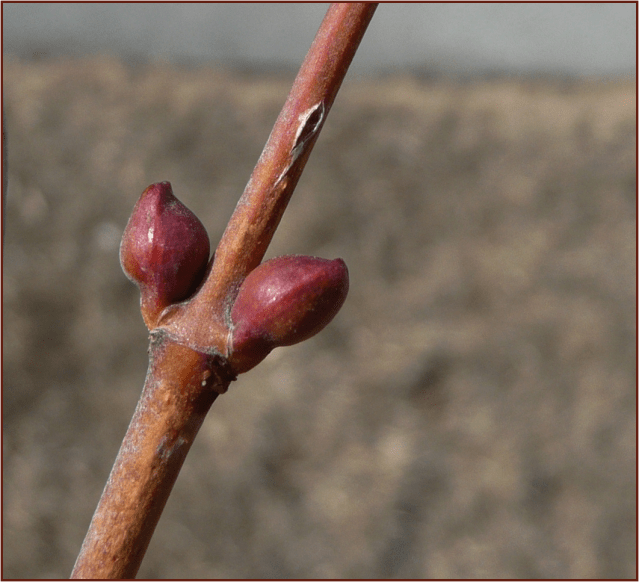
I don’t need a calendar to tell me it’s spring though. There may still be frost in the ground, but spring is in the air – literally. Just look up – the trees are telling us it’s spring. You can see the subtle flush of colour, a slight aura emanating from their branches – leaf buds are beginning to swell. As spring gathers momentum the buds continue to swell, thousands on each branch, so when backlit by late day sun the trees appear adorned with jewels.  Closer inspection will show the buds to be plump and fleshy – life will soon burst forth. This multitude of bulging buds adds a dazzling texture to our skyward view.

Shrubs too are showing life in their branches – rounded buds, like colored baubles, cling to each branch and everything takes on a rich layered appearance.

A shimmer of colour rests atop Salix pentandra on a March weekend at Confederation Park.
Photo: Pat Gaviller

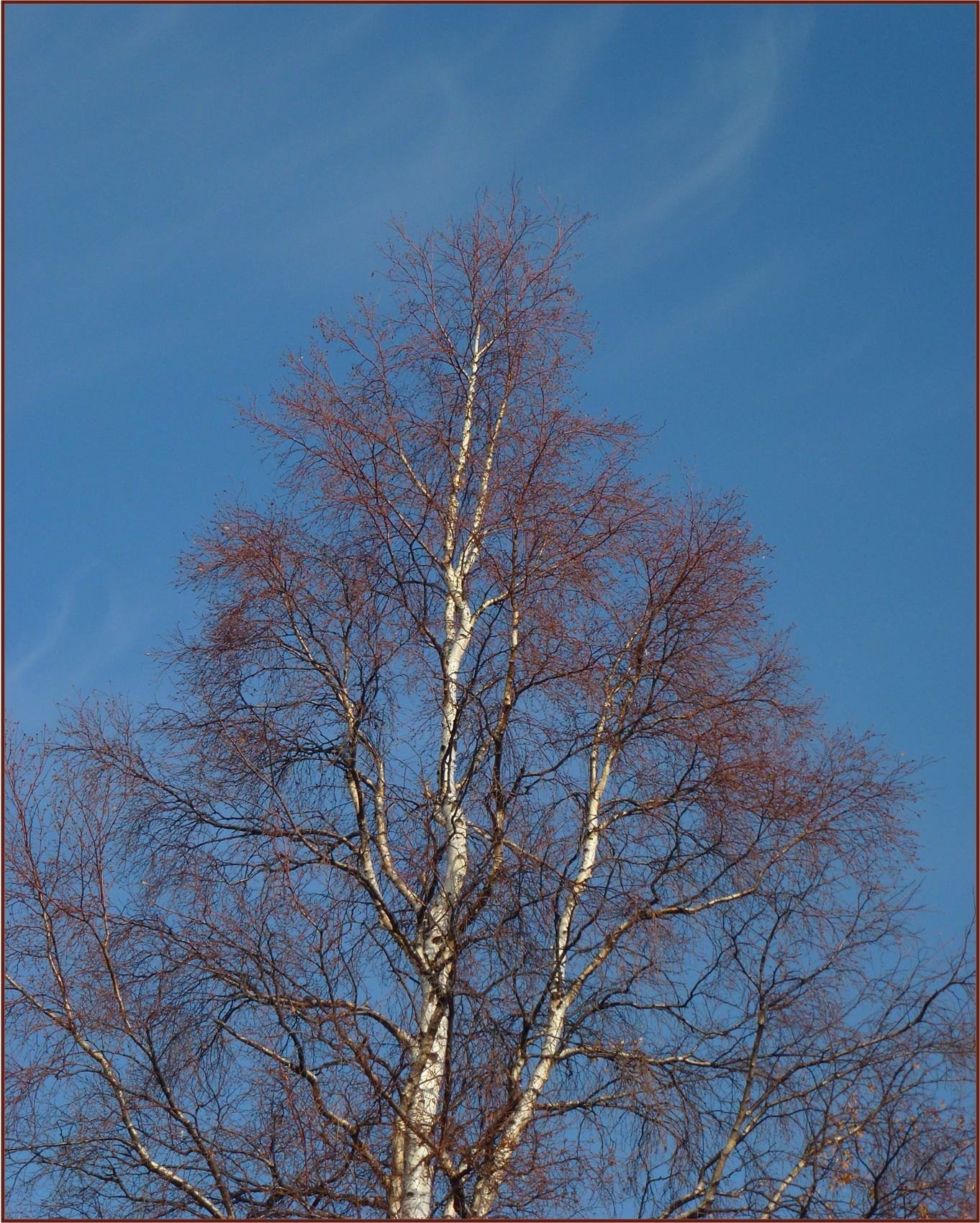
The deep red hue of Betula papyrifera branches intensifies as buds swell and life returns.
Photo: Pat Gaviller

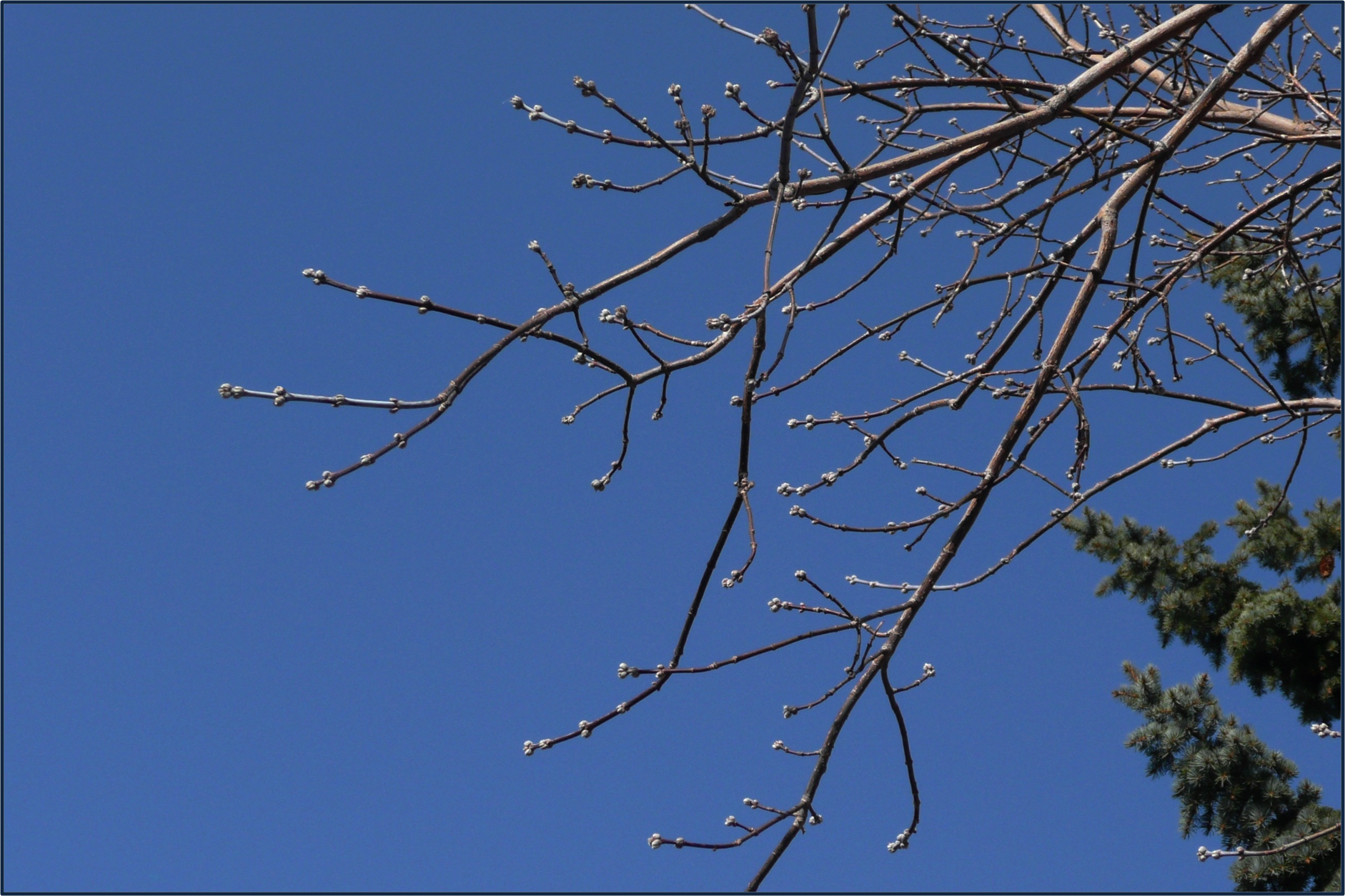
The buds on this Acer negundo look like tiny pearls against an ocean of sky. The Manitoba maple, often maligned for its weedy growth habit and tendency to aphid infestation, is one of the earliest trees to bud out in the spring. Photo: Sue Gaviller

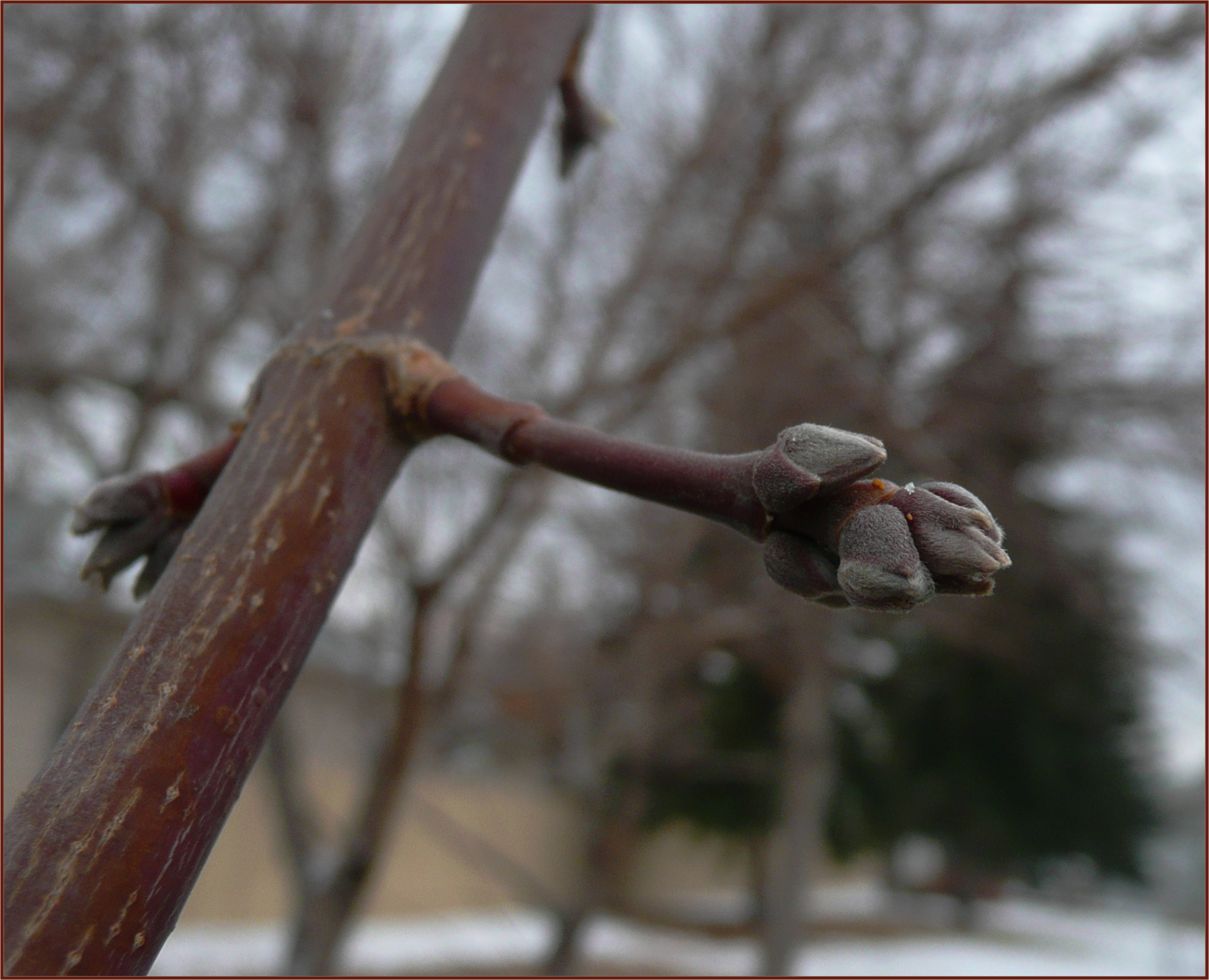
Acer negundo ‘Sensation’, a cultivar of the Manitoba maple, is a lovely tree with yearlong interest. Though debatably hardy here, this specimen has been growing in a protected spot in Northwest Calgary for many years. Viewed up close Manitoba maple buds are soft and fuzzy – this cluster of buds is reminiscent of puppy paws or bunny feet. Photo: Sue Gaviller

The ruby-red buds of Viburnum trilobum rival the colour of the berries that will be produced at season’s end. Photo: Sue Gaviller

Fat rounded buds like tiny soccer balls, line the branches of Larix sibirica. Photo: Sue Gaviller

The new growth on Crataegus mordenensis, both buds and branches, is rich plum red – shiny, supple and leathery in appearance. Photo: Sue Gaviller

Syringa buds almost ready to open: from left, Syringa meyeri, Syringa vulgaris, Syringa prestoniae Photos: Sue Gaviller

Ulmus pumila, the Siberian Elm, has pea-sized spherical buds – here they glow copper in the late day sun. Photo: Sue Gaviller

The enlarged buds of this Populus sp. embody the delicate colour and texture of spring. It won’t be long before these buds open to become the leaves of summer. Photo: Sue Gaviller

 Yes indeed spring is in the air.

Just look up – the birds are telling us it’s spring. Our red breasted friends are back – there are few sounds quite so heart warming as the first Robin’s chirp each spring. I heard it a couple of weeks ago, which seems quite early to me, though birding enthusiasts tell me that a few of these passerines actually overwinter here in Calgary. That may be true but I doubt many of us have witnessed this – for most of us the robin is still the quintessential sign of spring. Soon we will hear them singing their merry song each morn before dawn breaks, and little blue eggs will turn into tweeting baby robins – how very sweet that thought.

The American robin or Turdus migratorius (I dare you to say that with a straight face) is one of our country’s most beloved birds, likely because they herald the coming of warmer weather.
Photo: http://www.naturespicsonline.com/

Other birds have returned as well .

I’ve seen and heard Woodpeckers and Flickers hammering away on whatever hard surface will make the most noise – this is part of their courtship behaviour.  Merlins too, are squealing overhead as they call to potential mates. These are all such noisy birds, but so full of character and personality that one can easily forgive them the racket they make.

A male red-shafted flicker perches high up in a poplar tree in Centennial Park, Calgary
Photo: Pat Gaviller

Yes indeed spring is in the air.

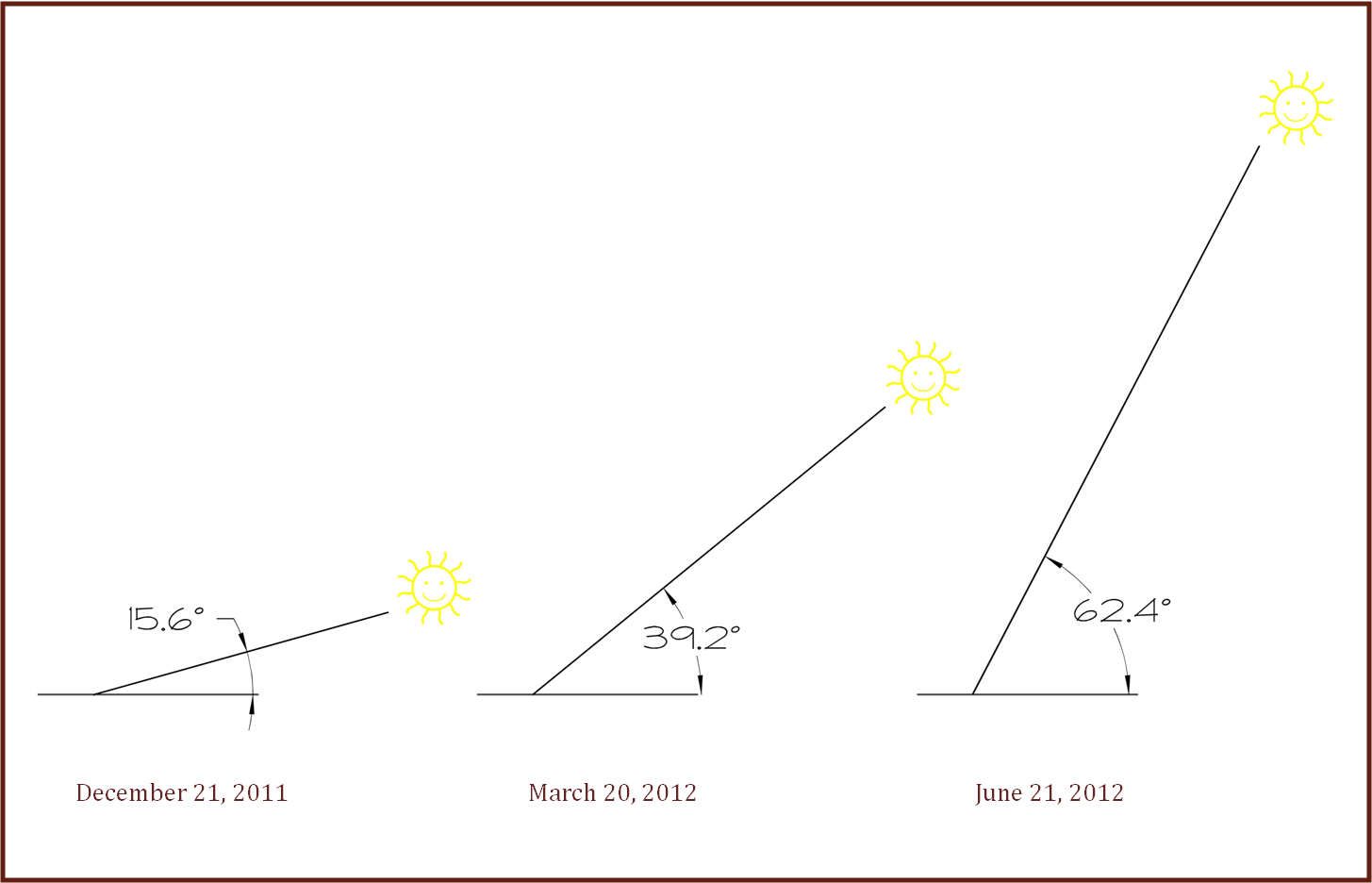
Just look up – the sky is telling us it’s spring. Well, more specifically the sun. Today, March 27th, the sun rose at 7:22 AM and will set at 8:02 PM. Tomorrow, sunrise will be at 7:20 AM and sunset at 8:04 PM. The following day – 7:17 AM and 8:05 PM. We  are currently gaining approximately 4 minutes of daylight every 24 hours, and the angle that the sun’s rays strike the earth is increasing daily.

Angle of sun at Winter Solstice, Vernal Equinox and Summer Solstice.

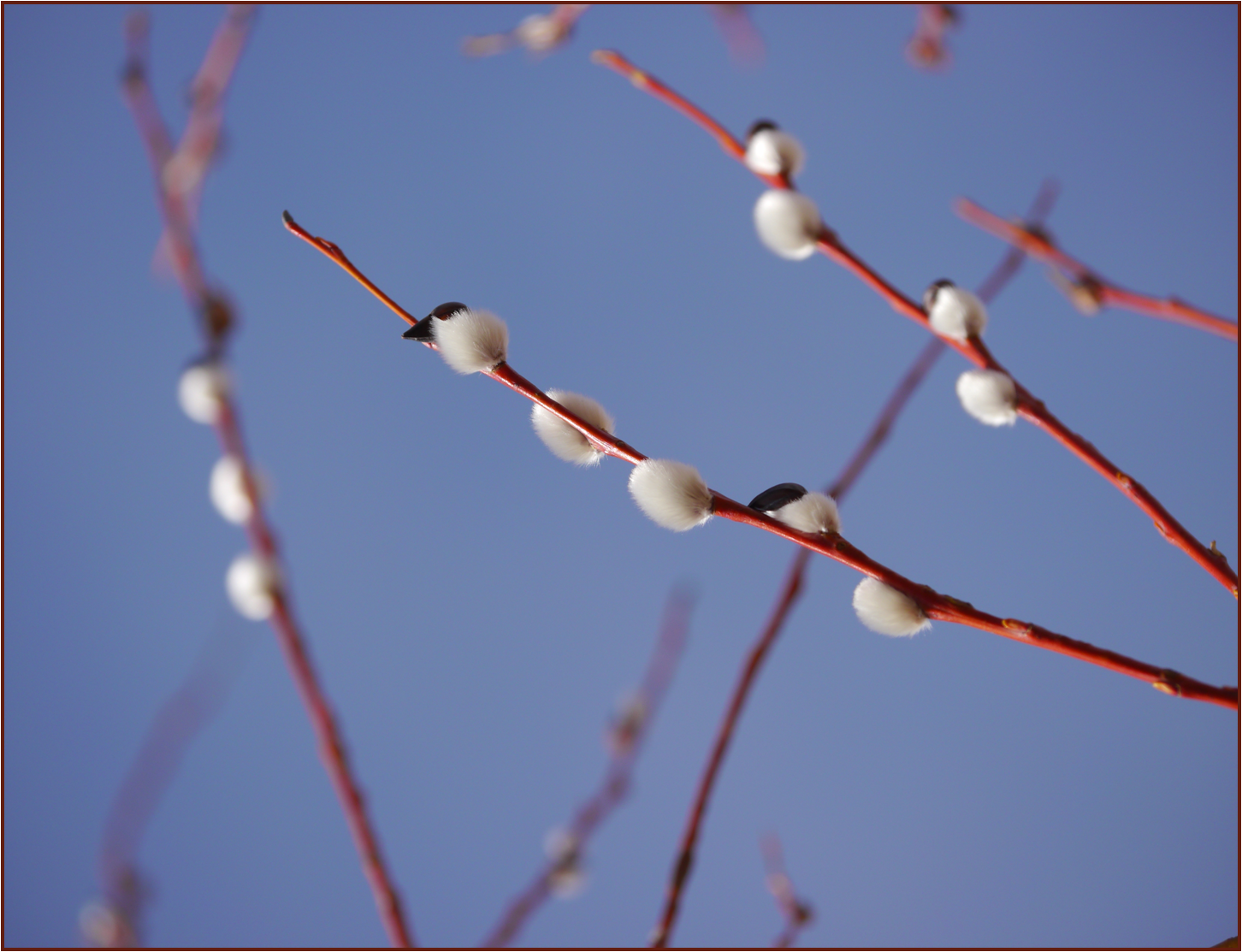
Of all the harbingers of spring, the native Salix discolor is for me the most poignant – this pussy willow resides in a school yard in Northwest Calgary and is covered in these sweet little fluff balls.
Photo: Pat Gaviller

The air is rich with new life and new possibilities – yes indeed spring is in the air.

Just look up!

Happy Spring,
Sue

© Sue Gaviller and Not Another Gardening Blog 2012.

Unauthorized use and/or duplication of this material without express and written permission from this blog’s author and/or owner is strictly prohibited. Excerpts and links may be used, provided that full and clear credit is given to Sue Gaviller and Not Another Gardening Blog with appropriate and specific direction to the original content.

Form, Colour and Texture in the Winter Garden

I had hoped to follow up with this second post on “Winter in the Garden” before now, but photo shoots take time, especially for a beginner photographer like me. However, this is Calgary and winter will be sure to hang around for a bit longer, so the topic is still timely.

In my last post I discussed Focal Points and their value in the winter garden. You’ll recall from that discussion, that a focal point refers to a ‘hard’ or non-living feature that draws the eye. We can also employ ‘soft’ or living elements in the garden to create winter interest – plant material that contributes form, colour and texture.

Form

Plants with strong architectural form offer a unique kind of winter interest – naked of foliage from fall through spring, their distinctive silhouette draws the eye in much the same way as a focal point, hence many of the same guidelines would apply: don’t overuse, make sure they are planted perfectly upright (they will sometimes lean over time so need to be straightened periodically) and stage them for maximum visual impact.

So what constitutes ‘strong architectural form’? There are a number of plant shapes that fit the bill.  I find that ‘weeping standards’ are among the most dominant of plant forms – small weeping ‘trees’ which are developed by grafting a pendulous or prostrate form onto a standard, e.g. Malus ‘Rosy Glo’, Betula pendula ‘Youngii’. These little beauties bring real elegance to a composition. Not surprising then that gardeners often make the erroneous assumption that because one looks awesome, two will look even better. More is better? This may be a great philosophy – when it comes to lobster, or cheesecake, but not here. I made this mistake in my own front yard a few years ago. On one side of the yard a Royal Beauty weeping crab took centre stage and I wanted something interesting to balance it on the other side. Off I went to the nearest greenhouse to look for the perfect garden addition. A beautiful Young’s weeping birch caught my eye. Oh yes, I thought, that will be perfect for that spot. I should really know better – in fact even as I stood in line I was having an internal dialogue: “Sue, you already have a weeping standard in the front yard – another one would be overkill”… “But, but it’s such a perfect specimen and the bark will look lovely against the cedar fence in the winter”. Well, the gardener won out over the designer – I bought it and had it planted within an hour. I guess it looked okay, but it didn’t take my breath away. The real effect was that each of the two similarly strong features diminished the impact of the other, even though they were 40 feet apart.

As I scrutinized this over the next few weeks, I eventually decided that it wasn’t ideal but it would have to do … for awhile anyway. It has of course, now been replaced – like I said I should know better. Weeping standards are definitely best used as single specimens. But enough about my garden challenges.

This attractive little Caragana arborescens ‘Walker’s Weeping’ has been nicely staged by underplanting with a Juniperus sabina cultivar and framing with 2 Juniperus scopulorum specimens – likely Wichita Blue. Photo: Sue Gaviller

Additional plant forms that are distinctive and provide winter appeal would be:

  • other top grafted standards, e.g. top-graft Syringa meyeri
  • columnar trees, e.g. Populus tremula ‘Erecta’
  • vase shape trees e.g. Caragana arborescens ‘Sutherland’, Malus ‘Pink Spires’
  • tall upright grasses e.g. Calmagrostis acutiflora ‘Karl Foerster’ or ‘Avalanche’
  • evergreen topiary e.g. Juniperus chinensis ‘Mint Julep’(pom-pom)

These can be used as single specimens, and with the exception of certain topiary forms (e.g. pom-poms), they can also be grouped, used to frame entrances/views or planted sequentially to direct visual movement and reinforce design lines. And while more than one can be used in a composition, they too if overused, will create visual unrest.

This ‘pom-pom’ topiary pine is appropriately used as a single specimen. Here, it needs very little staging as the detail on the house is an effective backdrop. The upright blue juniper supports visually too, although appears to have once been a topiary specimen itself – it would be best if allowed to revert to natural form so as not to compete with the pine. Photo: Pat Gaviller

This grouping of spire-like Populus tremula ‘Erecta’ creates a stately feel in an otherwise informal landscape. Photo: Sue Gaviller

The upright form of these Calamagrostis acutiflora ‘Avalanche’, effectively directs visual movement along the pathway in one of my client’s front yards. Photo: Sue Gaviller

Top-grafted standards like this Syringa meyeri, provide strong form while allowing a view beneath it to what lies beyond.

You can get away with using numerous strong forms if they aren’t all the same shape. For example when I removed the Young’s weeping birch, I replaced it with a Pink Spires Crabapple – a lovely vase shape tree. In front of this I placed a bird bath – these two together created a co-dominant ‘focal vignette’, completely different in appearance from the weeping crab. Hence the effect is that they support rather than compete with each other.

For the average gardener it can be hard to predict how certain plant forms will work together – just keep in mind that the more striking or unusual its form, the more likely it is that it will need to stand alone.

I will be discussing plant form in more detail in a later post, but in the meantime the best advice I can give you is to practice some restraint. (Really? Is that even possible for a gardener?)

Colour

There is of course a limited palette available to us at this time of year – let’s see, gray, brown, grayish brown, brownish gray, sometimes white, some green, a bit of blue. Anything else? Well yes actually – take a look:

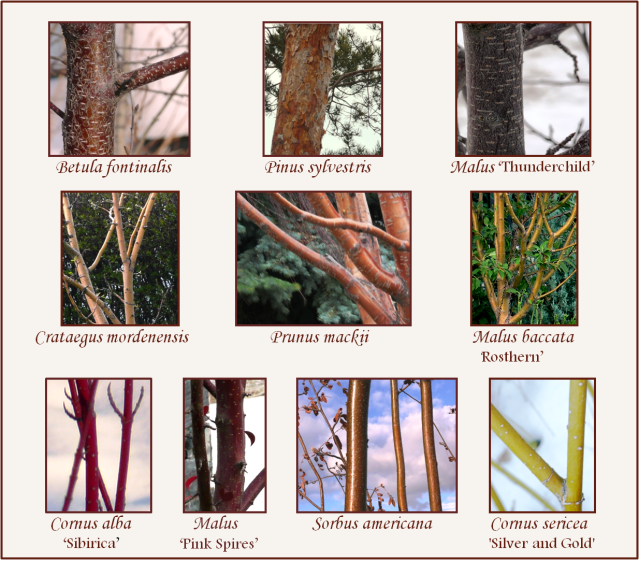
Many trees have colourful bark, in varying hues of green, yellow, orange, red and purple. These colours may be less saturated than the colours of summer, but because they are exhibited by an entire tree or shrub, the effect can be quite dramatic. Photos: Sue Gaviller

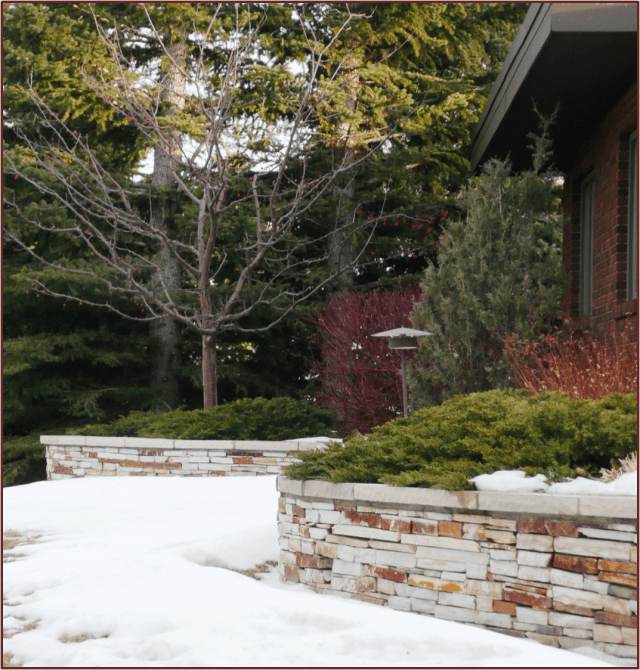
The beautiful bronze bark of this Prunus mackii picks up the warm hues of the wood and stone on the house. These same colours are seen again in the boulder in the foreground. Photo: Pat Gaviller

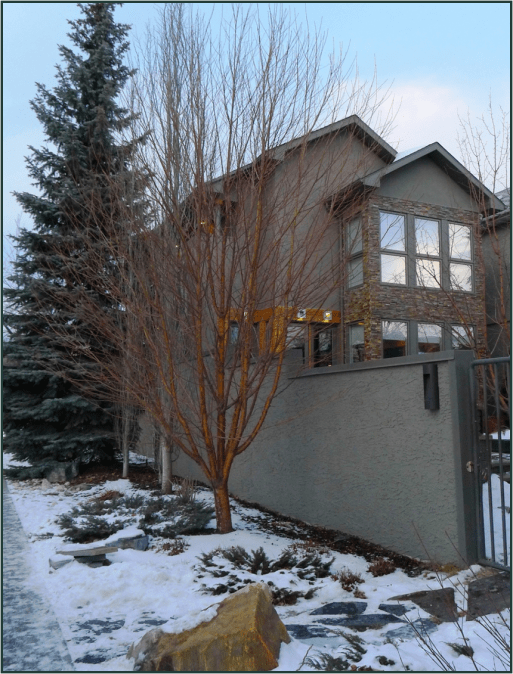
This landscape was also featured in my last post. I’ve included another photo, (minus the lopsided light fixture), because it’s an excellent example of how colourful a winterscape can be. Photo: Sue Gaviller

Berries too can provide winter appeal. The visual impact will be determined by the amount of fruit and it’s size – this may vary from year to year. As well, berries with little water content, like the above examples, will retain colour better through the winter than juicier fruits.

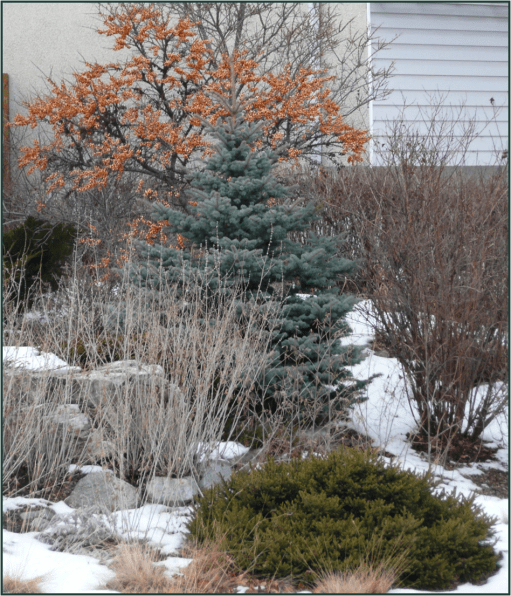
The abundance of Hippophae rhamnoides berries caught my eye when driving by this landscape – a good illustration of the use of form, colour and texture to provide winter interest. Photo: Sue Gaviller

While all conifers provide winter interest, it is the rich green of several Pinus mugo that enlivens this scene. Imagine how drab it would appear without them. Photo: Pat Gaviller

Evergreen Colour

I aim for at least 1/3 of the plant material in a composition to be evergreen – and I mean evergreen, not everblue. Not that I don’t love blue spruces and blue junipers – I do, and they should be used, but not to the exclusion of green. Blue-grey foliage has less pigment than green foliage, hence can contribute to the washed-out look of a winter landscape, especially in the absence of snow. If you’ve ever been to one of my Colour Theory lectures, you know my thoughts on green – it’s the most important colour in your landscape, the colour which allows other colours to have significance.

Green is the colour of life (plant life that is). It can tame the most unruly of hues, add visual depth and infuse richness into your landscape year round. So for every blue conifer you use, plant a few green ones. You’ll see how much more alive your garden will look in the dead of winter.

Texture

Textural contrast is another important consideration when planning your garden. Texture can be fine or coarse – during the growing season, fine texture generally refers to small leaves or flowers that are grouped closely together, and coarse texture would be large leaves or flowers spaced further apart. During the winter months though, we need to look at texture differently. Since most herbaceous perennials have little or no presence in the winter, and most deciduous trees and shrubs lose their foliage entirely, then it is the texture of their bark and branches we see. Spiraea and Potentilla, for example are fine textured – their branches are small, twiggy and tightly spaced. Syringa and Fraxinus (especially males) have much coarser texture – their branches are beefier, and more widely spaced. At any time of year too much tiny, tightly packed foliage, flowers or branches will end up looking busy, so punctuating with some coarse texture will create both emphasis and contrast.

Texture can also refer to the surface of something – is it rough or smooth, shiny or matte. In the winter this will refer mostly to the bark of trees and shrubs.

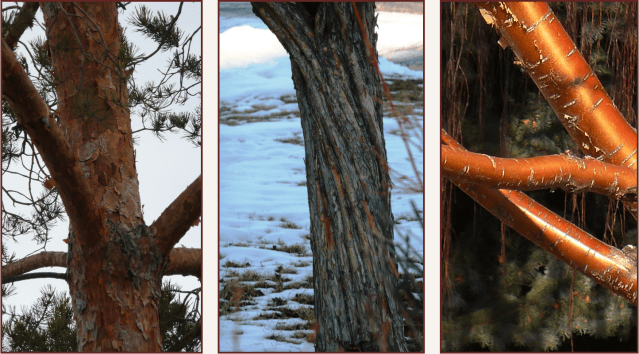
Compare the very different texture of the above three trees – the oddly flaking bark of Pinus sylvestris (left), the twisted striated bark of Crataegus mordenensis ‘Toba’(centre), and the shiny peeling bark of Prunus mackii (right). Photos: Sue Gaviller

Evergreen Texture

All evergreen foliage is considered fine textured – narrow needles spaced closely, and yet they appear texturally quite different. Some appear weightier than others – they may be denser or the needles longer, or stiffer. Use of contrast in this regard will produce superior results to utilizing a single type of evergreen. Yet another example of me not practicing what I preach – I have too many junipers in my backyard, with few other evergreen foliage types (that and my Rosy Glo has developed quite a lean).

These conifers are all fine textured, but they differ in perceived weight. The lacy foliage of Juniperus chinensis ‘Mint Julep’ (right), appears lighter and airier than the stiff needled Pinus mugo (left) and Picea pungens ‘Globosa’ (middle). Photo: Sue Gaviller

The beauty of winter is that it offers us a glimpse of colour and texture combinations that would be obscured in other seasons by branches clothed in foliage. Photo: Sue Gaviller

I invite you to open your eyes to the beauty that is winter – at least for a few more weeks.

Spring is coming.

Til then,
Sue

© Sue Gaviller and Not Another Gardening Blog 2012.

Unauthorized use and/or duplication of this material without express and written permission from this blog’s author and/or owner is strictly prohibited. Excerpts and links may be used, provided that full and clear credit is given to Sue Gaviller and Not Another Gardening Blog with appropriate and specific direction to the original content.

ANOTHER GARDENING BLOG … seriously?

Yes indeed – another gardening blog. Bear with me though, as I present a designer’s perspective of what is for some, a minor hobby, and for others an obsession so grand they forget to eat, bathe or feed their children: The Garden.

My intention had been to start blogging on Jan 1st – New Year, new endeavour. But honestly, I just couldn’t get excited about garden writing when the darkest days of winter were still upon us, regardless of the above average temperatures we’d been experiencing. Then when winter truly hit and we plunged into the deep freeze, so did any ambition to write about all things spring and summer.

Temperatures have since moderated – in fact the days are again unseasonably warm and the promise of spring is actually believable. There are still weeks of winter ahead of us though – Balzac Billy saw his shadow. Sooo… what better to write about than the garden in winter!

Many gardeners don’t see winter as a “gardening season” and I guess, considering nothing is growing at this time of year, we don’t really garden. But that doesn’t mean we can’t, or shouldn’t, design our gardens with winter in mind. In fact as a designer, when I‘m choosing plant material for a landscape plan, I always start with winter appeal – evergreen plant material, trees /shrubs with colourful bark or berries, plants with strong form or interesting texture. All these things allow us to extend the beauty of our garden-scapes beyond the growing season to fill much of the rest of the year.

These first blog posts then will address how we might plan our gardens for winter interest.

Focal Points in the Winter Garden

A Focal Point refers to an element in the garden that is constant, unchanging. This means it is a “hard” feature, i.e. non-living. A non-living element doesn’t grow, or change colour, or lose its leaves. It simply remains the same – drawing the eye and giving it a place to rest, throughout the seasons. Never is the importance of focal points more evident though, than during the dreary winter months when there is often little else to capture our attention. A well placed bird bath or piece of sculpture in the dead of winter can be as lovely as any summer garden scene, albeit more subtle. The presence of a focal point reminds us that the garden is still here, still beautiful in its simplified form.

But just plopping the aforementioned feature anywhere in the yard will not necessarily create the postcard winterscape we’re after – a focal point is most effective when properly staged. Too often I see a unique garden element with no visual support – stuck out in the middle of the lawn or a part of the garden that is completely barren from fall through spring. Of course everything is picture pretty when covered in snow, but in the austerity of a snowless landscape (as is often the case in Calgary), more artful planning is required. Plant material that maintains a presence throughout the year will provide an effective prop for your garden ornament. This means using woody plant material (trees and shrubs), ideally some of it evergreen, in the vicinity of or surrounding your focal point.
I drove by this garden recently while taking an alternate route home - this charming lady presents an elegant focal point and would be equally lovely even in the absence of snow. Photo: Sue Gaviller

I drove by this garden recently while taking an alternate route home – this charming lady presents an elegant focal point and would be equally lovely even in the absence of snow. Photo: Sue Gaviller

A single boulder, ideally with a unique shape and textural interest, can serve as a focal point. Photo: Pat Gaviller

A single boulder, ideally with a unique shape and textural interest, can serve as a focal point.

Photo: Pat Gaviller

Containers are a valuable addition to the winter landscape - the container itself serves as the focal point and also allows for the use of seasonal arrangements, as this homeowner has created. In this example the rocks play a supporting role rather than focal. Photo: Sue Gaviller

Containers are a valuable addition to the winter landscape – the container itself serves as the focal point and also allows for the use of seasonal arrangements, as this homeowner has created. In this example the rocks play a supporting role rather than focal. Photo: Sue Gaviller

This wintry scene as viewed from my back window illustrates how a focal point can be so well merged with its setting that it appears to have ‘grown there all by itself’. Photo: Sue Gaviller

This wintry scene as viewed from my back window illustrates how a focal point can be so well merged with its setting that it appears to have ‘grown there all by itself’. Photo: Sue Gaviller

Another photo taken by my sister on one of our walks - not sure if the colour of the gazing ball was purposefully chosen to echo the golden inflorescence of the reed grasses in the background, but the result is quite effective. Photo: Pat Gaviller

Another photo taken by my sister on one of our walks – not sure if the colour of the gazing ball was
purposefully chosen to echo the golden inflorescence of the reed grasses in the background, but the result is quite effective. Photo: Pat Gaviller

A focal point, in any season, can pull together an otherwise nondescript scene. This gazing ball is surrounded by woody and evergreen plant material surround, so will have the same effect in winter as well. Photo: Sue Gaviller

A focal point, in any season, can pull together an otherwise nondescript scene. This gazing ball is surrounded by woody and evergreen plant material, so will have the same effect in winter as during the growing season. Photo: Sue Gaviller

Bear in mind that your focal point needs to be level. If your bird bath is leaning, get out your level and straighten it, otherwise it just looks sloppy.

And don’t be tempted to overuse focal points – this is probably the most common mistake gardeners make with garden decor. Too many of these in close proximity will create competition for the viewer’s attention, hence visual unrest. So how many is too many? Unfortunately there is no formula for this – it depends on the particular focal point, the overall landscape design and the size of the area.  Generally speaking though, for an average size front yard, one bold focal point can deliver sufficient visual punch – there will be other “soft” (i.e. living) features drawing the eye as well. I’ll discuss these in my next post.

Consider too that there are superfluous elements in the garden that may inadvertently serve as focal points, e.g. a couple of my personal pet peeves – bright blue security system signs and outdoor lighting fixtures.  I don’t mean elegant post lamps or subtly placed spot lights – rather I’m referring to the cheesy sets of lights gardeners poke haphazardly into the ground, forgetting that the purpose of garden lighting is to draw attention to the lovely light that is cast, not the fixture that is casting the light. But more on garden lighting another time. As for security system signs, I appreciate that they serve an important purpose and hence need to be visible, but to me they are beyond visible, they are visually distracting– just keep this in mind when placing them.

I often pass by this well done landscape on my neighbourhood walks – though it’s especially attractive at this time of year, I doubt the homeowners intended for the light fixtures to be the focal point in this composition, especially since one is noticeably lopsided. Photo: Sue Gaviller

I often pass by this well done landscape on my neighbourhood walks – though it’s especially attractive at this time of year, I doubt the homeowners intended for the light fixtures to be the focal point in this composition, especially since one is noticeably lopsided. Photo: Sue Gaviller

Well, so ends my inaugural blog post. I realized when writing this that I ought to practice what I preach – the bird bath in my front yard could use some evergreen plantings around it. That will be my first purchase come spring. Ah yes, spring – so close … yet so far.

Till next time,
Sue

© Sue Gaviller and Not Another Gardening Blog 2012.

Unauthorized use and/or duplication of this material without express and written permission from this blog’s author and/or owner is strictly prohibited. Excerpts and links may be used, provided that full and clear credit is given to Sue Gaviller and Not Another Gardening Blog with appropriate and specific direction to the original content.