Pretty in Pink

Everything’s popping up pink along city boulevards, in parks and front yards – the first of the spring-flowering shrubs are strutting their stuff.  These pretty ladies are various species of the Prunus genus, a large genus that includes peaches, plums, cherries, apricots and almonds. In Calgary, the current explosion of pink blossoms comes from 3 different species.

Prunus tomentosa is first on the scene, with pale pink flowers that present before the leaves.  Commonly known as Nanking Cherry, this medium to large shrub is native to China, Korea and the Himalayas. It has been cultivated in North America since early last century, providing a drought tolerant, cold hardy (Zone 2) shrub that grows to a height and spread of 2–3 metres. It produces small tart cherries that are excellent for jams and jellies.

Prunus tomentosa

Pale pink Prunus tomentosa is a common sight on city boulevards. Photo: Sue Gaviller

Prunus triloba multiplex, the double-flowering plum, is by far the showiest of the three, its large double pastel-pink blossoms like cotton-balls along the many arching stems. A very vigorous grower, reaching 2–3 metres tall and wide, it will benefit from periodic pruning to remove any crossed or rubbing branches. This variety is sterile and doesn’t produce fruit.

Prunus triloba multiplex. Photo: Sue Gaviller

Prunus triloba multiplex. Photo: Sue Gaviller

Prunus tenella (Russian almond) is a smallish shrub with an upright vase shape and narrow green leaves that appear at the same time as the medium pink flowers. It’s compact and tidy, reaching only about 1 metre in height and spread. Very fragrant too, it is much underutilized in the urban landscape.

Prunus tinella. Photo: Sue Gaviller

Prunus tenella. Photo: Sue Gaviller

Despite their similar appearance when seen from a distance, these three shrubs have very different blossoms. Left – Prunus tomentosa. Middle – Prunus tenella. Right – Prunus triloba multiplex.  Photos: Sue Gaviller

Despite their similar appearance when seen from a distance, these three shrubs have very different blossoms. Left – Prunus tomentosa. Middle – Prunus tenella. Right – Prunus triloba multiplex.
Photos: Sue Gaviller

Design Value

Many designers eschew the use of these shrubs because they’re ‘old fashioned’. It’s true they are, but they still have design value. They’re right at home in a Naturalistic garden and are especially useful in Asian-inspired or Colonial style gardens – and they’re reliably floriferous too.

A naturalistic planting of grasses, pine and double flowering plum in a local park.  Photo:Sue Gaviller

A naturalistic planting of grasses, pine and double flowering plum in a local park.
Photo: Sue Gaviller

Prunus tomentosa is lovely in front of the Asian inspired fence I designed for a client. Photo: Sue Gaviller

Prunus tomentosa is lovely in front of an Asian-inspired fence I designed for a client. Photo: Sue Gaviller

When finished blooming, their design worth is more as a backdrop than a showpiece. Nanking cherry and flowering plum both have a lovely natural vase shape, as well as dark green, medium-coarse leaves which provide nice contrast to other brighter plants. Russian almond is much finer textured with lighter green leaves – together with its very upright branches, also provides good contrast in the landscape. And as woodies, they all offer much-desired structure to our gardens.

Perhaps it’s time to rethink these old-fashioned beauties – charm and grace come with age you know.

Til next time,
Sue

Healing Spring

It seems at this time of year I go from zero to 100 in the space of a few days. While I usually have several designs to work on over the winter, the pace is very relaxed – no pressure, just creative calm. Except I don’t pace myself – I languish throughout the early winter months, then as spring approaches I must hustle to complete my winter projects. Still, spring comes in fits and starts, so even then there’s a little breathing space……………until now. Warmer weather is finally here, and while my fellow gardeners are out playing in the dirt, I am playing catch-up so my clients can have their designs, and my landscape contractors can start getting to work…………like tomorrow. Zero to 100.

When I first became a designer, I naively thought it would be a rewarding way to make some extra money to spend on my own garden. Don’t get me wrong, I love what I do – it is very rewarding, and while I do indeed have extra money to spend on my own garden, I now have very little time.

So today I work in my garden – cleaning up the refuse that remains after last year’s early snowfall, and breathing in the burgeoning spring, late as it is. It was a difficult winter for me – not just because it was unusually long, but because life brought some unwelcome challenges. I’ll spare you the details (despite the very public nature of blogging, I am a very private person) and say only that nursing someone dear to me through a broken heart has been a very painful experience. Sobering it is too, accepting that words – no matter how wise or comforting – cannot heal. Only the passage of time can do this.

Time. Is she enemy or is she friend? She oft dawdles behind us………then gets way ahead, sometimes giving too much of herself and more frequently, not enough.

C.S. Lewis, the great Christian apologist, believed that humans are discomfited by the concept of time because we are actually timeless beings imprisoned in a time-stamped existence, and only in the ‘great beyond’ is there timeless joy. Of course the subject of this blog isn’t theology or philosophy, but I often find that when working in the garden, tending the ground, my thoughts ironically turn to the cosmos, the ethereal.

As gardeners, we tend to think of time as the enemy, or at the very least, a big ol’ thorn in our side – I mean we’re always waiting for something, right? But as I rake the blanket of leaves off awakening perennials, watching the ladybugs scurry off, it occurs to me that it is time that has brought me here, to this simple healing moment.

A Red Admiral butterfly flutters past. A pair of nesting crows coo at each other in a nearby tree. Finch-song and robin-twitter float on the breeze. Overhead a Prairie Merlin squeals, as if sounding the all-clear to trees and shrubs that it’s safe to leaf out. All around life erupts in the symphony that is spring. Yes we must make peace with time, knowing she is both harsh mistress and nurturing healer – the passing of the seasons bears witness to this.

A week or so ago my sister Pat and I took a drive out of the city. Turning a corner onto a gravel road I noticed a flurry of avian activity – as we drew closer, a smallish very bright blue bird alit on a fence post. “Bluebirds,” Pat exclaimed. I caught my breath and whispered “I’ve never seen a bluebird before.” Growing up on an acreage in Southern Ontario, one would think this bird would have been a common sight, but for reasons I can’t remember, the native Eastern bluebird had become quite rare in the area. My mother spoke of them with great reverence, and catching sight of one would be an unlikely, though extraordinary occurrence. Since moving to Calgary more than 3 decades ago I’ve spent very little time in the country, so I’ve never had the opportunity to see a Mountain bluebird either. But here they were, a whole bunch of them, apparently arguing over who got to nest in the birdhouse affixed to the fence post.

We drive on, eventually reaching a dead-end where we turn around – we find another fence-box housing a mated pair of bluebirds. The intensely hued male perches on guard a few metres away, not knowing he’s being a most co-operative photo subject. I snap a few shots. Pat snaps many more.  “The Bluebird of Happiness,” she says softly, referencing a phrase oft used in songs and literature to lift spirits and welcome a new day.

Yesterday she sent me one of her bluebird photos in an email with the message ‘May the bluebird of happiness take your pain away – & all that schlock’

Bluebird

Photo: Pat Gaviller

Time it seems has transformed my ‘winter of discontent’, at long last, into Healing Spring.

So to my fellow gardeners patiently waiting for prized perennials to rise from the ashes of winter, to all who are sick or in pain patiently waiting for time to heal you, and to my wounded loved one – may the warmth of spring wash over you, bringing new life.

……….& all that schlock.

Yours,
Sue
© Sue Gaviller and Not Another Gardening Blog 2012.Unauthorized use and/or duplication of this material without express and written permission from this blog’s author and/or owner is strictly prohibited. Excerpts and links may be used, provided that full and clear credit is given to Sue Gaviller and Not Another Gardening Blog with appropriate and specific direction to the original content.

The Form of Things to Come – Part 6

I promised myself I wouldn’t begin today’s post with comments or complaints about our wintry weather as I did in three of my last four posts. I don’t want readers to get the erroneous impression that Canada is the land of perpetual ice and snow. Nor do I want readers to think all Calgarians are a bunch of weather-whiners. And I certainly don’t want you to think that whining about the weather is my shtick – the hippy dippy weather girl, or that it’s the only intro I can come up with. Because it’s not. I have plenty of clever intros up my sleeve – clever is my middle name. So how about this………………….nah, okay then how about……………………….dagnabbit, folks that’s all I got today. I just wanna whine about the weather okay?

Correct me if I’m wrong fellow Calgarians, but has it not been an extraordinarily long winter? I know it’s only the middle of April but Spring isn’t even trying anymore. She just teased us and left us high and dry – well more like cold and wet. Even my stoic husband, who chides weather-whiners for bemoaning that which they can’t control, has on two recent occasions grumbled about the weather. “This weather is sucking the life out of me,” he lamented last night.

Today I look out my window at snow-covered branches, knowing there’s more snow in the forecast – I don’t even think it makes for a pretty picture anymore. I feel like I’m in Narnia under the white witch’s rule – where “it’s always winter, but never Christmas” (uttered with the most refined of British accents). Enough already old man winter – go away.

Okay I’m done complaining now. I’m not even going to attempt a smart segue into today’s topic, I’m just going to start right in on rounds and mounds and flats and mats. If you’re joining me for the first time, you may wonder what on earth I’m talking about – if you’ve been following my latest series of posts, you’ll know of course that I’m referring to plant form.

Round/Mound

Rounded plant forms grow in a roughly spherical shape. Mounds are somewhat flattened rounds.  These ‘roundy-moundys’, as my design instructor called them, are the most common form. They are non-directional, meaning they don’t send the eye up or down – rather the eye just glides over them and moves through the landscape in an undulating kind of progression.

Round and mound forms

This rolling English landscape consists mostly of rounded/mounding trees and shrubs. Photo: Marny Estep

Rounds and mounds are relatively neutral and soft, thus aren’t particularly dominant forms. They can be massed, work well grouped in threes, and a single round form, if large, can make an effective anchor. As well these forms can ‘echo’ other curvy forms.

A trio of Cherry Bomb Barberry orbs visually supports the more dominant weeoing caragana. Photo: Sue Gaviller

A trio of globe-shaped Cherry Bomb barberry visually supports the more dominant weeping form of Walker’s caragana in a client’s gardenThey also nicely echo the orbicular shape of the wall-mounted light fixture. Photo: Sue Gaviller

Globe cedar

A large globe cedar provides a visual corner anchor. Photo: Sue Gaviller

Round forms are excellent foils for colmnar forms like this Pinus sylvestris 'Fastigiata', but the effect would have more credibility if the heavily pruned round evergreen had more natural form. Photo: Sue Gaviller

Round forms are excellent foils for columnar forms like this Pinus sylvestris ‘Fastigiata’, but the effect would have more credibility if the heavily pruned globe-shaped evergreen had more natural form. Photo: Sue Gaviller

Despite the ubiquity of the round/mound form, gardeners and landscapers seem to want more of it, often pruning shrubs unnaturally into this shape. It may be that the form’s common presence leads to the mistaken notion that all shrubs are round; hence they all get pruned that way. Or it may be that gardeners intuit the gentle movement that results from the use of rounded or mounding forms in the landscape.

Regardless, this pruning style can sometimes produce attractive results and sometimes not.

Cornus sericea natural form

Cornus sericea has a naturally round form. Photo: Sue Gaviller

Cotoneaster

While Cotoneaster lucidus grows naturally as a very large loosely shaped ball, this homeowner has pruned them into an attractive rhythmic sequence of perfect spheres. Photo: Pat Gaviller

Round forms

Geometric forms like these roundly sheared boxwood, abound in formal landscapes. Note the very rolling movement that results, especially when planted sequentially. Photo: Jane Reksten

This form is common in certain theme gardens – for example, in the Japanese garden, shrubs are pruned into globose forms to mimic rocks, an important component in their garden compositions.

Formal gardens too, utilize very round shapes as well as other strong geometric forms.

Round forms in Formal Garden

In this formal landscape, shrubs have been pruned to repeat the shape of the stone spheres .
Photo: Marny Estep.

pruned mounds in Japanese Garden

Three mounded shrubs pruned to symbolize rocks. Japanese Garden, UBC. Photo: Ann Van de Reep

Keep in mind that despite their relative neutrality, round forms can be overused – so use them freely but make sure you punctuate periodically with other forms.

Flat/Mat

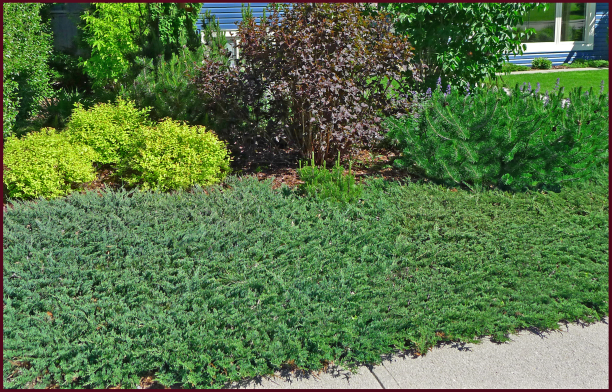
Flat forms are much wider than they are tall, and of course flat. If they have any appreciable curve to their upper surface then they are actually mounds – due to the undulating movement the curved surface creates. Flat forms that hug the ground and create spreading groundcovers are mats.

Mat form - underplanting

Spreading Juniperus sabina ‘Calgary Carpet’ underplants Syringa reticulata ‘Golden Eclipse’ in a client’s front yard.
Photo: Sue Gaviller

Like rounded and mounding forms, flat and mat forms are very common.

They are the most neutral of all the plant forms, making them excellent backdrops or underplantings for other more significant elements, like a focal point or specimen tree.

Their shorter stature and flattened surface, relate the scale of the garden to the horizontal plane of the ground.

mat form - junipers

Various Juniperus sabina and horizontalis cultivars underplant other trees and shrubs and effectively delineate the planting space and the lawn. Photo: Sue Gaviller

In addition, flat and mat forms transition the landscape from pathways or lawn into the garden, thereby connecting them.

Mat forms - transition

Numerous flat and mat forms in my front garden provide a transition zone, connecting the lawn to the garden. Photo: Sue Gaviller

Thymus pseudolanuginosis

The mat form of Thymus pseudolanuginosis provides transition from sidewalk to garden and softens the straight lines of the pathways. Photo: Cathy Gaviller

Well my friends I’ve reached the end of my discussion on plant form. Texture and colour are next, but I think I’ll postpone those until our gardens wake up a bit and allow for some new ‘photo pursuits’. I’ll come up with some other topics to write about in the interim, so do stay tuned.

As I’m preparing to publish this post, I’ve become aware of the horrific events that occurred in Boston earlier today – our weather woes seem suddenly pretty trivial. I won’t complain again anytime soon.

Be sure to hug your loved ones tonight.

Til next time,
Sue
 

© Sue Gaviller and Not Another Gardening Blog 2012.

Unauthorized use and/or duplication of this material without express and written permission from this blog’s author and/or owner is strictly prohibited. Excerpts and links may be used, provided that full and clear credit is given to Sue Gaviller and Not Another Gardening Blog with appropriate and specific direction to the original content.

The Form of Things to Come – Part Five

They say gardeners and golfers are the most impatient people on the planet. While I can’t speak for golfers as I don’t golf, I can certainly attest to the impatience of gardeners. Whether it’s for a prized plant to bloom or for the arrival of gardening season, we have difficulty waiting.

It’s tempting to let the warmer days and chirping robins declare the beginning of the season, but the snow has barely melted and the ground is still soggy. Patience gardeners – old man winter has at least one more kick left in him. So to keep y’all busy while patiently waiting for another gardening season to begin, let’s have some more ‘Fun with Forms.’

Today I look at Fountain forms.

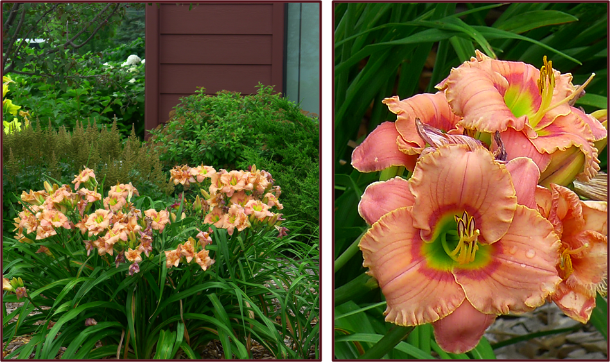
Fountain-shaped plants grow upward, then arch out and curve downward, often to the ground. They are graceful and soft, so most of the plants that exhibit this form are herbaceous perennials – daylilies, grasses/sedges, and ferns for example. There are also some woody shrubs that grow in this manner – bridal wreath spirea and Rose Glow barberry to name a couple.

Rose Glow Barberry and Ornamental Grasses

The fountain forms of Berberis thunbergii ‘Rose Glow’ and ornamental grasses create an elegant picture in this Victoria, B.C. garden. Photo: Pat Gaviller

Like weeping forms, fountains draw the eye up and back down again, but their form is much less rigid, so has a different landscape application.

While its exquisite form can make a fountain-shaped plant an appropriate accent or feature, the emphasis it provides is quite subtle because of the soft drape of its foliage. Larger size then, must also be a factor if this form is to truly stand out.

Ornamental grass and statue

A large fountain form like this striking Miscanthus can provide emphasis on its own, but the effect is that much more pronounced when paired with a non-living focal point. The two together make a stunning feature. Photo: Pat Gaviller

Fountain forms can be used fairly freely in the landscape but they do require some woody neighbours with stiffer structure to visually support their more yielding form. They’re neutral enough to be massed, the resulting effect a bit like waves in the ocean. Smaller selections planted en masse are great for underplanting a specimen tree and look especially lovely in front of a taller vertical accent to ‘stage it’.

Daylily underplanting

Left – A mass of fountain-shaped Hemerocallis provides a neutral underplanting for Syringa reticulata. Photo: Sue Gaviller.
Right – Hemerocallis ‘Stella d’Oro’ effectively stages the very vertical Caragana arborescens ‘Sutherland’ and bird bath, creating a lovely focal vignette. Photo: Sue Gaviller

This form is particularly effective when planted along the length of a design line, serving to accentuate it. When planted along both sides of a walk, fountain shapes define the passageway while still maintaining an open, welcome space.

Helictotrichon and Hemerocallis

Fountain shapes look lovely as spatial definers. Here a swath of Helictotrichon sempervirens lines the sidewalk and Hemerocallis delineates the property line. Photo: Sue Gaviller

Fountain forms can also be useful for repeating the cascading branches of weeping trees, or mimicking the spray pattern of a water fountain. This repetition of line and form brings unity to a garden composition.

Carex

Repeating clumps of ornamental grasses echo the form of both the weeping Norway spruce (right) and the droopy foliage of the pom-pom cypress (left). Photo: Pat Gaviller

Helictotrichon

The beautiful inflorescence of Helictotrichon sempervirens appear like sprays of water in this scene from my front garden. The effect is especially marked when backlit by late-day sun. Photo: Sue Gaviller

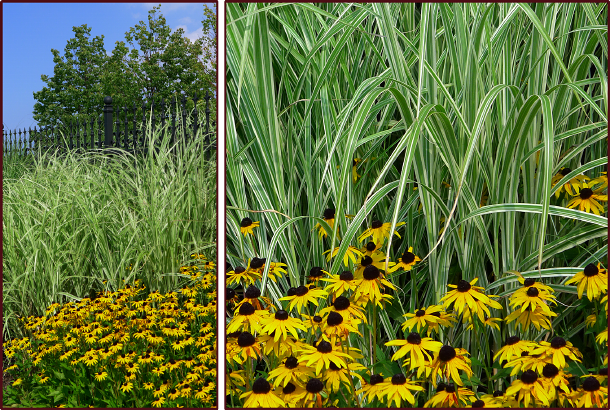
Keep in mind that some perennials have foliage that grows in an arching fountain shape, but the flowers have a more upright growth habit. For example, Calamagrostis foliage is fountain-like but the inflorescence is upright, so when in bloom the overall effect is that of an upright column. Or the reverse may be the case where only the flowers exhibit a fountain form and the foliage presents as some other form. Determining whether a plant should be utilized as one form or the other will depend on when it blooms. In the case of Calamagrostis, the inflorescence appears fairly early, so the whole plant presents as an upright form for most of the season and should thus be used accordingly.

Well fellow gardeners, we have only a couple more plant forms to look at – I’ll cover those in the next and final post in this series on Plant Form in the landscape. Do come back!

Until then,
Sue
© Sue Gaviller and Not Another Gardening Blog 2012.

Unauthorized use and/or duplication of this material without express and written permission from this blog’s author and/or owner is strictly prohibited. Excerpts and links may be used, provided that full and clear credit is given to Sue Gaviller and Not Another Gardening Blog with appropriate and specific direction to the original content.

Harbingers of Hope

A small clump of daffodils is nestled in the corner beside my front steps. I planted the bulbs there soon after we moved into the house – that is to say, at least 20 years ago. They’ve never amounted to much, unfortunately residing in an area of the garden that’s in constant flux. Despite their roots being dug into and disturbed year after year, spring snow storms knocking them down in the height of bloom every year, and foliage cut down prematurely every year, they always come back – in fact the clump gets a wee bit bigger each year.

In this warm sheltered corner, the daffodils emerge from the ground in early February; a heartening assurance that winter won’t last forever. They seem to remain in stasis then, until late March when the warming sun persuades the cheery blooms to open.  While nature provides many subtle indications that spring is approaching, the lemon-hued daffodil announces spring with a flamboyant burst of colour. Indeed daffodils are the inaugural appearance of colour in my garden each spring – a true herald of winter’s end and the coming growing season.

Hope embodied.

Today they’ve begun to bloom – though a tad shorter than usual (likely due to yet another blast of snow and cold), still they speak of hope. Hello spring.

Photo: Pat Gaviller

Photo: Pat Gaviller

Much lore surrounds the daffodil: the origin of its name, its once-believed medicinal properties and even its cultural symbolism – it has been said to represent vanity, misfortune, and death. Conversely, it is also considered a symbol of rebirth, hope, joy and love. I prefer the latter.

Photo: Pat Gaviller

In the year 2000, the Canadian Cancer Society adopted the daffodil as its official emblem – the quintessential sign of hope.

Few among us can say we haven’t been touched in some way by the ‘C’ word – it has taken from us our dearest family members, our best friends and our beloved pets. For those who’ve survived its ravages, it has scarred or disfigured, taken our dignity, our youthful energy and our trust in life. But it can never take away hope – hope for a cure, hope for another day. As long as there is hope there can be joy – this is what the daffodil represents for many.

Shortly before the birth of my first child, my sister Pat was diagnosed with Stage 4 Hodgkin’s Lymphoma – a grave diagnosis requiring many months of chemo. During her intermittent hospital stays, there was always a vase of daffodils by her bedside. One such night, lying there anxious and alone, a vase of yet-to-open daffies on her nightstand, she asked God for strength, for healing, or merely for acceptance of whatever He willed. Shortly thereafter, she heard a barely audible ‘pop’………then a puff of sweet fragrance. Turning to the daffodils she saw that the first of the bunch had just opened. Then pop, pop, pop – several more opened right before her eyes, each one accompanied by the same sweet scent. I believe, as does she, that this was a moment with the Divine, an otherworldly gift – a sign of hope. My sister knew then, that regardless of the outcome, everything was going to be okay.

The month of April is Daffodil month in Canada, the Cancer Society’s spring fundraising campaign of door-to-door daffodil sales. Daffodils can also be purchased at numerous venues around your city, as well as online.

April at Hatley Park, Victoria, B.C. Photo: Jane Reksten

April at Hatley Park, Victoria, B.C. Photo: Jane Reksten

Let’s all set a vase of these bright beacons of hope, the lovely Narcissus, on our tables – it will brighten our days, and give hope to others.

“Learn from yesterday, live for today, hope for tomorrow”  ~  Albert Einstein  ~

Yours in good health
Sue
 

© Sue Gaviller and Not Another Gardening Blog 2012.

Unauthorized use and/or duplication of this material without express and written permission from this blog’s author and/or owner is strictly prohibited. Excerpts and links may be used, provided that full and clear credit is given to Sue Gaviller and Not Another Gardening Blog with appropriate and specific direction to the original content.

The Form of Things to Come – Part Four

Top o’ the mornin to all ye lads and lasses. Today is St. Patrick’s Day – a good day to celebrate all things green don’t ya think?  Not so green ’round here though is it?

Well soon enough my friends, soon enough. Spring will come – in the meantime we still have a ways to go in our study of plant form, texture and colour. I’ll try to have you ready in time for the frenetic plant-shopping sprees that will begin in the next month or so.

Continuing our exploration of plant form then……next up are grafted standards and topiary forms.

Grafted Standards

A grafted standard is essentially a shrub grafted onto a stem or ‘standard’ – also called a ‘top graft’, the overall effect is that of a stick with a ball on top. If that sounds disparaging, it isn’t intended to – they’re actually very attractive additions to the landscape. Many different shrubs can be grafted this way, but the ones that work best are those that are smallish with a naturally round(ish) growth habit – this means minimal pruning will be required. Dwarf Korean lilac, globe spruce and globe Caragana are all commonly used and available in grafted form at most nurseries.

Depending on the particular shrub used, the height of the standard, and how it is pruned, this form can have several landscape or garden applications. They work well as linear plantings to emphasize a design line – both curving and straight design lines can be planted this way.

I designed this fence/wall combo to prevent weed encroachment from a neighbouring property onto my client’s property. It nicely showcases these three top-graft globe spruce. Photo: Sue Gaviller

Rhythmic repetition of grafted Syringa meyeri standards reinforce movement along this uniquely curving fence. Photo: Sue Gaviller

A row of grafted Syringa meyeri standards accentuates a curving fence line. Photo: Sue Gaviller

Euonymus fortunei standard

This oddly shaped Euonymus fortunei standard makes a unique feature tree. Photo: Pat Gaviller

If they’re tallish and not too wide, two top-grafted standards on either side of an entryway, can make an attractive frame – not so much, if they’re short and stout though; these are best used as single specimens.

I find this form to be especially useful when designing certain theme gardens, most notably Mediterranean, Colonial and English Landscape Style.

Mediterranean Theme

Left – Top-graft Syringa meyeri is underplanted with Lavandula angustifolia ‘Hidcote’ in a client’s Mediterranean-inspired back yard. Photo: Pat Gaviller
Right – Two potted standards gracefully frame an arched entryway for a Tuscan wedding reception. Photo: Cathy Gaviller

As a general rule grafted standards don’t work in groups (unless planted in a row along a design line), but there are of course exceptions to every rule – see below.

3 Syringa meyeri

Planting standards in a triad isn’t usually recommended, but in this scenario they are all different heights and widths – the end result is therefore quite pleasing. I suspect this was purposeful……..very clever in fact.
Photo: Pat Gaviller

Topiary

Topiary is the practice of shearing woody plant material into……..well, just about any shape you can imagine. My intention here isn’t to instruct you in the art of plant sculpture (my attempt at topiary would likely result in something akin to Richard Dreyfuss’s infamous mashed potato mountain), but rather to instruct you in their appropriate use. Of course a shrub can be sculpted into a mouse, a monkey, or a monster but the most common forms you’ll find at a nursery are standards, pom-poms, poodle tiers and spirals.

Standards

These are created by pruning a large shrub, which is naturally multi-stemmed, into a single-stem, tree-like form with a ball-shaped top.  They look pretty much the same as a grafted standard – in fact now that I think of it, a couple of the photos in this post were of standards I just assumed were grafted, but they could well have been shrubs that had been pruned to a single trunk, rather than grafted. No matter, their application is exactly the same.

Pom-poms

Pom-pom topiary is formed from a shrub that is pruned into several main stems with a ‘ball’ of foliage at the end of each. This is a very unique form and  should be used as a lone specimen – this means only one in your entire composition. No grouping, repeating, planting in a row, or framing – they’re the wrong shape for any of these applications.

Topiary Pine

Pom-pom topiary has such distinctive form that it must stand alone, like this lovely pine, which has been situated beautifully. Photo: Pat Gaviller

Topiary pine and Syringa standards

This landscape is one I’ve featured before - I love its clean lines and minimalistic style. While I don’t as a rule choose to critique another’s work on this blog, for the sake of a teaching moment, I will suggest that the pom-pom pine might have greater effect without the Syringa meyeri standards to compete with.
Photo: Sue Gaviller

Pom-poms, especially pines, can lend an Asian feel to a garden composition because they, like bonsai, are part of the Japanese aesthetic. Topiary and bonsai are used to create ‘Reduced Scale’, an important Japanese design principle which refers to the reproduction in miniature, of scenes in nature – bonsai and topiary are used to fashion ‘trees’, but in much-reduced scale. For this reason, it is acceptable to use more than one of these forms in a Japanese garden composition.

Japanese Topiary

A modified form of pom-pom topiary, cloud pruning is used to create the impression of aged and weathered trees. Photo: Pat Gaviller, Butchart Gardens Victoria, B.C.

Poodle Tiers

Bay Laurel Topiary

A potted two-tier poodle topiary makes a pretty statement. Photo: Deborah Silver, Dirt Simple

This form is a single trunk with two or more individual balls of foliage along its length. Poodle tiers are fairly upright specimens, which makes them an appropriate choice for framing views and entryways. They also make excellent single features. Like topiary standards and grafted standards, poodle tiers are especially suited to Mediterranean style gardens, formal Colonial style gardens and English Landscape gardens.

tiered topiary 2

Left: This Spanish Mediterranean-style home is suitably landscaped, except for the two pom-pom topiaries. While the goal may have been to frame the entrance, their form doesn’t effectively serve this purpose.
Photo: Patti Cartier
Right: A graphic depiction of the more appropriate 3-tiered poodle topiary providing the desired frame.

Spirals

Spiral topiary is an upright form that has been pruned into a spiral or corkscrew shape. These forms have the same application as poodle tiers and standards – they’re elegant as single specimens, or repeated sequentially along a design line, are suitable for framing, and are fine additions to theme gardens like Colonial, Mediterranean or English Landscape.

Two spiral junipers frame the entrance to a lavish outdoor ‘sitting room’.
Photo: Deborah Silver, Dirt Simple

In our climate most garden topiary is Juniperus chinensis, Juniperus scopulorum or Juniperus virginiana, as well as several Pinus species. In warmer climes, Boxwood, Yew, False Cypress, Rosemary and Bay Laurel are used. These are often available as potted annuals for us Northern gardeners, and given a sunny window, they might overwinter indoors.

Topiary and grafted standards present very strong form in the landscape – suitably sited, they will bring style and sophistication to your garden.

Happy St. Pat’s Day – just think green.
Sue

The Form of Things to Come, Part 3 – Weeping Form

Until a day or two ago, it was feeling quite springy around here – longer days, mild daytime temperatures, and I’d begun the flurry of client interviews and site assessments that typify my spring schedule. Then BAM – old man winter returns with a big dump of the white stuff.  Lucky for you, this means a short reprieve from aforementioned activities, and I can work on this post. Next in the plant form series is weeping form.

Weeping plants can be huge trees like Betula pendula ‘Laciniata’, or small grafted specimens like Betula pendula ‘Youngii’. The large weeping trees have less distinct form because there are countless branches, each with delicate drape – the resultant outline of form is therefore somewhat amorphous, though still quite elegant.

Weeping Birch

Large weeping trees like this weeping birch don’t exhibit a distinct outline – the weeping habit of their branches creates more textural interest, than well-defined form. Photo: Pat Gaviller

To me, they bring a sense of quiet luxuriance to a landscape, perhaps because I associate this form with the giant weeping willows that reside near still waters – the picture of both opulence and serenity.

Although these big weepers lack definitive form, their lacy texture makes them lovely feature trees – if scale and proportion allow. They are especially lovely as waterside accents and make elegant shade trees – again if the size of your house and/or property allows.

Small weeping trees offer much stronger architectural form than their larger counterparts– their arched weeping branches create an umbrella-like form. Many of the weeping specimens available at nurseries are actually low-growing creeping shrubs that have been grafted onto a standard, for example Young’s weeping birch, Walker’s weeping Caragana or Rosy Glo weeping crabapple.

This form draws the eye up……..and back down again. It is strongly dominant so should always be used as a single specimen – I can’t stress this enough. Don’t try to group them in threes, or use two to frame an entry, or plant several in linear fashion – it just doesn’t work. I made the mistake of planting two in my front yard several years ago – you can read about it in my post from last year around this time: Form, Colour and Texture in the Winter Garden. The bottom line is, any more than one and they’ll just compete for dominance and create visual unrest. So one is enough – got it?

Malus Rosy Glo 3

Malus ‘Rosy Glo’ makes a beautiful specimen tree as it looks spectacular any time of year – here I’ve underplanted with Juniperus sabina ‘Moor Dense’ which stages her nicely. Photos: Sue Gaviller

C. arborescens ‘Walker’s Weeping’

A weeping form makes a nice centrepiece for a symmetrical composition. Left – Caragana arborescens ‘Walker’s Weeping’ in a client’s raised planter. Right – another of those pretty scenes I periodically drive by, C. arborescens ‘Walker’s Weeping’ in winter still has strong form. Photos: Sue Gaviller

Weeping Caragana

Walker’s weeping Caragana: simple repetition of line makes this tidy scene one I often stop to admire. Photo: Sue Gaviller

These small weeping trees are useful for highlighting architectural details, like arched doorways or windows – the arching form of the branches mimic the architectural line, thus bringing attention to it, and creating unity (by repetition).

Fountains too, can be ‘echoed’ in this way with the placement of a weeping tree nearby.

As well, a weeping form looks very appealing at the top of, or near a slope – the weeping branches reiterate the sloping line of the hillside.

And don’t plant one of these feature trees in the middle of an expanse of lawn where it will appear lonely and insignificant – it’s much more effective when staged and supported by the presence of other plant material.

Weeping Norway Spruce

A fine-looking specimen, Picea abies ‘Pendula’ looks splendid in this sloped front yard garden in charming Elora, Ontario. Photo: Sue Gaviller

I’ve had several clients tell me they don’t like the shape of weeping trees because it makes them feel sad (maybe it’s the name – y’know power of suggestion and all). I don’t get this. To me weeping forms are graceful and very pleasing to the eye. Indeed their appropriate use demonstrates a mature design sensibility. I guess it’s a humble reminder for me, and all you aspiring designers, that there is a degree of subjectivity in design that must be acknowledged and respected. And with that little piece of wisdom my friends, I shall bid you adieu.

More ‘Fun with Forms’ in my next post – see ya then.

Humbly yours,
Sue

© Sue Gaviller and Not Another Gardening Blog 2012.

Unauthorized use and/or duplication of this material without express and written permission from this blog’s author and/or owner is strictly prohibited. Excerpts and links may be used, provided that full and clear credit is given to Sue Gaviller and Not Another Gardening Blog with appropriate and specific direction to the original content.